Five hundred and fifty terabytes a year, and two million hours of MTBF. Both are the highest figures on this shelf — the next workload rating is 300 TB a year and the next MTBF is 1.2 million hours — and both sit on a drive the title describes as Renewed.
That combination is the whole of this listing. The fifth bullet gives the rating, the MTBF, round-the-clock operation and a dual-stage micro actuator for positioning accuracy. The description adds that the drive is an enterprise-class unit for data centers and cloud storage, professionally tested and certified Renewed. And nowhere on the page — not in the title, not in the five bullets, not in the description — is there a warranty term of any length.
The three figures want keeping apart, because this page shows exactly why. A workload rating is the duty a drive is specified for: 550 TB a year is what the manufacturer designed the mechanism to take. An MTBF is a population statistic in hours: two million hours describes a fleet, not this unit, and it is not a prediction about the drive in the box. A warranty is a commercial promise, and here there is none. The first two figures belong to the drive as designed and manufactured; the third is what a seller offers, and a renewed drive is precisely the case where the third matters most.
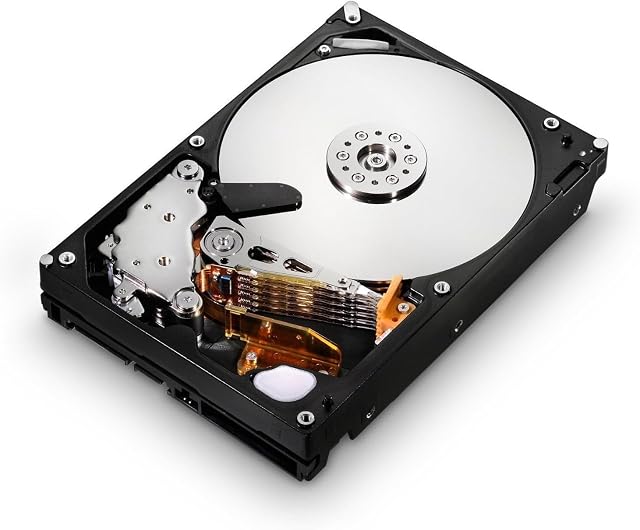
The published refurbished Hitachi on this shelf has the same gap — no warranty term — and publishes 800,000 hours against this drive’s two million, 64 MB of cache against 256, 5700 rpm against 7200, and no recording method at all. That drive is a MegaScale DC; this one is an Ultrastar DC HC310. Two different Hitachi families, two refurbished four-terabyte drives on one shelf, and this is the better specified of the two on every published line.
CMR is stated in the third bullet, in words rather than as an abbreviation alone: conventional magnetic recording, offered for consistent write performance under write-intensive workloads. The fourth bullet gives 7200 rpm and 256 MB of cache, and adds something no other listing on this shelf names — a non-volatile cache, which holds the contents of the write buffer through a power loss rather than discarding it.
The title also publishes a sector format: 512e. That is the only one on this shelf. A 512e drive has four-kilobyte physical sectors presented to the host as five-hundred-and-twelve-byte ones, which is worth knowing because some controllers and some older systems care about the distinction. No other listing here, published or new, raises the subject.
Amazon.com listed it on October 26, 2026 without a current offer that passed our price check, so no price is quoted; the reason to weigh it carefully is on the first line of the title, which says Renewed. No figure in watts and no decibel value appears anywhere, and no weight or measurement is published.