Skip to content

UGREEN DXP4800 GT review

The most completely specified enclosure on this shelf: a processor with cores, threads and a clock, a 64 GB memory ceiling with an ECC upgrade path, two ten-gigabit sockets and bays that take three different kinds of drive.

Four bays, and they are not four of the same thing. The sixth bullet states four SATA bays taking up to 32 TB each, of which up to two will also accept U.2 NVMe solid-state drives, plus two M.2 slots carrying up to 16 TB between them — 144 TB in total, and the arithmetic holds: 4 × 32 + 16 = 144.

The processor line is matched here only by the TerraMaster F8 SSD Plus. The first bullet gives an AMD Ryzen Embedded R2514 with four cores, eight threads and up to 3.70 GHz. Most enclosures on this shelf name a chip by its part number; the TerraMaster F8 SSD Plus also gives cores, threads and a clock, and the DXP6800 Plus gives cores and threads without a clock. The memory is 8 GB DDR4 expandable to 64 GB, which is the highest ceiling on the shelf — the DS723+ bundle supplies 32 GB and the DS225+ tops out at 6 GB.

The eighth bullet does something unusual and worth reading twice. It states that the unit supports an ECC memory upgrade to detect and correct errors over long operation, and then states that the memory supplied is non-ECC, so error correction requires a compatible module bought separately. Two other listings here name ECC: the DS723+ bundle supplies ECC memory, and the DS225+ names its own as non-ECC. This is the only listing on the shelf that publishes a path from one to the other, and it publishes the catch in the same breath.

The network side is two 10GbE sockets. The seventh bullet gives each at 10 Gbps, about 1.25 GB/s theoretical, and states that with link aggregation on compatible equipment the pair is quoted at 20 Gbps or about 2.5 GB/s. Both figures are offered as theoretical, which is the maker stating its own ceiling as a ceiling. Nothing else on this shelf publishes two sockets at that rate: the DXP6800 Plus pairs one 10GbE with one 2.5GbE, and the F8 SSD Plus has a single 10GbE.

The rest of the connections are counted by kind rather than by number: a USB-A at 10 Gbps, a USB-C at 10 Gbps, a USB 2.0, a 4K HDMI output and an SD card slot, stated in the fourth bullet. The card slot is the only one on this shelf, and the bullet explains what it is for — importing from a camera card straight into a folder without a reader or a computer in between.

The software is named, which only the two DSM listings here also manage. UGOS Pro is given with Docker, virtual machines and SAN Manager, and Plex, Emby, Jellyfin and Home Assistant are named as things it will run; the eighth bullet adds that Plex goes through Docker and needs setting up by hand. A surveillance function is built in, limited in as many words to ONVIF and RTSP cameras, with footage kept locally.

RAID is named in the fifth bullet without a level being numbered. Carrying on through a failed drive is what redundancy does, and it is a different thing from having the data in a second place; no array arrangement here substitutes for a copy on separate hardware. The page publishes no figure in watts, no decibel value, and no measurement of the case: the product record carries 257 by 178 by 178 mm (7.01 in) and 6,610 g (233.2 oz), and the bullets carry neither.
Where it holds up, and where it stops

Strengths

  • Cores, threads and a clock all published, which only the TerraMaster F8 SSD Plus here also manages — four cores, eight threads and up to 3.70 GHz
  • A 64 GB memory ceiling, the highest here, with an ECC upgrade path published alongside the fact that the supplied memory is not ECC
  • Two 10GbE sockets with the aggregated figure given as well as the single one, and both labeled theoretical
  • Bays that take three kinds of drive — SATA, U.2 NVMe in two of the four, and two M.2 slots — with the 144 TB total matching its own arithmetic
  • The only SD card slot on this shelf, with the bullet saying what it is for rather than listing it as a socket

Compromises

  • No figure in watts and no decibel value, on a 6.6 kg (14.6 lb) four-bay machine likely to sit in a room someone works in
  • The USB sockets are named by kind and never counted, so the page gives three types and no number
  • RAID is named with no level numbered, on a unit whose capacity arithmetic is otherwise complete
  • The surveillance function is limited to ONVIF and RTSP cameras, which rules out a good many consumer ones
  • Dearer than every Buffalo on this shelf, and the ECC upgrade is a further purchase on top

Specifications

Bay countFour — stated in the sixth bullet as four drive bays for SATA drives up to 32 TB each, with up to two of those same bays also accepting U.2 NVMe solid-state drives
Drive interfaceSATA bays at up to 32 TB each, two of which also take U.2 NVMe — stated in the sixth bullet. No drive size in inches is printed anywhere on the page, so the bus is named and the format is not
Solid-state slot countTwo M.2 slots carrying up to 16 TB between them, stated in the sixth bullet, plus up to two of the four SATA bays accepting U.2 NVMe drives. The 144 TB total is 4 × 32 TB plus 16 TB, and the arithmetic holds
ProcessorAMD Ryzen Embedded R2514, four cores, eight threads, up to 3.70 GHz — stated in the first bullet. With the TerraMaster F8 SSD Plus, it is one of two processors on this shelf published with cores, threads and a clock together
Memory8 GB DDR4 expandable to 64 GB — stated in the first bullet, the highest ceiling on this shelf. The eighth states that an ECC upgrade is supported while the memory supplied is non-ECC, so error correction needs a compatible module bought separately
Ethernet port countTwo — stated in the first and seventh bullets as dual 10GbE networking, with each socket counted separately in the aggregation arithmetic
Port speed10GbE on each socket, given as up to 10 Gbps or about 1.25 GB/s theoretical, and up to 20 Gbps or about 2.5 GB/s aggregated across the pair with link aggregation on compatible equipment — stated in the seventh bullet, which calls both figures theoretical
USB portsThree named by kind and none by number — one USB-A at 10 Gbps, one USB-C at 10 Gbps and one USB 2.0, stated in the fourth bullet alongside a 4K HDMI output and an SD card slot
Supported redundancy levelsRAID named without a level — the fifth bullet states that RAID support adds redundancy and helps recovery after a drive failure, and numbers nothing. Carrying on through a failure is a different thing from holding the data in a second place, and no level here substitutes for a copy on separate hardware
Published operating systemUGOS Pro — named in the second bullet, with Docker, virtual machines and SAN Manager, and Plex, Emby, Jellyfin, Home Assistant and web hosting named as workloads. The eighth bullet states that Plex runs through Docker and must be set up by hand
Stated idle powerNot published on the listing — no figure in watts appears in the title or in any of the eight bullets
Stated acoustic figureNot published on the listing — no decibel value and no claim about noise appears, on a page otherwise detailed enough to publish a thread count
Stated dimensionsNot published in the bullets — the product record carries 257 by 178 by 178 mm (7.01 in) and 6,610 g (233.2 oz), and no measurement of the case appears in the title or in the eight bullets
Amazon referenceB0GTZC19FX
EAN6942752010576
On Amazon.comAmazon.com had an offer at $660 on October 26, 2026.

Where this unit differs

Put against the median of its own group on this site — not against every network product sold.

  • Drive interfaceSATA bays at up to 32 TB each, two of which also take U.2 NVMe — stated in the sixth bullet. No drive size in inches is printed anywhere on the page, so the bus is named and the format is not+300 % against the median of this group
  • Ethernet port countTwo — stated in the first and seventh bullets as dual 10GbE networking, with each socket counted separately in the aggregation arithmetic+300 % against the median of this group
  • Port speed10GbE on each socket, given as up to 10 Gbps or about 1.25 GB/s theoretical, and up to 20 Gbps or about 2.5 GB/s aggregated across the pair with link aggregation on compatible equipment — stated in the seventh bullet, which calls both figures theoretical+300 % against the median of this group

The questions that come up before an order

Does the ECC memory come with it?

No. The eighth bullet states that the unit supports an ECC upgrade and that the pre-installed memory is non-ECC, so error correction requires a compatible ECC module bought separately.

How does it reach 144 TB?

The sixth bullet gives four SATA bays at up to 32 TB each and two M.2 slots at up to 16 TB between them. Four times 32 plus 16 is 144, so the headline figure matches the bays the page describes.

What are the two ten-gigabit sockets worth together?

The seventh bullet gives each at up to 10 Gbps, about 1.25 GB/s theoretical, and the pair at up to 20 Gbps or about 2.5 GB/s with link aggregation on compatible network equipment. Both figures are called theoretical on the page.

Will it run Plex?

The second bullet names Plex among the applications and the eighth states that it runs through Docker and requires manual setup, which is the condition rather than the promise.

Against the rest of the network and storage gear

This network and storage gear share the category and the price bracket. Only what each one states is shown; an incomplete column would mislead.

Model Price Bay countDrive interfaceSolid-state slot countProcessor
UGREEN DXP4800 GT $660 Four — stated in the sixth bullet as four drive bays for SATA drives up to 32 TB each, with up to two of those same bays also accepting U.2 NVMe solid-state drivesSATA bays at up to 32 TB each, two of which also take U.2 NVMe — stated in the sixth bullet. No drive size in inches is printed anywhere on the page, so the bus is named and the format is notTwo M.2 slots carrying up to 16 TB between them, stated in the sixth bullet, plus up to two of the four SATA bays accepting U.2 NVMe drives. The 144 TB total is 4 × 32 TB plus 16 TB, and the arithmetic holdsAMD Ryzen Embedded R2514, four cores, eight threads, up to 3.70 GHz — stated in the first bullet. With the TerraMaster F8 SSD Plus, it is one of two processors on this shelf published with cores, threads and a clock together
UGREEN DXP4800 Plus $657 Four — stated in the title as a 4-Bay unit. The second bullet gives a capacity ceiling of 144 TB without publishing the per-bay figure that would produce itNot published on the listing as a size or a bus — the seventh bullet names Western Digital, Seagate and Toshiba as compatible and directs the reader to a compatibility list not reproduced on the pageNot published on the listing — no M.2 slot and no cache slot is named, and the 144 TB figure is given with no arithmetic behind itNot published on the listing — the first bullet says "Powerful Procesor", misspelled, and gives no model, no core count and no clock speed anywhere on the page
TERRAMASTER F8 SSD Plus, eight M.2 bays and no SATA bay at all $765 Eight — stated in the title and in the second bullet as eight M.2 2280 NVMe slots, each taking up to 8 TB for 64 TB in total. The arithmetic holds, and it is the highest bay count on this shelfM.2 2280 NVMe only — stated in the second bullet. No SATA bay appears anywhere on the page, which makes this the only all-solid-state enclosure on this shelf; every other listing here is built around SATA baysEight, which is the same as the bay count — the two figures coincide because every bay is an M.2 slot. Each takes up to 8 TB, stated in the second bulletIntel Core i3-N305, eight cores and eight threads with a turbo frequency up to 3.4 GHz, with UHD Graphics — stated in the first bullet. It is the highest core count on this shelf; the UGREEN DXP4800 GT here publishes four cores, eight threads and a higher clock at 3.70 GHz
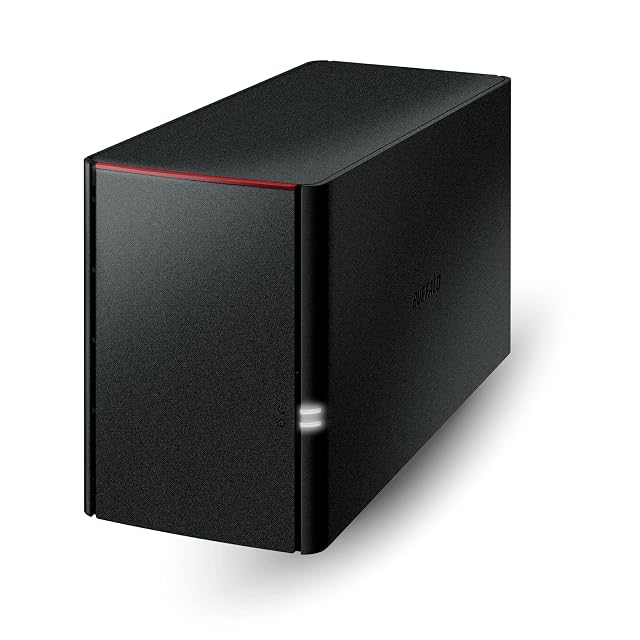
BUFFALO LinkStation SoHo 220, 8 TB $475 Two — stated in the title as 2-Bay and in the seventh bullet as two drive bays holding 8 TB in total. The title specifies the division as 2 × 4 TB, which no other LinkStation page on this shelf doesNot published on the listing as a size or a bus — the title gives 8 TB as two 4 TB drives and the seventh bullet repeats the total, and no inch figure and no bus appears anywhereNot published on the listing — no M.2 slot and no cache slot is named in the title or in any of the ten bulletsNot published on the listing — no chip, no core count and no clock speed appears anywhere on the page

What separates the models, in network and storage gear

  • If price decides: BUFFALO LinkStation SoHo 220, 8 TB, at $475.

The buyer this one serves, among network and storage gear

A four-bay machine asked to transcode, run containers and serve several people at ten gigabits, where the specification has to be readable before buying.

What this one costs among network and storage gear

Details checked on October 26, 2026.

The network and storage gear guides it appears in

What buyers actually choose

Amazon reports what buyers took in the month before this page was last checked: at least 400.

The figure is a floor, rounded by Amazon, and read through Keepa — it says what buyers picked, not what a maker claims.

Sources

Specifications: the manufacturer sheet for network and storage gear and the matching Amazon product page. Prices and availability: Keepa. Every figure on this page names its source.

What we look at on this network and storage gear

Every price named in a summary was read on the date that review carries. What a shop asks today is shown beside the product, and it moves.