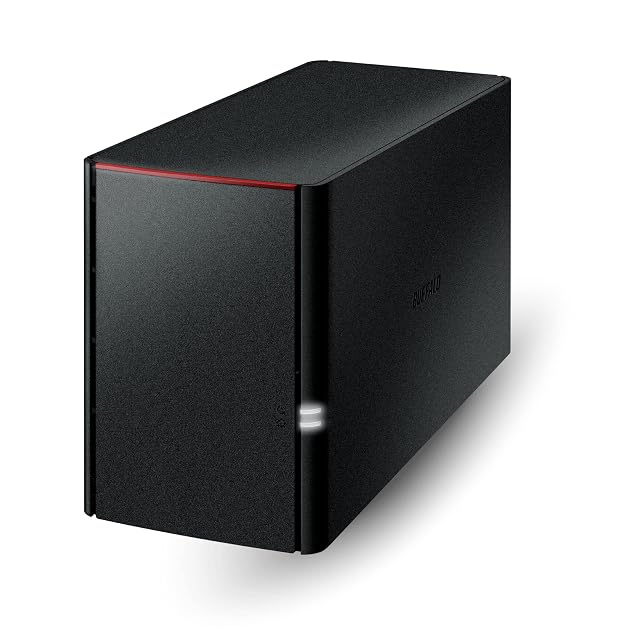
Three capacities of this one box are on this shelf, and the only honest way to read them is side by side.
On Amazon.com on October 26, 2026: four terabytes of drives for $285.99, shipping in RAID 1 with two terabytes usable. Eight terabytes for $362.99, four usable. Twelve terabytes for $461.99, six usable. Per raw terabyte that is $71.50, $45.37 and $38.50; per usable terabyte in the arrangement each arrives in, $143.00, $90.75 and $77.00. This one is the most expensive storage on the ladder by both measures, by a wide margin, and $176.00 separates it from the version holding three times as much.
The seventh bullet is the sentence that makes the comparison possible: “4TB Total Capacity With 2 Drive Bays — Ships in RAID 1 (Automatic Backup and 2TB useable capacity) but can be set to RAID 0 to use the full 4TB.” Five listings on this shelf publish both the array they arrive in and the usable figure it leaves, and every one of them is a LinkStation. Not one of the enclosures sold empty here publishes a usable figure at all, because there are no drives in them to compute one from.
The bullet calls RAID 1 an automatic backup, and it is not one. A mirror writes the same data to both drives so the machine survives one of them failing. A file deleted by mistake goes from both copies at once; a fire or a theft takes both, because both are in this box. A copy on separate hardware is a different arrangement and nothing in a mirror substitutes for it. What the bullet describes is real and useful; the words it uses for it are wrong.
The first bullet claims “Value NAS with RAID” and here, with two bays, that is true — the same sentence appears on the one-bay LinkStation 210 pages on this shelf, where it is not. The same bullet then recommends a different range: “Check out the LS 700 for enhanced features, cloud capabilities, macOS 26, and up to 7x faster performance than the LS 200.” The LS 700 is also on this shelf, as the LS710 and the LS720, and both of those pages confirm macOS 26 compatibility in their own second bullet. The second bullet here caps this unit at macOS 15 (Sequoia) and repeats the referral.
Everything else is the LinkStation template: a closed system that keeps third-party applications out, SSL on transfers, folder-level access, NAS Navigator and PC backup software supplied, NAS Navigator 2 for macOS 15 and earlier, “Made in Japan”, 24-hour support from the United States, and a two-year warranty covering the drives. No processor, no memory, no socket count, no port speed, no drive size, no decibel value, no figure in watts.
The product record carries 454 g (16 oz) and 128 by 254 by 224 mm (8.82 in). A two-bay enclosure with two drives in it does not weigh 454 g (16 oz), and the eight-terabyte version of the same chassis is recorded at 247 g (8.7 oz) while the twelve-terabyte one is recorded at 2,504 g (88.3 oz) with entirely different measurements. Three capacities, one box, three records that cannot all be describing it.
Prices quoted in this text were read on October 26, 2026. The live price is at the top of the page.