Bay count, drive interface and the processor behind the applications · review
ACEMAGIC N3A, four-bay enclosure that ships without an operating system review
A four-bay enclosure that states its bay size, counts its solid-state slots and supplies no operating system at all, naming three the buyer may install instead.
The bottom line Unusually specific about what goes inside it and silent about how anything gets to it. The bays, the slots, the memory and the warranty are all published; the network socket that makes it network storage is not named once.
On the listing
A four-bay enclosure sold without drives; an AMD R2544 processor described as suited to network storage, 8 GB of DDR4 and a 128 GB system drive; four bays for 3.5-inch drives at up to 30 TB each, plus two M.2 NVMe slots at up to 8 TB each for cache or separate fast storage, giving up to 136 TB in total; local private storage without monthly fees; freedom to install almost any compatible operating system, with TrueNAS, Unraid and OpenMediaVault named; continuous operation with a power-saving profile and a BIOS boost profile offering up to 30 per cent more processing; and 24 months of warranty with a 30-day return period.
The socket that is never counted
Four bays, two M.2 slots, a processor, memory and a system drive are all published. The network socket is not — not its count, not its speed, not its type. On a product whose category name contains the word network, that is the one omission that changes what the machine can do, because everything inside it is served through a link the page declines to describe.
An enclosure with no software in it
TrueNAS, Unraid or OpenMediaVault, chosen by the buyer. The fourth bullet makes this a selling point rather than an omission, and it is a legitimate one. It also moves the array arrangement, the applications and the update path off this page entirely, which is why the redundancy line here is blank and honestly so.
Two profiles, no figures
The fifth bullet offers a quiet, economical mode and a boost mode reached through the BIOS, worth up to 30 per cent more processing. Neither carries a figure in watts, and neither carries a decibel value, so the cost of the faster profile is described only as a percentage of an unstated baseline.
Before ordering
Ask for the network socket and its speed, and confirm which system you intend to install before the hardware arrives. This enclosure is sold as a platform, and a platform is judged on what it connects to and what runs on it.
Availability
Priced from 600 € to 620 € across the German and French Amazon stores the day this page was checked.
In the American Amazon catalogue with no live offer against it: the reference exists, nobody is filling it.
The British, Italian and Spanish Amazon stores returned nothing at all, so the buy button there opens a search in that country rather than a page that would not load.
Every figure in this section is what Keepa held on the day this page was last updated. Stock and prices move without warning.
Prices quoted in this text were read on 10 September 2026. The live price is at the top of the page.
Where it holds up, and where it stops
Strengths
The bays are given a drive size, which two of the six enclosures on this shelf never do
Two M.2 slots are counted, given a capacity ceiling each, and published with what they may be used for rather than left as a bare slot count
The operating system is openly the buyer’s to choose, with three named, and a warranty term of 24 months is printed on the same page
Compromises
Not one network socket is counted or given a speed, which is the whole link between this machine and everything that uses it
A boost profile is offered as up to 30 per cent more processing without a figure in watts or decibels for what it costs
The processor appears under two spellings of its name and never with a core count or a clock speed
Specifications
Bay count
Four — stated in the title as 4-Bay and repeated in the second bullet, which counts four slots for 3.5-inch drives
Drive interface
Bays for 3.5-inch drives — stated in the second bullet, with a ceiling of 30 TB per bay. The bus those bays run on is not named anywhere on the page
Solid-state slot count
Two M.2 NVMe slots — stated in the second bullet, taking up to 8 TB each, and offered either as cache or as a separate fast volume. That choice of use is published, which is unusual
Processor
AMD R2544 — printed in the title as AMD Ryzen R2544 and in the first bullet as an AMD R2544 described as suited to network storage. Both forms of the name are on the page; no core count and no clock speed appears with either
Memory
8 GB DDR4 — printed in the title and in the first bullet, which also names a separate 128 GB system drive for the operating system
Ethernet port count
Not published on the listing — no network socket is counted anywhere in the title or the six bullets, on a product sold as network storage
Port speed
Not published on the listing — with no network socket counted, none is given a rate
USB ports
Not published on the listing — no USB socket is named, and the only expansion the page describes is the pair of M.2 slots
Supported redundancy levels
Not published on the listing — no array arrangement is named, which follows from the fourth bullet leaving the operating system to the buyer, since that is where an array would be configured
Published operating system
None supplied, and three named as installable — the fourth bullet states that almost any compatible system can be installed and names TrueNAS, Unraid and OpenMediaVault, contrasting the unit with closed maker systems
Stated idle power
Not published on the listing — the fifth bullet names a power-saving profile and a boost profile enabled through the BIOS, and gives no figure in watts for either
Stated acoustic figure
Not published on the listing — the fifth bullet says the power-saving profile runs particularly quietly and prints no decibel value beside it
Stated dimensions
Not published on the listing — the unit is called a desktop enclosure and no measurement of the case appears
Amazon reference
B0GXZ8CKN5 (same reference on 3 Amazon marketplaces)
EAN
0662652963739
The questions that come up before an order
What changes when an enclosure ships without an operating system?
The buyer chooses and installs one, and everything the software would decide moves with it — the array arrangement, the applications, the update path and the support. The upside is freedom and a longer usable life; the cost is that nothing on this page can promise how the finished machine behaves, because that part has not been written yet.
What are the two M.2 slots for on a machine with four bays?
The second bullet offers two uses. As cache they sit in front of the spinning drives to absorb repeated reads and writes; as a separate volume they hold data that has to be fast in its own right. The distinction matters because caching adds no usable capacity while a separate volume does, and this page states both openly.
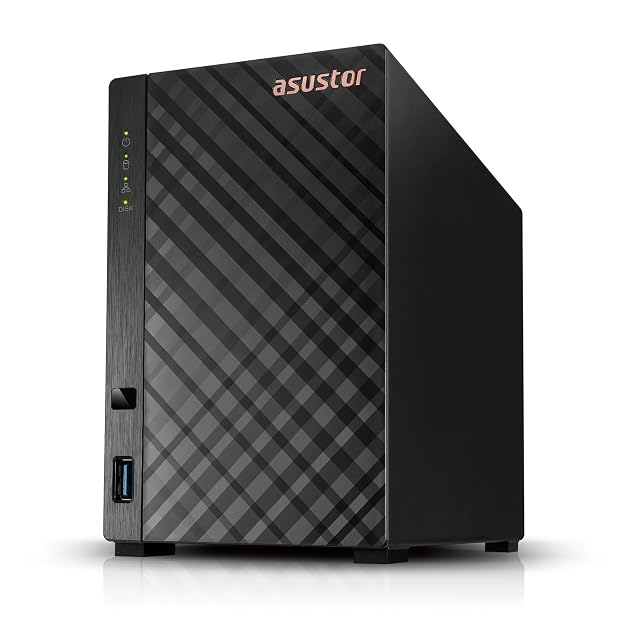
two bays · Realtek RTD1619B, four cores at 1.7 GHz · 1 GB DDR4 · one 1GbE socket · Btrfs and iSCSI snapshots named · sold without drives
A two-bay enclosure whose title states the processor, the memory and the single gigabit socket, and whose page never names the drive interface, an array arrangement or the software that runs it.
Best for: A first enclosure for a household copy of photographs and documents, where one gigabit is enough and where the buyer is content to look up the drive compatibility elsewhere.
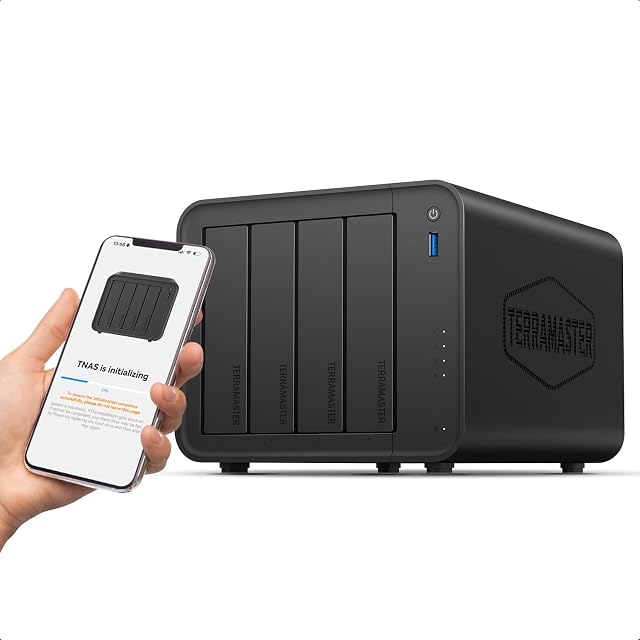
four bays · 8 gb of memory · four bullets that describe no product · title in Spanish on a German shop · reference printed short of the product record
A four-bay enclosure whose page carries a bay count, a memory figure and four bullets that would fit any object at all, printed in a language the shop does not use.
Best for: A buyer who already knows this model from elsewhere and is here only for the price, since the page itself will not tell them what they are buying.
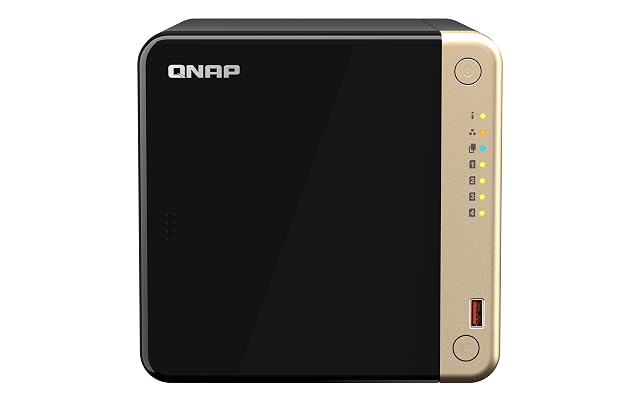
four bays · Intel x86 quad-core · 4 GB memory · one 2.5GbE socket · TRAID named · 22 dB(A) · 30 TB per bay, 120 TB in total
A four-bay enclosure that publishes an acoustic figure, a per-bay ceiling and the name of its array scheme, and that never says what size of drive its four bays take.
Best for: A media collection that has outgrown a two-bay unit and lives in a room where people sleep, bought by someone who will confirm the drive sizes separately.