Port count, port speed, and whether the fan ever stops · review
D-Link DGS-108, eight-port Layer 2 gigabit switch in a metal case review
An eight-socket gigabit switch whose headline figure counts both directions of one socket at once, and which never says where the unit is meant to be mounted.
The bottom line A solidly specified switch with one headline that needs reading carefully and one blank that is harder to forgive. The 2000 Mbit/s is two directions added together; the missing mounting line is the thing to ask about.
On the listing
A switch in a robust metal case with gigabit sockets for fast exchange between up to eight devices and up to 2000 Mbit/s per socket in full duplex; a stated fit for 4K video streaming, video surveillance, large downloads and online conferencing; QoS support for uninterrupted telephony, gaming and downloads with automatic power saving; automatic MDI/MDIX; an overview of sockets needing multicast streams, with network load reduced by filtering them; and plug and play working.
The 2000, explained
Both directions, added. A gigabit socket carries up to 1000 Mbit/s each way. Add the two and the result is the number in the title. It is the same operation that produces a switching capacity, performed on one socket rather than on eight, and it describes a total rather than a speed. Read as a rate, it doubles the unit on paper.
Non-blocking, without a total
The title claims the internal path can serve every socket at once. That is exactly what a switching capacity figure would quantify, and no such figure is printed. The claim and the number that would support it sit on opposite sides of a gap.
Multicast, described properly
The fifth bullet is unusually specific: sockets that need multicast streams are identified, and network load falls because the rest are filtered out. That is a description of what IGMP handling does, written without naming the standard.
The blank
Nothing on this page says how the unit mounts. No wall holes, no feet, no ears, no brackets. On a shelf it does not matter. Anywhere else it is the first question.
Before ordering
Ask the seller whether there are wall-mounting holes on the rear, and whether an adapter comes in the box. Neither appears on the page.
Availability
Priced from 27 € to 41 € across the German, French and Italian Amazon stores the day this page was checked.
It is stocked on the American and British Amazon stores as well, in that country’s own currency. The range above leaves those out: it counts euro stores and no others.
The Spanish Amazon price runs past 1.6× the cheapest store. A gap that size normally marks a reshipper and not a seller in the country, so that listing stays out of the range above.
Every figure in this section is what Keepa held on the day this page was last updated. Stock and prices move without warning.
Prices quoted in this text were read on 10 September 2026. The live price is at the top of the page.
Where it holds up, and where it stops
Strengths
Names a non-blocking architecture, which is the claim that every socket can be served without waiting for another
Names QoS and multicast filtering as separate behaviours, with the multicast one described as reducing load by filtering the streams nobody asked for
The metal case and the fanless design are both in the title, where a shelf is compared
Compromises
The headline figure of 2000 Mbit/s per socket counts both directions at once, which is arithmetic rather than a rate, and the page does not say so
No mounting is described at all, so whether the unit can hang on a wall is unknown before it arrives
Neither the word managed nor the word unmanaged appears, so the absence of a settings page has to be inferred
Specifications
Port count
Eight — stated in the title as an eight-port unit, with the first bullet describing fast exchange between up to eight devices
Port speed
Gigabit sockets, quoted by the maker as up to 2000 Mbit/s per socket in full duplex — stated in the title and in the first bullet. The figure adds the two directions of one gigabit link together rather than describing a rate in either direction
Managed or unmanaged
Not published on the listing as either word — the sixth bullet says the unit is ready to use straight away, and the QoS support of the third bullet and the multicast filtering of the fifth are described as built-in behaviours with no page on which to change them; the title names the unit as Layer 2
Stated switching capacity
Not published on the listing as a whole-unit total — the title names a non-blocking architecture and the per-socket figure of up to 2000 Mbit/s, and no figure adds the eight sockets together
Fanless or fan-cooled
Fanless — stated in the title in that word, with no fan named in any of the six bullets
Case material
Metal — stated in the title, in black, and again in the first bullet as a robust metal case
Desktop or rack mounting
Not published on the listing — no mounting arrangement of any kind is named in the title or in the six bullets, and no holes, feet, ears or brackets appear
Power supply type
Not published on the listing — automatic power-saving is named in the third bullet, and nothing says where the power comes from or what is in the box
Amazon reference
DE B000BCC0LO · US B007HZCM9S · GB B007HZCM9S · FR B007HZCM9S · IT B007HZCM9S · ES B007HZCM9S
EAN
0071020061210
The questions that come up before an order
How can a gigabit socket be quoted at 2000 Mbit/s?
By counting both directions at the same time. A gigabit link carries up to 1000 Mbit/s each way, and adding the two gives the figure printed here. It is the same arithmetic that produces a switching capacity, applied to one socket instead of to the whole unit. Nothing sends 2000 Mbit/s in one direction.
What does a non-blocking architecture claim?
That the internal path can carry every socket at full rate at the same time, so traffic between one pair of machines does not have to wait for traffic between another. It is a claim about the design rather than a measured figure, and this page makes it without publishing the total it implies.
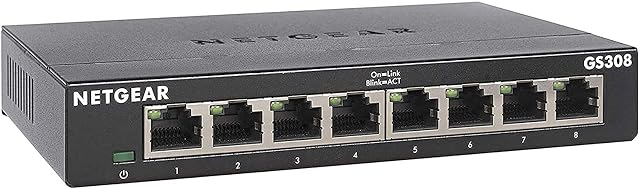
eight sockets at 1.0 Gbps · unmanaged, stated · Layer 2 · Cat5e or Cat6 named · fanless · metal case · on-off switch
An eight-socket unmanaged switch that names the cable grades its sockets expect and puts a power switch on the case, and publishes no figure for the unit as a whole.
Best for: A cupboard or a desk where the switch will occasionally need restarting, and where the wiring is already Cat5e or Cat6 and expected to stay that way.
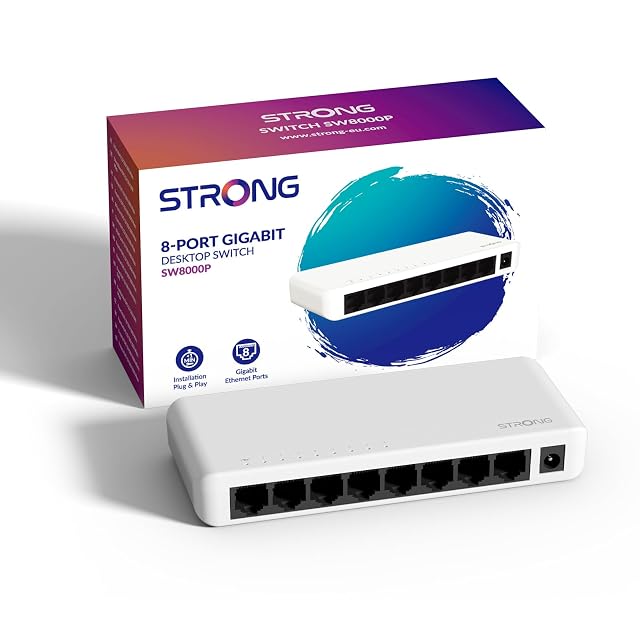
An eight-socket gigabit switch that publishes both the material of its case and a switching capacity, which is two answers more than most of this shelf gives.
Best for: A room that needs eight quiet wired sockets and a unit light enough to hang on a wall, where a plastic shell is a fair trade for the price.
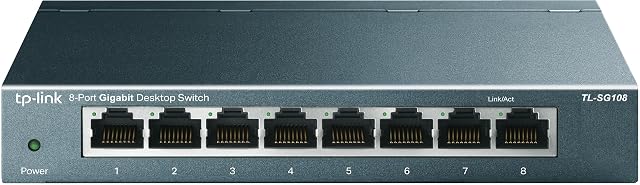
eight gigabit sockets · unmanaged, stated · 802.1p and DSCP QoS · IGMP snooping · fanless · metal case · power adapter in the box
An unmanaged eight-socket switch that names its traffic-priority and multicast standards and lists what arrives in the box, without printing any figure for the unit as a whole.
Best for: A living room or study where set-top boxes and streaming devices share the wiring, and where a metal case that never needs a fan is worth the small premium.