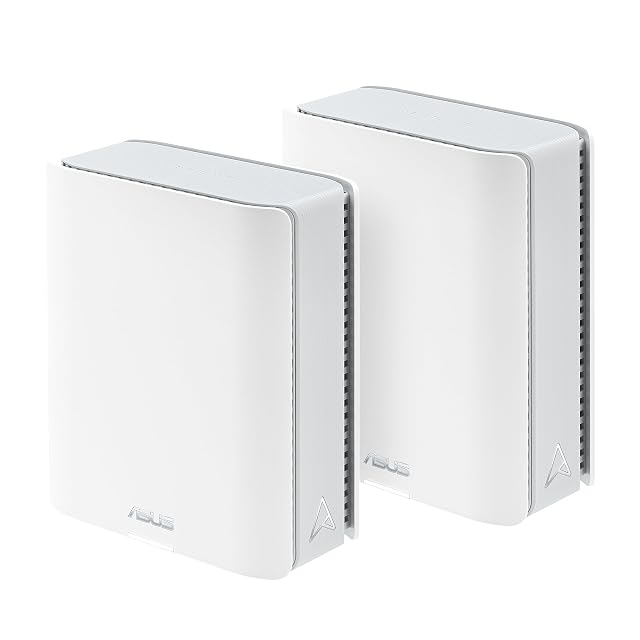
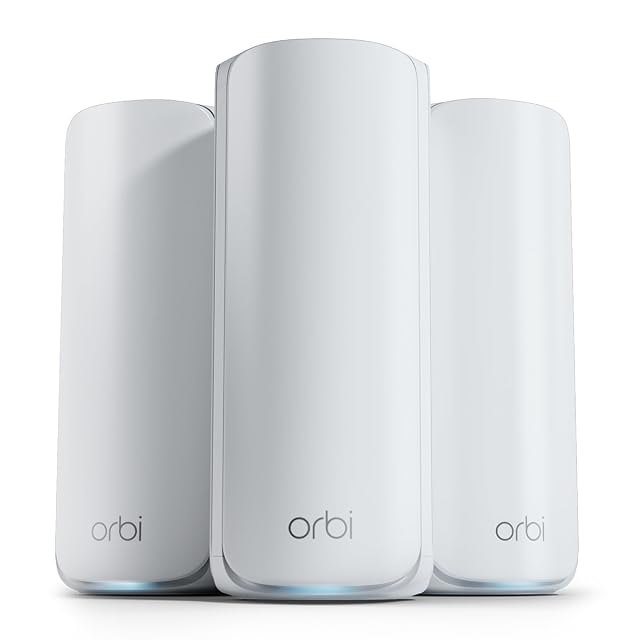
Both of these are Wi-Fi 7 tri-band systems quoting coverage in the same range, and they are built on different assumptions. The ASUS ZenWiFi BT8 is two identical nodes reaching up to 550 m², with a 6 GHz radio named and up to 14 Gbit/s stated. The NETGEAR Orbi 770 is a router and two satellites reaching up to 540 m², with 11 Gbit/s stated, a named backhaul arrangement, and a qualification the ASUS page does not make.
Orbi 770 Series, router and two satellites, Wi-Fi 7
Wi-Fi generation
Wi-Fi 7, in the title and the first bullet
Wi-Fi 7, described as the next generation of speed
IEEE designation
Not published — the generation appears by number only
Not published — nine bullets name the generation by number and none prints a letter pair
Stated class figure
Up to 14 Gbit/s for the tri-band radios, with MLO and 4K-QAM named; no BE designation, and the figure is not divided between the three radios
Up to 11 Gbit/s, described as 2.4 times faster than Wi-Fi 6, with the maker adding that actual speed depends on the devices and the internet plan
Band plan
Tri-band including a 6 GHz radio, named; the individual rates are not given
Tri-band with what the listing calls Enhanced Backhaul; the three frequencies are not named
Backhaul type
Not published — AiMesh is named and described as AI-driven, without saying whether a radio is reserved for the link or a cable may carry it
Wireless, named as Enhanced Backhaul within the tri-band arrangement; which radio carries it is not said
Node count
Two
Three
Pack composition
Two units, with coverage extending further through compatible routers from the same maker
One router and two satellites, not three identical units; a further satellite is said to add up to 180 m²
Stated coverage area
Up to 550 m² for the system as a whole
Up to 540 m² on every floor for up to 100 devices, with the maker naming floor plan, building materials and satellite placement as what varies it
Ethernet port count
Not published — none of the five bullets counts a socket
Not published — none of the nine bullets counts a socket
Port speed
Not published — with no socket counted, no wired speed appears
Not published — readiness for plans up to 2.5 Gbit/s is stated without naming the socket that carries them
Separate WAN socket
Not published — nothing identifies which socket the incoming line uses
Not published — the router is stated to connect to an existing modem, and the socket it uses is not described
A tick means one listing published something the other did not, or published
a better figure. It does not mean the product is better, and the column is not
a score out of anything: a maker who says less loses lines here without losing
a comparison. The two verdicts below are where the page is settled.
Which one, for whom
Buy the ASUS ZenWiFi BT8, two-node tri-band Wi-Fi 7 set
The ZenWiFi BT8 is two of the same thing, which matters more than it sounds: either unit can be the one by the modem, and a spare is a spare. It names the 6 GHz radio directly, quotes the higher figure at up to 14 Gbit/s, and carries seven internal antennas. What it will not tell you is how the two units talk to each other — AiMesh is named as AI-driven and the backhaul question is left open, which on a two-node system is the question.
Buy the NETGEAR Orbi 770 Series, router and two satellites, Wi-Fi 7
The Orbi 770 is three units where one is the router, so the topology is fixed and a satellite cannot take the router’s place. Against that, it is the more honest page: it names its backhaul, it states the coverage figure with the conditions that change it, and it says the speed depends on the devices and the plan. Its 11 Gbit/s is the lower headline of the two, and it is the one qualified by the maker who printed it.
The questions that come up before an order
Is 14 Gbit/s better than 11 Gbit/s here?
As a headline, yes; as a promise, neither is one. Both figures are sums across three radios, and no single device connects at either. The Orbi page says so itself, naming the connected devices and the internet plan as what actually decides. The ASUS page prints the larger number and leaves the qualification out — which is why that row goes to NETGEAR.
What is the practical difference between two nodes and three?
Coverage, and what happens when one fails. Three units cover more floor between them, and the ASUS pair claims 10 m² more than the NETGEAR trio, so the arithmetic is not simply about counting boxes. With the Orbi, only one unit is the router; with the ZenWiFi, both are the same model. That is a spare-parts argument as much as a coverage one.