The bottom line A well-described radio on an undescribed chassis. If Wi-Fi 7 clients and a 6 GHz band are the reason to buy, the specification is there; the sockets, on a set quoted at 14 Gbit/s, are the omission worth chasing.
On the listing
Tri-band Wi-Fi 7 with up to 14 Gbit/s, a 6 GHz radio, MLO and 4K-QAM; AI-driven AiMesh raising coverage to 550 m² and extending with compatible routers from the same maker; seven internal antennas and eight front-end modules described as removing dead zones; round-the-clock protection with a commercial-grade suite and advanced VPNs; and IoT networks, parental controls and VPN configured across devices under one set of management SSIDs.
What 14 Gbit/s counts
Three radios, each with a theoretical peak the standard defines from its channel width and stream count, added together. On a tri-band Wi-Fi 7 unit the 6 GHz radio contributes most of the total, which is exactly why the split matters and why its absence here is a gap: a client without a 6 GHz radio sees none of that share.
The hardware that is counted
Seven internal antennas, eight front-end modules. That is a specific claim about the part of a mesh node that decides how far it reaches, and it can be checked against a photograph of the board. Most listings on this shelf describe coverage with an adjective instead.
The hardware that is not
No socket count. No socket speed. No word on which unit takes the cable from the modem. On a set whose radios are quoted at 14 Gbit/s, the wired ceiling is the number that decides what the house actually gets, and it is not on this page.
Before ordering
If a wired backhaul between the two units is the plan, confirm the socket count and speed with the seller first. Nothing on this page says the units accept one.
Availability
Priced from 397 € to 459 € across the German, French, Italian and Spanish Amazon stores the day this page was checked.
It is stocked on the British Amazon store as well, in that country’s own currency. The range above leaves those out: it counts euro stores and no others.
The American Amazon store returned nothing at all, so the buy button there opens a search in that country rather than a page that would not load.
Every figure in this section is what Keepa held on the day this page was last updated. Stock and prices move without warning.
Prices quoted in this text were read on 10 September 2026. The live price is at the top of the page.
Where it holds up, and where it stops
Strengths
Counts the radio hardware precisely: seven internal antennas and eight front-end modules, which is a level of detail the rest of this group leaves out
Names the Wi-Fi 7 features that matter for a mesh — a 6 GHz radio, MLO and 4K-QAM — rather than only the generation number
States separate networks for IoT devices and guests under the same management, alongside a commercial-grade protection suite and VPN
Compromises
Not one Ethernet socket is counted or rated, on a Wi-Fi 7 set whose radios are quoted well above a gigabit
Up to 14 Gbit/s covers three radios and none of them is given a figure, so what the 6 GHz side is worth alone is unpublished
The coverage figure describes the AiMesh system rather than the two units in the box, and the listing does not tie it to a pack size
Specifications
Wi-Fi generation
Wi-Fi 7 — stated in the title and in the first bullet
IEEE designation
Not published on the listing — the generation appears by number only, and no 802.11 letter pair is printed in the title or in the five bullets
Stated class figure
Up to 14 Gbit/s — stated for the tri-band Wi-Fi 7 radios, with MLO and 4K-QAM named alongside it. No BE designation is given and the figure is not divided between the three radios
Band plan
Tri-band including a 6 GHz radio — stated in the title and confirmed in the first bullet; the rates of the individual radios are not given
Backhaul type
Not published on the listing — AiMesh is named as the mesh system and described as AI-driven, without saying whether a radio is reserved for the link between units or whether a cable may carry it
Node count
Two — stated in the title as a 2-pack
Pack composition
Two units — stated; the listing adds that coverage extends further with compatible routers from the same maker rather than only with more of these
Stated coverage area
Up to 550 m² — stated for the AiMesh system as a whole, described as raised by the AI-driven mesh
Ethernet port count
Not published on the listing — the five bullets cover radios, antennas, security, VPN and network segmentation, and none of them counts a socket
Port speed
Not published on the listing — with no socket counted, no wired speed appears
Separate WAN socket
Not published on the listing — nothing identifies which socket the incoming line uses, or whether one exists
Amazon reference
B09T9629T5 (same reference on 5 Amazon marketplaces)
EAN
4711387532089
The questions that come up before an order
What does MLO change on a mesh system?
Multi-link operation lets a client use more than one band at the same time rather than choosing between them. On a mesh that can also apply to the link between units. This listing names the feature and does not say which links use it.
Why does the antenna count matter?
Seven antennas across three radios is a hardware fact that constrains the stream count, which in turn is what a class figure is calculated from. It is not the same as publishing the stream count, but it is more than a listing that says the unit has good coverage.
Wi-Fi 7 · BE11000 badge over 10 777 Mbit/s published · dedicated 6 GHz backhaul · four 2.5G sockets, one WAN · 110 m² stated
The most completely specified unit in this group: three band rates, a named backhaul, four multi-gigabit sockets — and a badge 223 Mbit/s larger than the figures printed beneath it.
Best for: A household on a multi-gigabit line that wants every socket faster than a gigabit and a 6 GHz lane kept clear between nodes.
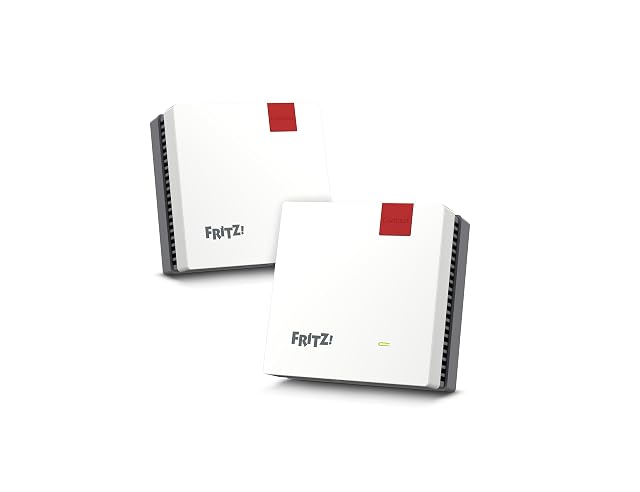
Wi-Fi 6 · up to 3000 Mbit/s stated · two units · seven of eleven lines unpublished · made in Europe
A two-piece set from a well-known European maker whose listing runs on four bullets: a generation, a figure, an installation promise and a sentence about security.
Best for: A buyer who already trusts the maker and wants a mesh pair that will sit behind an existing provider box without an argument.