Skip to content

Tenda A23, Wi-Fi 6 AX1500 plug-in repeater with a Gigabit socket vs STRONG AX3000 Wi-Fi 6 dual-band repeater with two adjustable antennas

A faster badge, or the Ethernet socket that makes the access point mode worth having?

Both of these are Wi-Fi 6 dual-band repeaters that also work as access points, and both publish the parts behind their badge. The Tenda A23 is AX1500 over 300 and 1201 Mbit/s — 1501 when added, within one of its own badge — and it has a Gigabit socket. The STRONG AX3000 is AX3000 over 574 and 2402, coming to 2976, and no Ethernet socket appears anywhere on its page.

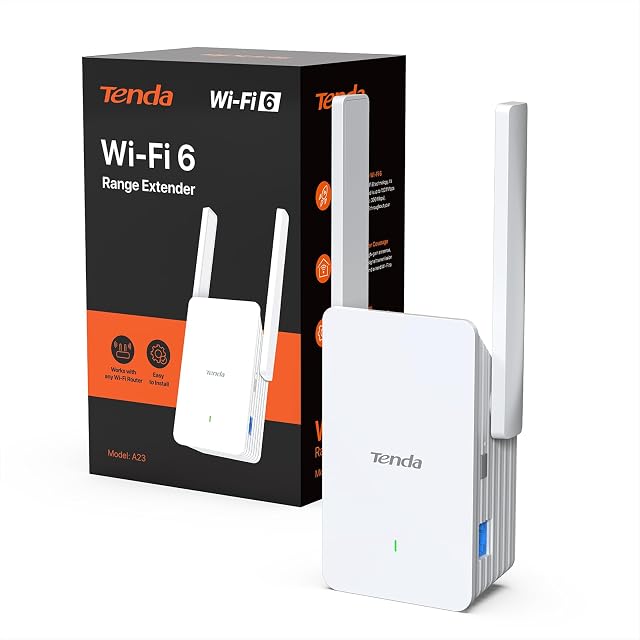
Tenda A23 white plug-in Wi-Fi 6 repeater with a status LED

Tenda A23, Wi-Fi 6 AX1500 plug-in repeater with a Gigabit socket

Wins 5 of 9

Check price

≈ 37 €

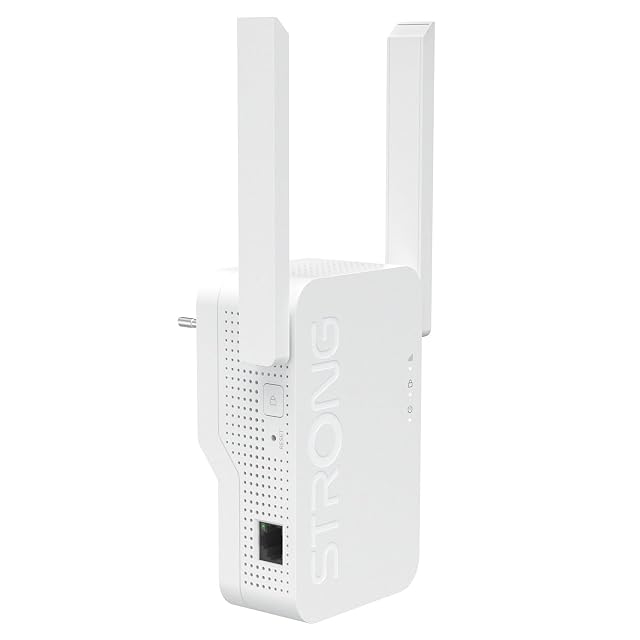
STRONG white dual-band Wi-Fi 6 repeater with two adjustable external antennas

STRONG AX3000 Wi-Fi 6 dual-band repeater with two adjustable antennas

Wins 1 of 9

Check price

Line by line

Compared on A23, Wi-Fi 6 AX1500 plug-in repeater with a Gigabit socket AX3000 Wi-Fi 6 dual-band repeater with two adjustable antennas
Wi-Fi generation Wi-Fi 6 Wi-Fi 6
IEEE designation Not published — no letter pair among the eight bullets Not published — no letter pair among the five bullets
Stated class figure AX1500, split as 300 at 2.4 GHz and 1201 at 5 GHz, coming to 1501 — within one of its own arithmetic AX3000, split as 574 and 2402, coming to 2976, so the badge rounds up by 24; the title prints the class name with an Mbit/s unit after it, which a class name is not
Band plan Two radios, rated: 300 and 1201 Mbit/s Two radios, rated: 574 and 2402 Mbit/s, described as usable at once by several devices
Stream count Not published for either radio Not published for either radio
Plug-in or desktop form Plug-in, stated, as a repeater for the mains socket Not published — two external adjustable antennas are described and no body shape is stated
Ethernet port count One Gigabit socket, for televisions, computers, cameras and other wired devices Not published — no Ethernet socket is named anywhere, on a unit that offers an access point mode
Port speed Gigabit, without the 1000BASE-T designation behind the word Not published — with no socket named, none is given a speed
Access point mode Yes — switching between repeater and access point, with a wired connection turned into a wireless signal Yes — extending an existing network or creating a new access point

A tick means one listing published something the other did not, or published a better figure. It does not mean the product is better, and the column is not a score out of anything: a maker who says less loses lines here without losing a comparison. The two verdicts below are where the page is settled.

Which one, for whom

Buy the Tenda A23, Wi-Fi 6 AX1500 plug-in repeater with a Gigabit socket

The A23 is the slower badge and the more complete device. Its Gigabit socket is what makes the access point mode mean anything: a cable arrives, a new wireless network leaves. It states that it plugs into a socket, which sounds trivial until you try to plan where one goes. And its badge is nearly honest arithmetic — 300 plus 1201 is 1501, one above AX1500.

Buy the STRONG AX3000 Wi-Fi 6 dual-band repeater with two adjustable antennas

The AX3000 is twice the badge and publishes both halves of it, 574 and 2402, so the 2976 behind the 3000 is visible. Two adjustable 5 dBi antennas are a real advantage at distance. But its listing names an access point mode and never names an Ethernet socket, which leaves the most useful of its two modes without an obvious way in. On a page with five bullets, that omission is the thing to weigh against the faster radios.

The questions that come up before an order

Why does the missing socket cost STRONG three rows?

Because the socket, its speed and the mode that depends on it are three separate questions, and the listing answers none of them. An access point takes a wired connection and turns it into a wireless one; if the page never names a wired connection, the mode is stated without the fitting it needs. This site records the page, not what the hardware probably has.

Is AX1500 or AX3000 the figure to compare?

Neither, on its own. Both are sums of two standard radio rates, and both pages publish the parts — 300 and 1201 on one, 574 and 2402 on the other. Compare the 5 GHz figures, which is where a modern device connects, and remember that a repeater sits between you and the router, so neither number is what arrives at the far end.

The full reviews

Every price named in a summary was read on the date that review carries. What a shop asks today is shown beside the product, and it moves.