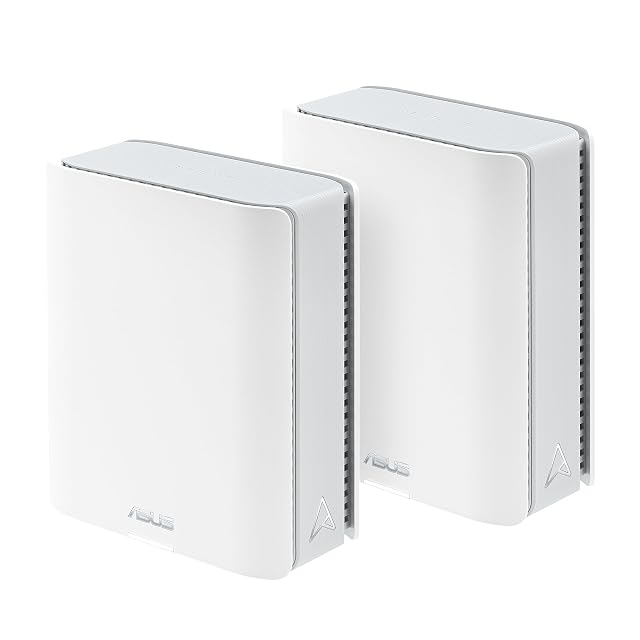
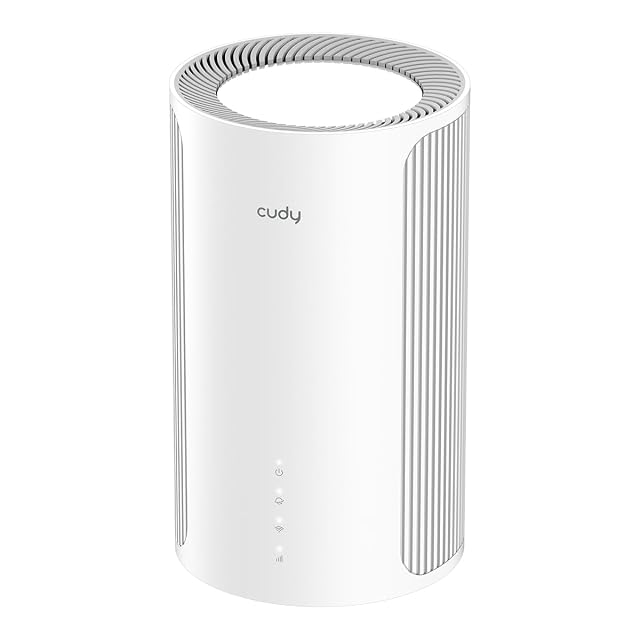
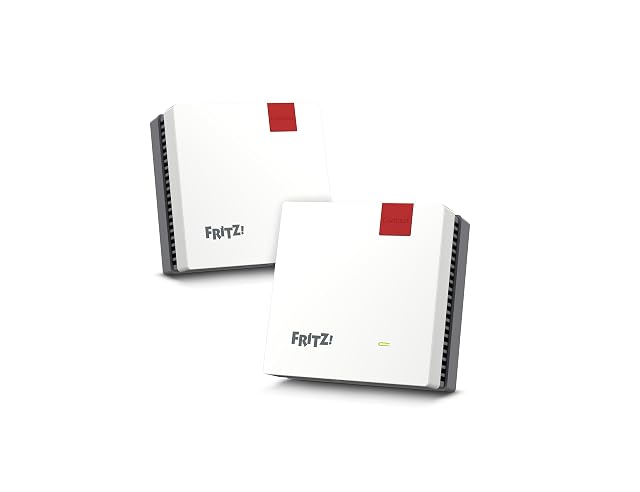
The bottom line The most candid listing in this group about what its own headline figures rest on, and one of the least forthcoming about its sockets. For a large house on a fast line the qualified coverage arithmetic is genuinely useful; the wired ceiling is what to establish before ordering.
On the listing
A router and two satellites covering up to 540 m² on every floor for up to 100 devices; tri-band with Enhanced Backhaul described as keeping every device fast at once; up to 11 Gbit/s of Wi-Fi 7, quoted as 2.4 times faster than Wi-Fi 6, with the actual speed said to depend on the connected devices and the internet plan; guided app setup; compatibility with cable and fibre providers and readiness for plans up to 2.5 Gbit/s; security features enabled from the factory with automatic firmware updates; a subscription security suite offered with a thirty-day trial; and expansion by a further satellite for up to 180 m² more, with actual coverage said to vary by floor plan, materials and placement.
Two figures, and their conditions
540 m², with the conditions printed. Floor plan, building materials, satellite placement. That is the honest version of a coverage claim, and it appears on one listing in eight here.
Up to 11 Gbit/s, with its conditions printed too. Connected devices, internet plan. A class figure is a sum of theoretical radio peaks and reaches no single link; saying so in the maker’s own bullet is unusual enough to note.
The backhaul that is named but not described
Enhanced Backhaul is a name, not a specification. It tells you the system reserves capacity for traffic between units; it does not tell you which band, how wide, or whether a cable can take over. On a tri-band Wi-Fi 7 system those are the differences that matter.
What is missing
Sockets, again. A system ready for a 2.5 Gbit/s plan needs a socket that can take 2.5 Gbit/s, and the page that makes the claim does not count one.
Before ordering
Use the 180 m² per extra satellite as your arithmetic, not the 540 m² total. It is the figure that tells you what a fourth unit buys, and it comes from the same maker assumptions as the first three.
Availability
Priced from 697 € to 800 € across the German, French, Italian and Spanish Amazon stores the day this page was checked.
It is stocked on the British Amazon store as well, in that country’s own currency. The range above leaves those out: it counts euro stores and no others.
In the American Amazon catalogue with no live offer against it: the reference exists, nobody is filling it.
Every figure in this section is what Keepa held on the day this page was last updated. Stock and prices move without warning.
Prices quoted in this text were read on 10 September 2026. The live price is at the top of the page.
Where it holds up, and where it stops
Strengths
Qualifies its own coverage figure by naming the floor plan, the building materials and the satellite placement as the things that change it
Qualifies its own speed figure too, saying the result depends on the connected devices and the internet plan
Publishes the expansion arithmetic — a further satellite adds up to 180 m² — so a fourth unit can be costed against a floor area before it is bought
Compromises
No socket count and no socket speed anywhere, on a system stated as ready for plans up to 2.5 Gbit/s
Enhanced Backhaul is named without saying which band carries it or whether a cable may replace it
Up to 11 Gbit/s is never split between the three radios, so how much of it a client without a 6 GHz radio can reach is unpublished
Specifications
Wi-Fi generation
Wi-Fi 7 — stated in the title and in the third bullet, described as the next generation of speed
IEEE designation
Not published on the listing — the generation is named by number across nine bullets, and no 802.11 letter pair appears in any of them
Stated class figure
Up to 11 Gbit/s — stated, and described as 2.4 times faster than Wi-Fi 6. The same bullet adds that the actual speed depends on the connected devices and the internet plan, and no BE designation is given
Band plan
Tri-band — stated, working with what the listing calls Enhanced Backhaul; the three frequencies are not named and none is given a rate
Backhaul type
Wireless, named as Enhanced Backhaul within the tri-band arrangement — stated. Which radio carries it is not said, and no wired backhaul is mentioned
Node count
Three — stated as a router and two satellites
Pack composition
One router and two satellites, not three identical units — stated; a further Orbi 770 satellite is said to add up to 180 m²
Stated coverage area
Up to 540 m² on every floor for up to 100 devices — stated, with the maker adding in the same listing that actual coverage varies with the floor plan, the building materials and where the satellite is placed
Ethernet port count
Not published on the listing — nine bullets cover coverage, backhaul, speed, setup, provider compatibility, security and expansion, and none counts a socket
Port speed
Not published on the listing — the system is said to be ready for plans up to 2.5 Gbit/s without naming the socket that carries them
Separate WAN socket
Not published on the listing — the router is stated to connect to an existing modem, and the socket it uses is not described
Amazon reference
B0DDPM175C (same reference on 6 Amazon marketplaces)
EAN
0606449171778
The questions that come up before an order
Why does a maker qualify its own coverage figure?
Because the figure was produced in a building the buyer does not live in. Naming the floor plan, the materials and the satellite position as variables is a statement that the number is a starting assumption. It does not make the figure comparable with a rival number produced under different assumptions, but it is more candid than printing it bare.
What does a router-plus-satellites pack change against three identical units?
Only one unit is designed to meet the incoming line, so the set has a fixed shape: the router goes where the modem is, and the satellites go where the coverage is needed. A pack of identical units can be arranged more freely. This listing states which kind it is, which not every listing does.
Wi-Fi 7 · BE11000 badge over 10 777 Mbit/s published · dedicated 6 GHz backhaul · four 2.5G sockets, one WAN · 110 m² stated
The most completely specified unit in this group: three band rates, a named backhaul, four multi-gigabit sockets — and a badge 223 Mbit/s larger than the figures printed beneath it.
Best for: A household on a multi-gigabit line that wants every socket faster than a gigabit and a 6 GHz lane kept clear between nodes.
Wi-Fi 6 · up to 3000 Mbit/s stated · two units · seven of eleven lines unpublished · made in Europe
A two-piece set from a well-known European maker whose listing runs on four bullets: a generation, a figure, an installation promise and a sentence about security.
Best for: A buyer who already trusts the maker and wants a mesh pair that will sit behind an existing provider box without an argument.