The USB link behind the socket sets the ceiling of the Ethernet port · review
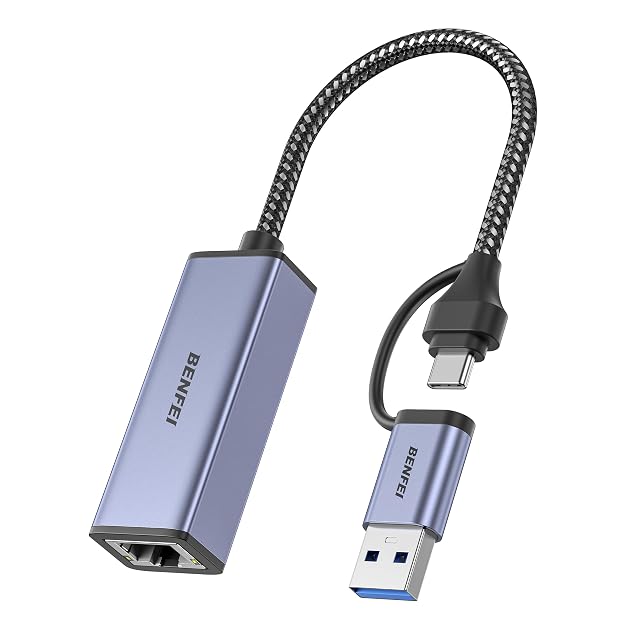
WAVLINK WL-NWU331GCA, 2.5-gigabit adapter carrying both USB plug shapes review
A 2.5-gigabit adapter that carries both USB plug shapes, names its chip, and states twice over that the host and the driver decide what the figure on the box is worth.
The bottom line The most useful adapter here for a bag that serves more than one machine, and the most careful page about what limits its own headline figure. The gaps are the USB generation and the shell, and neither changes what it does.
On the listing
A 2.5G USB LAN adapter with an integrated RJ45 socket supporting a network speed of 2.5 Gbps, with a note that the actual network speed is limited by the equipment of the buyer; a Type-A and Type-C adapter carrying both interfaces so that neither has to be chosen; compatibility with USB-C and USB-A desktops, laptops, tablets and ultrabooks, with Windows 7, 8, 8.1, XP, 10 and 11 and macOS 10.6 or later named, and Thunderbolt 3 and 4, USB 3.2 with 3.0 and 3.1, and USB 2.0 hosts named, the last with a note that it limits the adapter; a body of 2.6 by 1.1 by 0.6 inches weighing 76 g, an RTL8156B chipset, and two-colour green and amber indicator lights; and a closing note excluding ARM-based Windows RT and Windows Mobile, most Android devices, the TiVo Series 2 and the Wii, adding that older systems may need a driver and that older macOS holds the link at 1 Gbps with no jumbo frames until it is installed.
Both plugs, one adapter
Type-A and Type-C on the same unit. The bullet is written as a rhetorical question and the answer is the right one: an adapter that fits whichever machine is in front of you is worth more than one that fits the machine you had in mind. Nothing else on this shelf does it.
The note under the headline rate
The first bullet prints 2.5 Gbps and then says the network equipment of the buyer sets the limit. The third bullet prints a list of hosts and then says USB 2.0 limits the adapter. Two sentences, in two places, both making the same point about the same chain. A page that undercuts its own headline twice is a page that has been written by somebody who has answered support questions.
What an older Mac gets before the driver
A 1 Gbps link and no jumbo frames. Not a vague warning about compatibility: a rate, a missing feature, and the fix. That is what a limitation looks like when it is published properly.
Before ordering
Find out which USB socket on the machine is the fast one. The adapter names every host it will sit on and says plainly that the slowest of them decides, and machines rarely mark their sockets on the case.
Availability
Priced from 18 € to 21 € across the German, French, Italian and Spanish Amazon stores the day this page was checked.
It is stocked on the American and British Amazon stores as well, in that country’s own currency. The range above leaves those out: it counts euro stores and no others.
Every figure in this section is what Keepa held on the day this page was last updated. Stock and prices move without warning.
Prices quoted in this text were read on 10 September 2026. The live price is at the top of the page.
Where it holds up, and where it stops
Strengths
Carries both plug shapes on one adapter, which removes the single most common reason for a return on this shelf
Names the chipset, so the driver question can be answered before the order rather than after it
States what an older macOS gets before the driver is installed: a 1 Gbps link and no jumbo frames, which is a specific and checkable limitation
Compromises
The USB generation of the adapter itself is never stated, only the range of hosts it will sit on
The two lists of Windows versions do not agree, with Vista in one and Windows 11 in the other
Nothing about the shell material, on an adapter with a stated weight and stated dimensions
Specifications
USB generation
Not published on the listing as a generation for the adapter itself — the third bullet names the hosts it works with, Thunderbolt 3 and 4, USB 3.2 with 3.0 and 3.1 in brackets, and USB 2.0, and adds in the same line that USB 2.0 limits the performance of the adapter
Stated link rate
Not published on the listing for the host link — no figure in gigabits per second is attached to the USB side. The fifth bullet gives the nearest thing to one from the other direction: an older version of macOS holds the link at 1 Gbps until the driver is installed
Connector type
Both — the second bullet states a Type-A and Type-C adapter carrying both interfaces so that neither has to be chosen, and the title names USB-C
Ethernet port speed standard
2.5 Gbps over an integrated RJ45 socket — stated in the first bullet, which adds in its own words that the actual network speed is limited by the network equipment of the buyer. No BASE-T designation is printed
Controller family
Realtek RTL8156B — stated in the fourth bullet, named as the chipset behind the transfer
Stated operating system support
Published twice and not identically. The title names Windows 7, 8 and 10, XP, Vista and macOS 10.6 or later; the third bullet names Windows 7, 8, 8.1, XP, 10 and 11 and macOS 10.6 or later, with Windows 11 in the bullet and Vista only in the title. The fifth adds that ARM-based Windows RT, Windows Mobile, most Android devices, the TiVo Series 2 and the Wii are not supported, and that older versions of Windows, Linux and macOS may need a driver downloaded
Housing material
Not published on the listing — the fourth bullet gives the size and the weight and never says what the shell is made of
Cable arrangement
Not published on the listing as a length — the fourth bullet gives a body of 2.6 by 1.1 by 0.6 inches and a weight of 76 g, printed also as 2.7 ounces, and two-colour green and amber indicator lights, and says nothing about a lead
Amazon reference
B0F29DDS7T (same reference on 6 Amazon marketplaces)
EAN
6955362066826
The questions that come up before an order
What does the note about USB 2.0 actually mean for the 2.5 gigabits?
That the figure belongs to the Ethernet socket and the host decides what reaches it. The maker writes the sentence itself: a USB 2.0 host limits the performance of the adapter. That is the position of this hub stated by the seller, and it is the reason the socket on the machine matters more than the socket on the adapter.
Why would an older macOS be held at 1 Gbps?
Because the system carries a general driver that knows how to talk to the adapter but not how to run it at its full rate, and the maker says so: 1 Gbps and no jumbo frames until the proper driver is installed. It is a limitation with an end to it, and the page names both the limit and the remedy.
USB 3.0 · 5 Gbit/s bus stated · USB-C plug · 10/100/1000 Mbit/s · 802.3, 802.3u, 802.3ab and 802.3az named · Category 6 asked for · 18-month warranty
A gigabit adapter that names four Ethernet standards and then asks for Category 6 cable if the gigabit is to be had, which is the chain stated by the maker rather than by us.
Best for: A laptop with a Type-C socket and no Ethernet, on a network already wired with Category 6 or better, where the gigabit is the whole requirement.
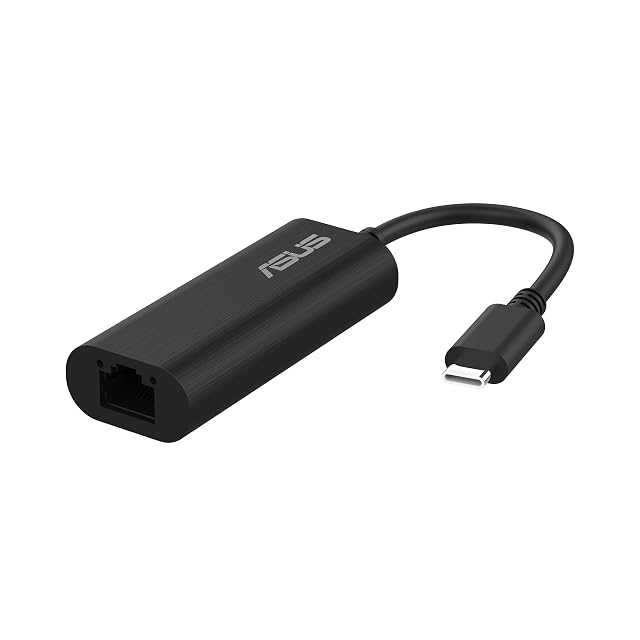
2.5G Ethernet named · USB-C · no driver stated · no host rate · no chip · no housing material · no operating system listed
A 2.5-gigabit Type-C adapter from a large name whose page publishes four short bullets and answers two of the eight questions this hub asks.
Best for: A buyer who is choosing on the name on the box and on a recent machine, where a Type-C socket and a 2.5-gigabit switch are already known quantities.
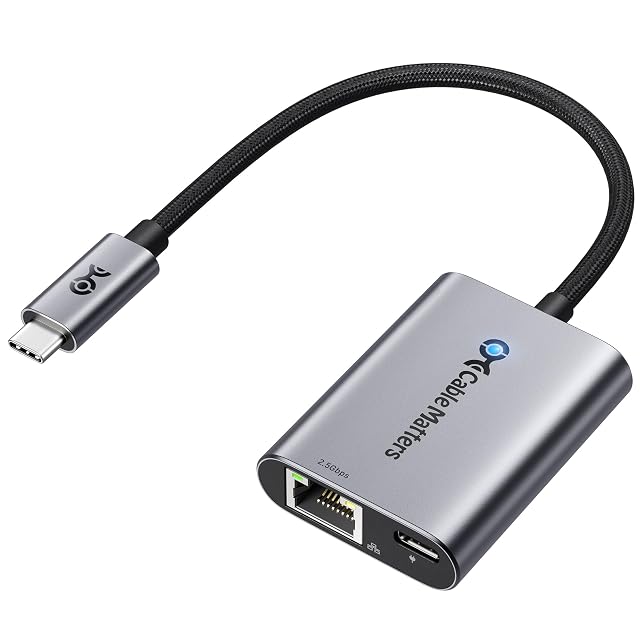
up to 2500 Mbit/s · USB-C · a second USB-C socket for charging to 140 W under USB-PD 3.1 · aluminium body · braided pigtail lead · controller maker named without a model
A 2.5-gigabit adapter that gives the single Type-C socket of a laptop back by carrying up to 140 W of charging alongside the network.
Best for: A modern laptop with a single Type-C socket that has to be charged and wired at the same time, on a desk where the adapter stays plugged in.