Everything here hangs on whether your exact printer is on the published list · review
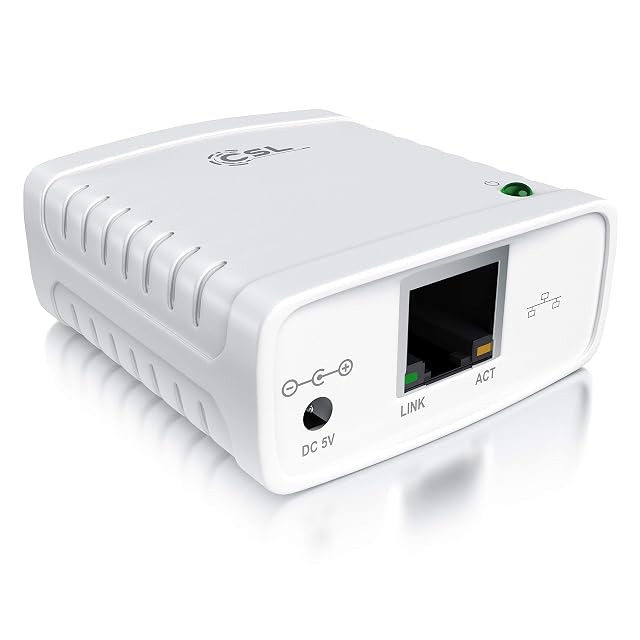
SatcOp wireless print server with a Type-C power socket and a network cable interface review
A wireless print server whose compatibility is given as a percentage, whose largest figure is measured in gigabytes, and half of whose bullet slots contain nothing at all.
The bottom line The only wireless unit of the four, and the least described product in this lot by a wide margin. What it does is guessable; what it works with, how fast, and over which protocols are not on the page at all.
On the listing
A wireless print server at 100 to 240 V and 5 V, compact, with several interfaces, plug and play over USB for a PC for XP, on an EU plug; a simple and compact design named for saving space and being easy to carry; a print sharing server said to support the printing of images as well as text; an adapter carrying a Type-C power socket, a USB socket for the printer and a network cable interface; a line saying that the adapter can be shared by several users with the wireless network printing function, with maximum support of 256 GB; and a closing line giving compatibility with more than 95 per cent of USB printer brands on the market and support for 3.4, XP or higher, which stops mid-sentence.
Ninety-five per cent is not a list
More than 95 per cent of the USB printer brands on the market. That is the entire statement of compatibility on this page. It names no maker and no model, and there is nothing in it a buyer can look a printer up in. This hub reads the list first on this family precisely because the list is what settles an individual case, and here there is no list to read.
The figure in gigabytes
256 GB, in a bullet about several users sharing a printer. Nothing says what it measures. On this shelf a figure in gigabytes usually belongs to an attached storage device, and that connection is not made anywhere on the page, so it is not made here either.
The bullets that end empty
Ten bullet slots, five of them containing text and five containing nothing. The fifth stops in the middle of a sentence, on the word for, in the same line that claims compatibility with most of a market. A listing that runs out halfway through its own compatibility statement is a listing to ask questions of.
Before ordering
Ask for a plain answer on three points: the make and model of your printer, whether the network side is wired, wireless or both, and which protocol the machines on the network will use to find it. None of the three is answered here.
Availability
Priced from 43 € to 58 € across the German, French and Spanish Amazon stores the day this page was checked.
The Italian Amazon price runs past 1.6× the cheapest store. A gap that size normally marks a reshipper and not a seller in the country, so that listing stays out of the range above.
In the British Amazon catalogue with no live offer against it: the reference exists, nobody is filling it.
The American Amazon store returned nothing at all, so the buy button there opens a search in that country rather than a page that would not load.
Every figure in this section is what Keepa held on the day this page was last updated. Stock and prices move without warning.
Prices quoted in this text were read on 10 September 2026. The live price is at the top of the page.
Where it holds up, and where it stops
Strengths
Wireless is offered at all, which is the one thing a print server can do that a network socket beside the printer cannot
The three connections are listed together in one bullet — printer, power and network — so what has to reach the unit is clear
Power comes over a Type-C socket, which is the connector most likely to be in a drawer already
Compromises
Compatibility is given as a percentage of brands, which is the furthest thing from the published list this family is judged on
Half of the bullet slots on the listing are empty, and the last populated one stops in the middle of a sentence
The figure of 256 GB is printed without saying what it measures, on a device that prints rather than stores
Specifications
Printer connection type
USB — stated in the third bullet, which names a USB socket for the printer alongside a Type-C socket for power and a network cable interface
Network port type
A network cable interface — named in the third bullet and described no further. No connector type, no RJ45 and no designation appears in the title or in any bullet
Network port speed
Not published on the listing — no figure in Mbit/s, no designation and no auto-sensing claim appears anywhere on the page
Wireless support
Named without a specification — the title calls the unit a wireless print server and the fourth bullet names a wireless network printing function. No standard, no band, no rate and no security scheme is published
Protocols published
Not published on the listing — not one printing or network protocol is named in the title or in any of the bullets, which leaves how a machine finds the unit entirely unstated
Number of printers served
Not published on the listing as a count — the fourth bullet says the adapter can be shared by several users, which counts people rather than printers, and no figure for printers appears
Scanner support
Not published on the listing — the second bullet says the unit prints images as well as text, and scanning is not named in either direction anywhere on the page
Stated operating system support
Published incompletely — the fifth bullet gives support for 3.4, XP or higher and then stops mid-sentence on the word for. The title names a PC for XP. Both are recorded here as printed, and nothing is completed on behalf of the seller
Published printer compatibility list
Not published on the listing — the fifth bullet claims compatibility with more than 95 per cent of USB printer brands on the market and names no maker, no range and no model. A percentage is a claim about a market, not a list a buyer can look a printer up in
Amazon reference
B0CP1BDY7G (same reference on 5 Amazon marketplaces)
EAN
7347709396052
The questions that come up before an order
What is the 256 GB figure attached to?
Nothing that the page states. It appears in the fourth bullet beside a sentence about several users sharing the unit and a wireless printing function. On a print server a figure in gigabytes would ordinarily describe attached storage, but this page never says so, and it is reported here as printed rather than explained on the behalf of the seller.
How much does more than 95 per cent of brands actually promise?
It promises a proportion of a market nobody has defined, which cannot be checked against one printer on one desk. The whole reason this hub reads the compatibility list first is that a list resolves the individual case. A percentage leaves it exactly where it was, and it is the only statement of compatibility this page makes.
USB 2.0 to the printer · RJ45 to the network · Fast Ethernet, unrated · web management · protocol list printed with HDCP in it · no model list
A wired print server with a web page for setup, whose protocol list includes a video acronym and whose compatibility is described in words rather than published as a list.
Best for: A small office with an ordinary USB printer and Windows machines, where the printer should stand where it is convenient rather than beside one desk.
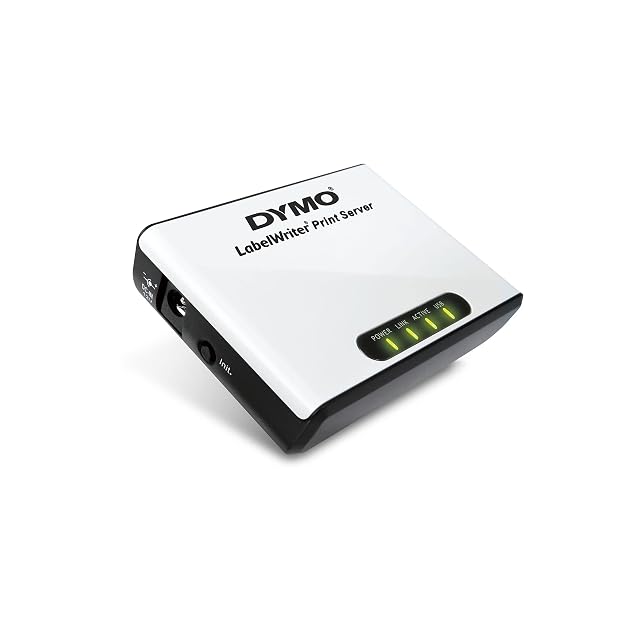
USB to the printer · Ethernet to the network, unrated · one printer · software in five languages · limited to LabelWriter 450-series machines · no protocols published
A print server sold for one range of label printers, which makes it the only unit here whose compatibility is bounded in writing rather than described.
Best for: An office already running a LabelWriter of the 450 series on one desk, where everyone else needs to print to it without moving the printer.
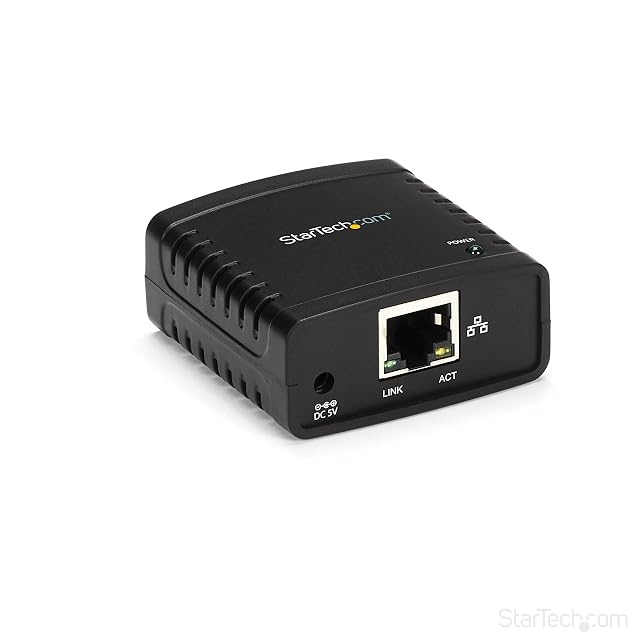
one USB 2.0 printer · 10BASE-T and 100BASE-TX auto-sensing · LPR and Bonjour named · Mac and Windows, no versions · network lead supplied · no model list
A one-printer server that names the two Ethernet designations behind its 10/100 and the two printing protocols it speaks, and publishes no list of printers.
Best for: A home or small office with one USB printer and a mixture of Mac and Windows machines, where Bonjour is what those machines already use to find things.