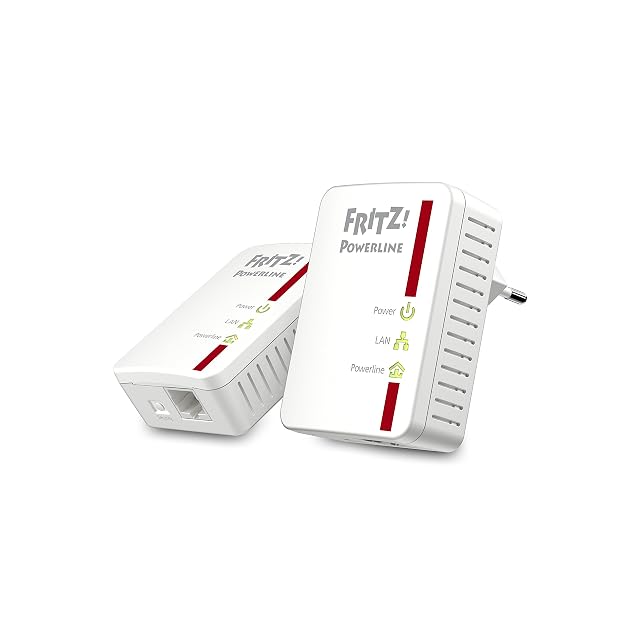
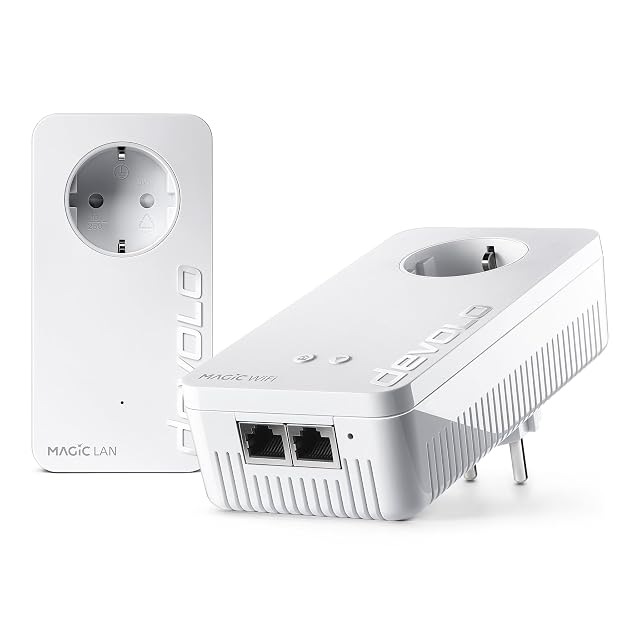
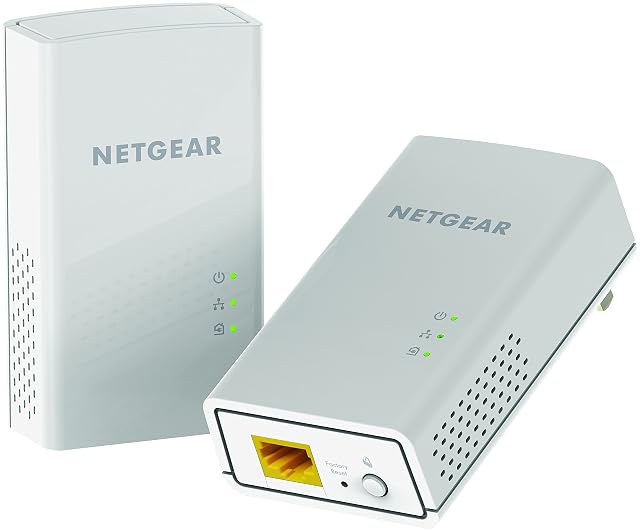
The fifth bullet gives two gigabit Ethernet ports, and the title confirms it: two per unit, which across the pair is four sockets in one box. The published TP-Link kit on this shelf gives one per unit. The devolo kit gives two across a three-unit set. The FRITZ! kit gives three across two units. Four is the most on this shelf, and on a kit meant to serve a television and a games console in the same room it is the figure that matters more than the headline.
That headline is AV2000, which the description explains with unusual care. The term “is derived from applicable specifications and refer to the theoretical maximum physical-layer data transfer rate” and is used “solely to indicate its compatibility with other AV2000 PowerLine devices”; actual speeds vary and are limited by the product’s Ethernet port and by traffic, electrical noise and wiring. That is the maker stating that its own headline is a compatibility label rather than a speed — and it is the clearest version of that sentence on this shelf.
Two thousand is the highest HomePlug figure here. It is not the highest figure here: the devolo kit publishes 2400 Mbit/s, and does so on G.hn, which is a different specification that the same devolo page states is not backwards compatible. HomePlug and G.hn cannot be paired, so the two numbers are not rivals — they are ceilings in different systems, and which one applies depends on what is already plugged in.
The eighth bullet lists what this kit will pair with: all AV2000, AV1300, AV1200, AV1000, AV600, AV500 and AV200 adapters. Seven generations named individually. No other listing on this shelf publishes a compatibility list of that length, and it is the sentence that decides whether an older adapter already in the house can stay.
The third bullet gives a pass-through outlet with noise filtering — the published TP-Link kit here publishes the same at 16 A, and no other listing on this shelf has one at all. The second gives 750 feet of reach, which with the add-on unit of the cheaper range makes two listings here publishing a distance against five that publish none.
The fourth bullet carries the AFCI warning: performance may be limited or blocked in houses with arc-fault breakers, standard in many homes built after 2000, and powerline may not work with routers running modified or open-source firmware. The third gives the usual conditions — a wall socket directly, the same circuit, no strips, no surge protectors, no extension leads, away from large appliances.
The description adds 2×2 MIMO, transferring data on two streams, and beamforming to strengthen the signal towards other powerline devices. It also gives the dimensions as 5.2 by 2.8 by 1.7 inches, which is 132 by 71 by 43 mm (1.69 in) and matches the product record exactly — one of the few listings on this shelf where the two agree.
There is no Wi-Fi: the fifth bullet suggests an Ethernet switch, sold separately, for more connections rather than a wireless access point. At $79.99 on Amazon.com on October 26, 2026 it was the most expensive kit here after the two NETGEAR kits, and the only one of the three with two sockets per unit and a pass-through outlet.
Prices quoted in this text were read on October 26, 2026. The live price is at the top of the page.