Skip to content

AVM FRITZ!Powerline 510E Set, 500 Mbit/s over the mains into a Fast Ethernet socket review

A two-unit set encrypted before it leaves the factory, whose mains figure is five hundred and whose socket is named Fast Ethernet without a number.

The bottom line A simple wired pair, closed from the factory and supplied complete with both leads. The socket is the limit and the page names it without rating it, which is the one line to read carefully.

On the listing

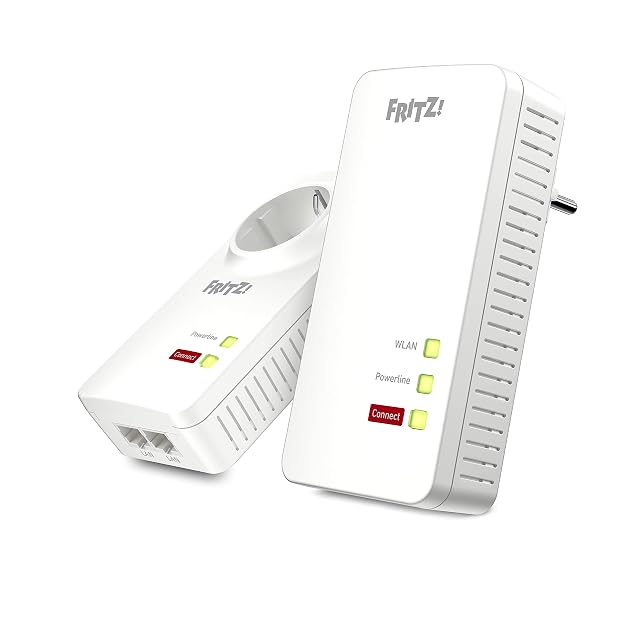
A powerline set at 500 Mbit/s with a Fast Ethernet LAN connection, described as fast data transfer over the mains wiring in a German-language version; internet and network at every socket in the household, carried into distant rooms; connections for a FRITZ!Box, computer, printer, television, hi-fi, games console, media player and other network devices, with IPv6 support named; a robust powerline connection of up to 500 Mbit/s with an integrated Fast Ethernet LAN connection joining network devices to the powerline network; ready to use with no software installation, encrypted individually and securely with AES 128-bit at the factory; and a box holding two FRITZ!Powerline 510E units, two network leads of 1.80 m and an installation guide.

Five hundred over the mains, Fast Ethernet at the socket

500 Mbit/s on the powerline side. Fast Ethernet on the cable side. The second is a name rather than a number, and the page never converts it. What the pairing establishes is that the socket is the narrower of the two links, which is the same shape of answer as the 600-and-100 kit on this shelf, arrived at with one figure instead of two.

The maker name and the product name

This set is recorded on the measurement under the maker name AVM and sold under the FRITZ! product name, and both appear on this page for that reason. The kit sitting beside it on this shelf carries the FRITZ! name in the maker field instead. Nothing is concluded from the difference here; it is written down so that a reader who notices it is not left wondering.

The standard that is never named

Not one specification name appears. That is a real gap on a family where the whole question of adding a third adapter later turns on which family the first two belong to. Compatibility here is asserted through the maker rather than through the standard, and only for its own equipment.

Encrypted before it leaves the factory

Individually and securely, with AES 128-bit, out of the box. No pairing ritual, no default key to change, nothing to remember. On a device that ends up behind a sofa for five years, a default that is already correct is worth more than a feature that has to be switched on.

Before ordering

Decide whether the far end is a printer or a television. The socket is a Fast Ethernet one, and the difference between those two devices is exactly the difference between that mattering and not.

Availability

No store we queried had a live offer for it the day this page was written.

In the German, American, British, French, Italian and Spanish Amazon catalogues with no live offer against it: the reference exists, nobody is filling it.

Every figure in this section is what Keepa held on the day this page was last updated. Stock and prices move without warning.
Where it holds up, and where it stops

Strengths

  • Encrypted with AES 128-bit at the factory rather than after a button press, so the link is closed from the first time it is plugged in
  • Both leads are supplied and their length is printed, 1.80 m, which is more than most kits here bother to say
  • IPv6 is named, which on a device that quietly passes traffic is worth knowing before a network is planned around it

Compromises

  • The socket is named Fast Ethernet and never rated, so the ceiling that everything plugged in will meet is left as a word
  • No powerline standard, so nothing on the page says what a third adapter would have to be
  • No pass-through outlet on either unit, and two sockets are occupied permanently

Specifications

Powerline standardNot published on the listing — neither HomePlug nor G.hn nor any other specification name appears in the title or in any of the five bullets, which leaves the compatibility of a third unit entirely open
Stated peak rate500 Mbit/s — stated in the title and in the third bullet as a robust powerline connection of up to 500 Mbit/s. The figure describes the mains link as the specification behind it defines it, and the wiring of the building settles what happens on it
Pass-through socketNot published on the listing — no integrated outlet, no current rating and no note about the socket being given back appears anywhere on the page
Ethernet port countNot published on the listing as a count — the third bullet names an integrated Fast Ethernet LAN connection in the singular, and no figure appears in the title or in any bullet
Port speedFast Ethernet — named in the title and in the third bullet, and never given a figure. The name carries a rate that the page declines to print, which is the reverse of the usual omission in this family
Kit compositionTwo FRITZ!Powerline 510E units, two network leads of 1.80 m and an installation guide — stated in the fifth bullet
Wi-Fi at the far endNot published on the listing — no wireless, no band and no access point appears in the title or in any of the five bullets, on a set described entirely as a wired extension
Stated maximum number of paired unitsNot published on the listing — the set is described as joining a router, computer, printer, television, hi-fi, games console and media player, and nothing says how many adapters may be joined at once
Amazon referenceB00AAO1AVO (same reference on 6 Amazon marketplaces)
EAN4023125025754

The questions that come up before an order

What does encrypted at the factory change?

It means the two units in the box already share a key and will not accept a stranger without a deliberate pairing. A kit that is open until a button is pressed depends on the button being pressed. This one is closed on arrival, which is the safer default for a device that lives behind a cupboard and is forgotten.

What rate does the name Fast Ethernet carry?

It is the name of the hundred-megabit generation of Ethernet over copper, and it has meant that since long before this product. The page uses the name and never prints the figure, so the figure is not quoted here as though it had been published. What the page does establish is that the socket is not a gigabit one.

Every price named in a summary was read on the date that review carries. What a shop asks today is shown beside the product, and it moves.