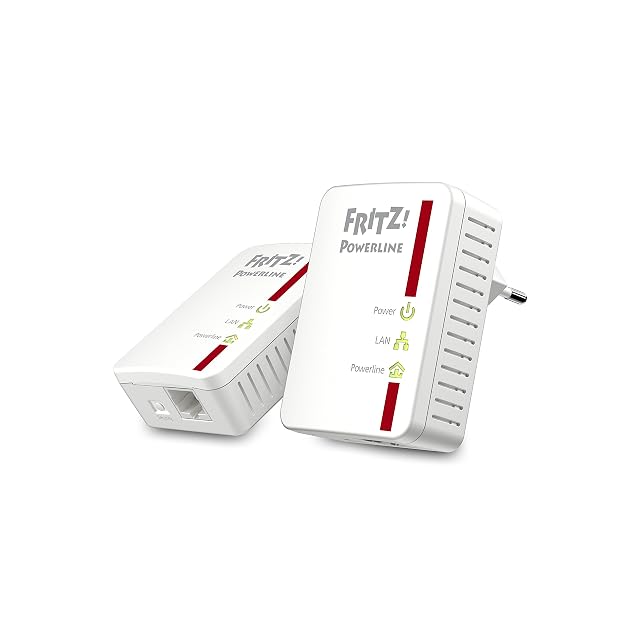
It is a European model with no Amazon.com offer on October 26, 2026. It is sold on the European Amazon stores, often with a European plug or power adapter, and a US buyer would be relying on an importer.
Models on this shelf that Amazon.com did sell on that date:
A wireless powerline starter kit given as up to 2400 Mbit/s with two gigabit LAN connections and dLAN 2.0 named in the title; mesh wireless of up to 1200 Mbit/s covering every room without a break, alongside a powerline speed of up to 2400 Mbit/s; powerline described as carrying the internet through ceilings and walls into every room; the newest G.hn generation, not backwards compatible, combinable with every devolo Magic adapter and not supporting adapters of the dLAN range; and a box holding two devolo Magic 2 WiFi next units, one devolo Magic 2 LAN unit, an installation guide, an Ethernet lead and a webcam lens cover or cleaning cloth.
G.hn, and the name in the title that contradicts it
The third bullet: the dLAN range is not supported. The title: dLAN 2.0. Three lines apart, on the same page. Both are printed here and neither is chosen. What can be said without choosing is that the bullet is the one written in the language of a specification, and that a buyer with older adapters in a cupboard has one question to ask before ordering.
Three units, one lead
Two wireless adapters, one wired adapter, and a single Ethernet lead between the three of them. The lead goes from the router to the Magic 2 LAN unit, because that is the connection the kit cannot work without. Everything plugged into the other two comes out of a drawer.
Two rates for two different paths
2400 over the mains, 1200 over the air. Printed separately, in the same bullet, without being added together. Both are figures the respective specifications define rather than rates anything obtains, and keeping them apart is what lets a reader see which link is which.
Before ordering
Work out which room takes the wired unit. It has to be within a cable of the router, and the kit ships with exactly one cable to make that happen.
Not a kit for American outlets
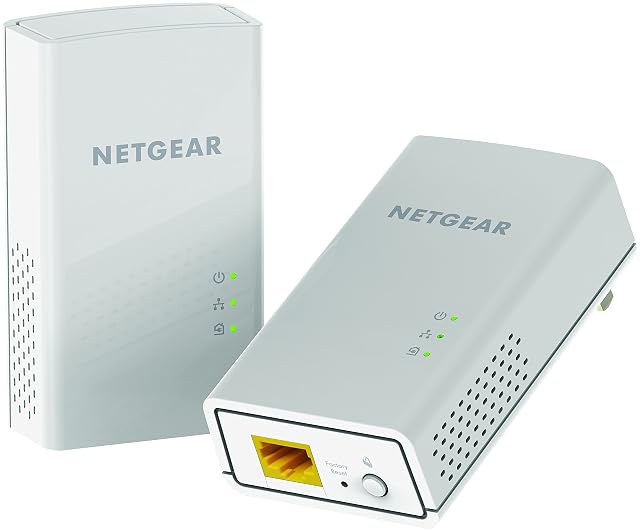
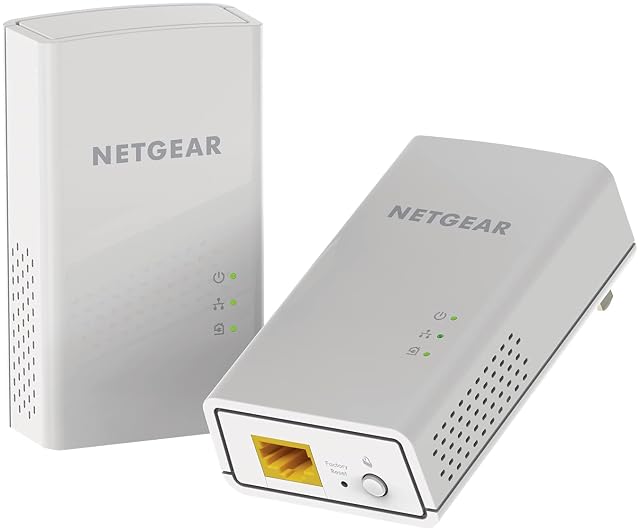
This kit is sold on the European Amazon stores and has no Amazon.com listing. Powerline adapters plug straight into the wall, and a European unit is made for European outlets. For an American home, the TP-Link, NETGEAR, Tenda and ReadyNet kits on this shelf are the ones sold on Amazon.com.
Where it holds up, and where it stops
Strengths
Names the specification, G.hn, and states that it is not backwards compatible, which is the sentence that stops a wrong second purchase
Three units in a starter kit rather than two, so two rooms gain wireless and a third gains a wired socket
Publishes the mains figure and the wireless figure separately, 2400 and 1200, rather than folding them into one number
Compromises
The title prints dLAN 2.0 and the third bullet says the dLAN range is not supported, and nothing on the page settles it
One Ethernet lead for three adapters, so two more have to be found before the kit is fully in use
The two gigabit sockets are never assigned to a unit, so which box carries them is unknown before it arrives
A European model for European outlets, not sold on Amazon.com
Specifications
Powerline standard
G.hn — stated in the third bullet as the newest G.hn generation, not backwards compatible, combinable with every devolo Magic adapter and explicitly not with adapters of the dLAN range. The title of the same listing prints dLAN 2.0 among its features, and nothing on the page reconciles the two
Stated peak rate
2400 Mbit/s over the mains — stated in the title and in the first bullet. It is the theoretical figure the G.hn specification defines across the conductors it can use, and the electrical path between two sockets settles what happens on it
Pass-through socket
Not published on the listing plainly — the title includes the word for a mains outlet inside the product description, and no bullet describes an outlet on the front of an adapter, gives it a current rating or says which of the three units carries one
Ethernet port count
Two — stated in the title as two gigabit LAN connections. The title does not say whether that is per unit or across the kit, and no bullet returns to the question
Port speed
Gigabit — stated in the title as gigabit LAN connections; no BASE-T designation and no figure in Mbit/s is printed
Kit composition
Two devolo Magic 2 WiFi next units, one devolo Magic 2 LAN unit, one installation guide, one Ethernet lead and one webcam lens cover or cleaning cloth — stated in the fourth bullet. Three adapters and one network lead between them
Wi-Fi at the far end
Yes — mesh wireless of up to 1200 Mbit/s, stated in the first bullet as covering every room without a break, on the two WiFi next units
Stated maximum number of paired units
Not published on the listing as a number — the third bullet names a family rather than a limit: every devolo Magic adapter may be combined, and the dLAN range may not
Amazon reference
B086B2GZ1F
EAN
4250059686342
On Amazon.com
It is a European model with no Amazon.com offer on October 26, 2026.
The questions that come up before an order
What does not backwards compatible mean for adapters already in the house?
That they will not join this kit. G.hn and the older powerline families do not talk to each other, and the third bullet says so directly: the Magic range yes, the dLAN range no. Any adapter already plugged in somewhere has to be checked against that line before this kit is ordered, whatever the title says.
Why does a starter kit contain three units?
Because two of them do wireless and one does not. The two WiFi next adapters raise coverage where they are plugged in, and the Magic 2 LAN unit is the one that sits beside the router and takes the cable from it. That is a three-room arrangement out of one box, and it is why only one Ethernet lead is supplied.
Our score
8.4/ 10
The largest kit in this group by unit count and the clearest about the specification it uses, except in its own title. The single Ethernet lead for three adapters is the practical thing to plan around.
The buyer this one serves, among network and storage gear
A house where two floors both need coverage and one room needs a cable, and where nothing older from the same maker has to be kept working.
What this one costs among network and storage gear
A reference exists on these Amazon stores: France, Germany, Italy, Spain, United Kingdom. Listed is not the same as in stock — availability changes daily.
Details checked on October 26, 2026.
Sources
Specifications: the manufacturer sheet for network and storage gear and the matching Amazon product page. Prices and availability: Keepa. Every figure on this page names its source.
500 Mbit/s stated · Fast Ethernet socket, unrated · no standard named · no pass-through outlet · two units, two 1.80 m (6 ft) leads · AES 128-bit from the factory
A two-unit set encrypted before it leaves the factory, whose mains figure is five hundred and whose socket is named Fast Ethernet without a number.
Best for: A room where a printer, a games console or a media player needs a wired connection and where a hundred-megabit socket is not the constraint.
HomePlug AV2 MIMO · 1200 Mbps stated · no pass-through outlet · one gigabit socket per unit · two units · up to SIXTEEN adapters · pick-a-plug LED · 100–240 V at 50/60 Hz
The only listing on this shelf that publishes how many adapters may be joined to one network — sixteen — alongside beamforming, a signal-strength LED and a published mains range.
Best for: A house that will grow to three or four powerline rooms, where knowing the ceiling is sixteen and seeing which socket works are worth more than a headline figure.
HomePlug AV2 · 1000 Mbps stated · no pass-through outlet · one gigabit socket per unit · two units · no Wi-Fi, despite two bullets saying otherwise · 100–240 V at 0.1 A published
A gigabit powerline pair that publishes its mains input — the first figure of its kind on this shelf — on a page whose first and last bullets describe a wireless model this product is not.
Best for: A buyer who wants the mains consumption bounded on paper and will ignore the two bullets describing the wireless model.