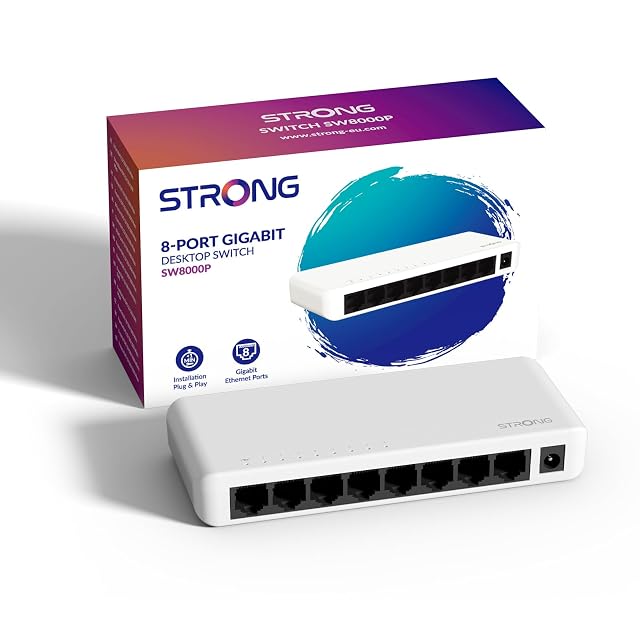
The bottom line A plainly described eight-socket switch that answers the question most buyers get wrong, by saying outright that it does not carry power. What it leaves out — the case, the supply, any capacity figure — matters less on a desk than it would in a cupboard.
On the listing
Eight RJ45 sockets with indicator lights, automatic negotiation across 10/100/1000 Mbit/s, full-duplex and half-duplex working, automatic MDI/MDIX, a stated maximum of 1000 Mbit/s, plug and play with no driver, a note that PoE is not supported, compatibility given as Windows, macOS, Linux, Android and iOS, desk placement or wall-mounting holes on the rear, a fanless design, and a standards line naming IEEE 802.3, 802.3u, 802.3x and 802.3ab.
The sentence worth reading twice
PoE is not supported. It sits in brackets at the end of the third bullet, and it is the most useful line on the page. A buyer whose camera or access point expects power over its network cable will get a link and no power from this unit, and most listings at this price leave that to be discovered.
What is not counted
A switching capacity is the sum of every socket running at full rate in both directions at the same time. That is how the quantity is defined, and it is what tells a buyer whether the unit can carry all its sockets at once rather than a few. This page prints no such figure at all, so the only rate on it belongs to one socket.
The case, and the wall
The mounting holes are described, the material around them is not. On a shelf that hardly matters. On a wall in an unheated cupboard it decides how the unit sheds heat, and this page leaves the question open.
Before ordering
Ask the seller whether a power adapter is in the box. Nothing on the page lists the contents, and a switch that arrives without its supply is a switch that waits a week.
Availability
Priced from 14 € to 19 € across the German, French, Italian and Spanish Amazon stores the day this page was checked.
In the American and British Amazon catalogues with no live offer against it: the reference exists, nobody is filling it.
Every figure in this section is what Keepa held on the day this page was last updated. Stock and prices move without warning.
Prices quoted in this text were read on 10 September 2026. The live price is at the top of the page.
Where it holds up, and where it stops
Strengths
Names the Ethernet standards individually — 802.3, 802.3u, 802.3x and 802.3ab — rather than printing the word gigabit and stopping there
Says in the third bullet, in as many words, that PoE is not supported, which is the one thing a buyer of a cheap switch most often assumes wrongly
Fanless is stated rather than implied, on a unit sized for a desk in a room where people sit
Compromises
No switching capacity anywhere, so the figure that would show whether all eight sockets can run flat out together is absent
The case material is left out on a unit that is meant to hang on a wall, where a metal shell and a plastic one behave differently
Nothing says what comes in the box, so whether a power adapter is included cannot be read before ordering
Specifications
Port count
Eight — stated in the title as an eight-port unit and counted again in the first bullet as eight RJ45 sockets, each with an indicator light
Port speed
10/100/1000 Mbit/s, negotiated automatically, with 1000 Mbit/s given as the maximum — stated in the first and third bullets, alongside full-duplex and half-duplex working and automatic MDI/MDIX. The standards line names IEEE 802.3, 802.3u, 802.3x and 802.3ab, the last of which is the gigabit-over-copper one
Managed or unmanaged
Not published on the listing as either word — the unit is described as plug and play with no driver required, and no configuration page, VLAN, port mirroring or traffic priority is named in any of the five bullets
Stated switching capacity
Not published on the listing — no whole-unit figure in Gbit/s appears, and the fastest number on the page is the 1000 Mbit/s ceiling of one socket
Fanless or fan-cooled
Fanless — stated in the fifth bullet as a fanless design, tied to silent running and to lower consumption
Case material
Not published on the listing — the fourth bullet describes where the unit goes rather than what it is made of, naming desk placement and wall-mounting holes on the back
Desktop or rack mounting
Desk or wall — stated in the fourth bullet, with the mounting holes on the rear panel; no rack ears and no rack unit height are named
Power supply type
Not published on the listing — neither an external adapter nor an internal supply is named in the title or in any bullet, and the box contents are not listed
Amazon reference
B0D9H7PLK4 (same reference on 6 Amazon marketplaces)
EAN
6941876253500
The questions that come up before an order
What does automatic MDI/MDIX do?
It lets the socket work out for itself which pairs in the cable are transmitting and which are receiving, so a straight lead and a crossover lead both work. It is the reason a modern switch can be wired by anyone, and this listing names it in the first bullet.
Does 802.3ab tell a buyer anything the word gigabit does not?
It names the standard the socket follows for gigabit speed over twisted-pair copper, which is what a cable of category 5e or better carries. The marketing word and the standard describe the same socket; the standard is the half that can be checked against a cable already in the wall.
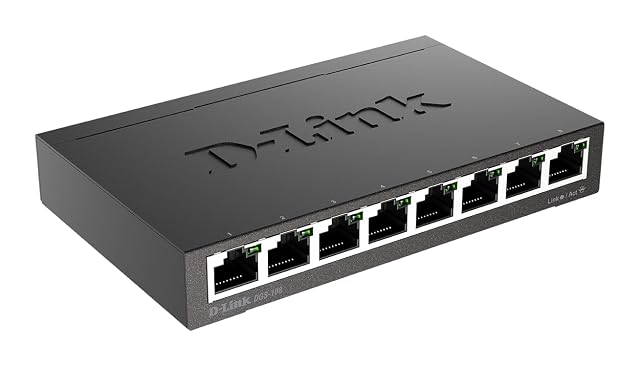
eight gigabit sockets · up to 2000 Mbit/s per socket in full duplex, stated · non-blocking architecture · Layer 2 · fanless · metal case, black
An eight-socket gigabit switch whose headline figure counts both directions of one socket at once, and which never says where the unit is meant to be mounted.
Best for: A shelf or a desk where the unit can simply sit, and where multicast television and a quiet metal case matter more than knowing how it mounts.
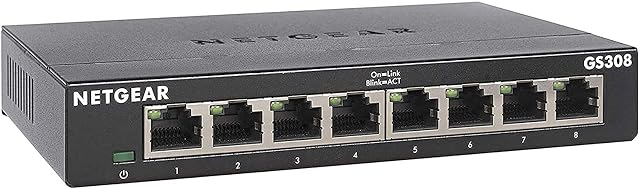
eight sockets at 1.0 Gbps · unmanaged, stated · Layer 2 · Cat5e or Cat6 named · fanless · metal case · on-off switch
An eight-socket unmanaged switch that names the cable grades its sockets expect and puts a power switch on the case, and publishes no figure for the unit as a whole.
Best for: A cupboard or a desk where the switch will occasionally need restarting, and where the wiring is already Cat5e or Cat6 and expected to stay that way.
An eight-socket gigabit switch that publishes both the material of its case and a switching capacity, which is two answers more than most of this shelf gives.
Best for: A room that needs eight quiet wired sockets and a unit light enough to hang on a wall, where a plastic shell is a fair trade for the price.