Continuity, wire map and length are three different instruments in one word · review
Tolesum multifunction RJ45 tester with an LCD screen, PoE checking and a torch review
A screen-based tester that checks power on a live socket, measures the voltage and current a device draws, and reports faults on an LCD rather than on a row of lights.
The bottom line The tester on this shelf for a network that carries power, with the af and at standards, voltage, polarity and current all covered. The silence about its own cells is the one small carelessness on a careful page.
On the listing
A complete RJ45 cable tester offering POE, CONT, Power and Loopback tests with a built-in light, for Cat 5e, Cat 6 and Cat 6a leads, fitted with an RJ45 remote interface described as needing no extra preparation; PoE and loopback analysis built for standard PoE equipment, covering the af and at standards, supply voltage, polarity and mode, withstanding up to 60 V DC, detecting and switching between 10M, 100M and 1000M modes, and offering cable tracing, short circuit checking and open circuit checking; cable checking with the lead plugged into the transmitter, with short circuits, crossings and breaks found automatically and shown on the LCD screen for accurate location of a line and a port, and with voltage and current between the supply and the attached device measured and the power drawn worked out; a portable design gathering the functions into one unit with a carrying case, and adjustable backlight time and automatic switch-off; a built-in light for working in poorly lit places, with cells not supplied; and a note to remove the screen protector before use, with cells not supplied.
Five tests on one screen
POE, CONT, Power, Loopback, and a torch. The first bullet lists them as a set rather than as a claim, and the LCD is what makes the set possible: a row of lights can report an order and a screen can report a value. That is the line between the two halves of this shelf.
Sixty volts, withstood
The rating that matters on a live network. A socket carrying power over its network cable can be checked with this instrument attached to it, which is the whole reason the af and at standards, the polarity and the mode appear on the page at all. Everything else here tests a lead that has been unplugged.
Locating a port is not measuring a length
The third bullet promises accurate location of a line and a port. That is a matter of finding which socket a cable ends at, and it is a genuinely useful thing in a cupboard full of them. It is not a distance measurement, and nothing on this page reports how far along a run a fault sits.
Before ordering
Ask which cells it takes. The page says twice that they are not included and never once says what they are.
Availability
Priced from 36 € to 42 € across the German, French, Italian and Spanish Amazon stores the day this page was checked.
In the American Amazon catalogue with no live offer against it: the reference exists, nobody is filling it.
The British Amazon store returned nothing at all, so the buy button there opens a search in that country rather than a page that would not load.
Every figure in this section is what Keepa held on the day this page was last updated. Stock and prices move without warning.
Prices quoted in this text were read on 10 September 2026. The live price is at the top of the page.
Where it holds up, and where it stops
Strengths
Checks a live socket before anything is unplugged, covering the af and at standards with voltage, polarity and mode
Works out the power drawn between the supply and the device, which is what tells you whether a camera is getting what it asks for
A carrying case is in the box, and the backlight time and automatic switch-off are both adjustable
Compromises
Cells are excluded twice and never described, so what to buy alongside it is unknown
No distance measurement, so a fault is named but not located along a run
RJ45 only, with no telephone or coaxial connector, unlike the simpler units on this shelf
Specifications
Tester type
A multifunction tester with an LCD screen — the first bullet names the tests as POE, CONT, Power and Loopback with a built-in light, and adds an RJ45 remote interface. It reads out on a display rather than through a row of indicator lights
Connector types accepted
RJ45 — stated in the title and in the first bullet, with Cat 5e, Cat 6 and Cat 6a leads named. No telephone connector and no coaxial connector appears anywhere on the page
Wire map detection
Yes — the third bullet says the unit automatically finds short circuits, crossed conductors and breaks and shows the result on the LCD screen
Split pair detection
Not published on the listing — the faults named are short circuits, crossings and breaks, and a pair that is continuous but wrongly twisted is not among them
Length reporting
Not published on the listing — no distance and no measurement in metres appears anywhere. The third bullet names accurate location of a line and a port, which is a question of finding a cable rather than of measuring one
Tone and probe function
Named as a function without a named part — the second bullet names cable tracing among what the unit does and the third names a transmitter and a cable finder. No separate probe is listed among the contents and no tone frequency is published
Remote units supplied
One — the first bullet names an RJ45 remote interface described as needing no additional preparation
PoE detection
Yes — the second bullet states testing of standard PoE equipment covering the af and at standards, supply voltage, polarity and mode, withstanding up to 60 V DC, with automatic detection and switching between 10M, 100M and 1000M modes. The third adds that the unit measures voltage and current between the supply and the attached device and works out the power drawn
Power source
Not published on the listing — cells are said twice, in the fifth and sixth bullets, not to be included, and neither the type nor the number is ever given
Amazon reference
B0FKFXCFN1 (same reference on 5 Amazon marketplaces)
EAN
4895232028122
The questions that come up before an order
What does withstanding 60 V DC describe?
The voltage the tester can be presented with without damage when it is plugged into a live socket carrying power over the network cable. It is a rating of the instrument rather than of the network, and it is what lets a socket be checked before the device on it is disconnected.
Does an instrument that reports a fault also certify the run?
No. Finding a short, a crossing or a break says the run is broken in a particular way. Certifying it means measuring its performance against the published limits of a category and issuing a result, which is a different instrument at a different price. Nothing on this page claims the second thing, and this page is not read here as though it did.
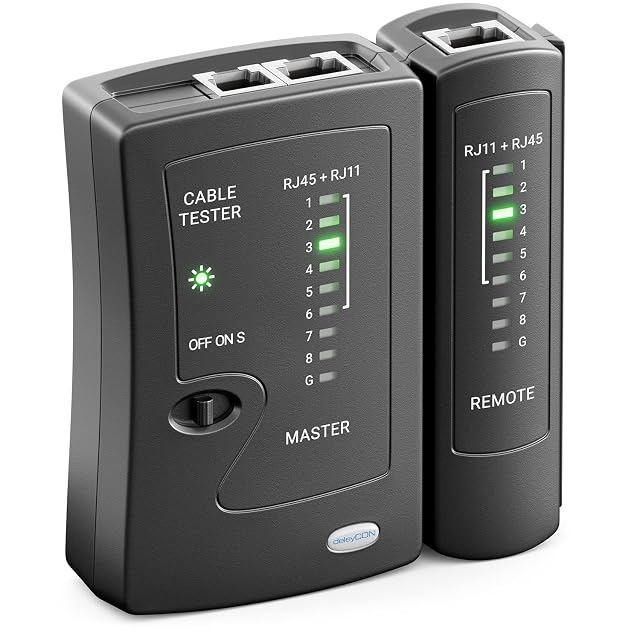
continuity tester · RJ11, RJ12 and RJ45 · ISDN and Cat 6 to Cat 8 named · four named faults · lights for eight conductors on the remote · no power source stated
A continuity tester that names the four faults it looks for one by one, and never says what it runs on.
Best for: A house with both telephone and network wiring in the walls, where a single tester should cover the older sockets as well as RJ45.
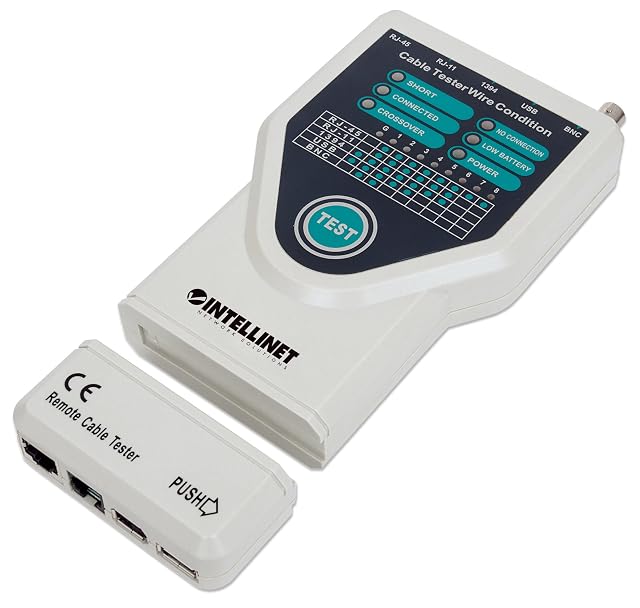
continuity tester · RJ45, RJ11, USB A and B, six-pin FireWire and coaxial · lights for eight conductors and the shield · three faults named · case and coaxial adapter supplied · no remote listed
A tester that reaches beyond network leads to USB, FireWire and coaxial, and whose contents list holds a case and an adapter and no remote unit.
Best for: A bench or a workshop drawer of assorted leads, where the network cables are only part of what needs checking and everything is within reach.
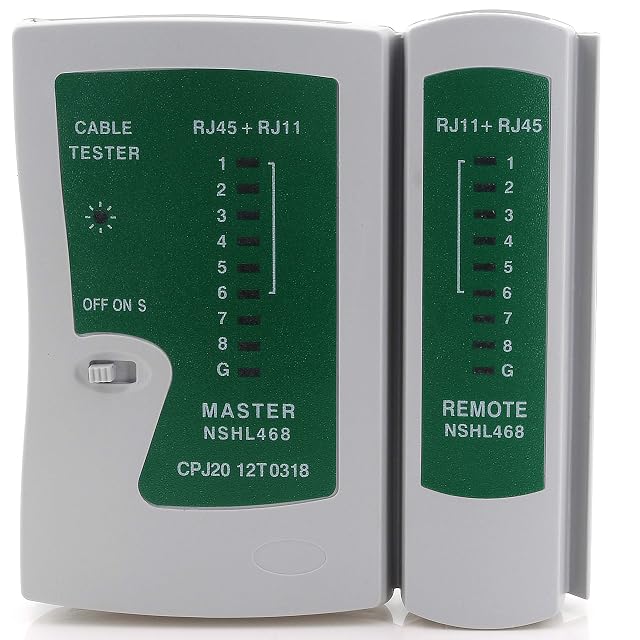
continuity tester · RJ11, RJ12 and RJ45 · separate lights for pins 1 to 8 and for ground · shielding scanned automatically · scan speed low or high · 9 V block, not supplied
A two-piece tester that gives ground its own indicator alongside the eight pins, scans the shield automatically, and lets the scan speed be set.
Best for: Shielded leads and shielded sockets, where whether the screen is actually connected is as much a question as whether the eight conductors are.