The bottom line A straightforward RJ45 checker whose scan speeds are a genuine and unusual feature. What is missing from the page is the detail that would say how precisely it names a fault.
On the listing
Quick checking of a cable connection, named for testing RJ45 network leads to find problems such as breaks and miswiring; compatibility with Cat 7, Cat 6 and Cat 5 network leads for home networks, offices and installation work; two test speeds, switchable between a fast and a slow mode for reliable diagnosis and quick fault clearing; a split design of a master unit and a remote unit allowing a lead already run through a building to be checked from either end; and operation on two AAA cells, not supplied, with no mains connection needed and portable use named.
Fast and slow, and why a tester has two speeds
Switchable between a fast and a slow mode. The fast one sorts a pile of leads. The slow one steps through the conductors at a pace an eye can follow, which is what catches a contact that only just makes. Nothing else in this group publishes the choice, and it is the reason to prefer this unit over the other simple ones here.
Both ends of a cable already in the wall
The fourth bullet gives the split design its proper justification: a run that is installed cannot be brought to the bench, and a remote at the far end means one person can do the job by walking. That is the whole reason the second box exists on every tester on this shelf, and this is the page that says it out loud.
What the lights are never counted as
Breaks, miswiring, reliable diagnosis. All effects, no mechanism. Whether each conductor gets its own indicator is not stated anywhere, and on a unit of this kind that is the difference between being told which conductor is wrong and being told that one is.
Before ordering
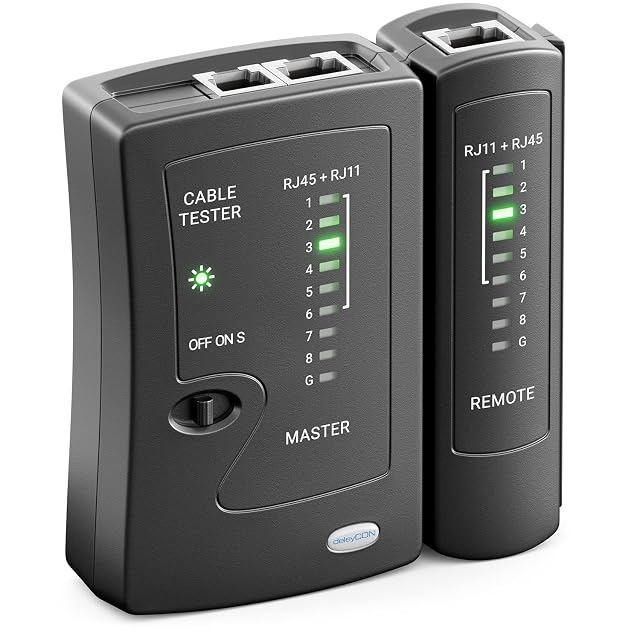
Look at the photograph for the row of indicators. The text describes what the tester finds and never says how it shows it.
Availability
Priced from 9 € to 13 € across the German, French and Spanish Amazon stores the day this page was checked.
In the Italian Amazon catalogue with no live offer against it: the reference exists, nobody is filling it.
The American and British Amazon stores returned nothing at all, so the buy button there opens a search in that country rather than a page that would not load.
Every figure in this section is what Keepa held on the day this page was last updated. Stock and prices move without warning.
Prices quoted in this text were read on 10 September 2026. The live price is at the top of the page.
Where it holds up, and where it stops
Strengths
Two switchable scan speeds, which is the one feature on this page nothing else in the group offers in the same words
A split master and remote design stated as such, with the reason given: a lead already in the wall can be checked from either end
Names three cable grades and the connector, so what fits and what is meant to be tested is readable in the first two bullets
Compromises
Nothing says how many conductors are shown separately, which is the difference between naming a fault and reporting one
RJ45 only, so telephone leads and the older sockets accepted by three other units here are outside its range
No tone and probe and no mention of power on the line, which are the two features that would take it beyond the bench
Specifications
Tester type
A continuity tester in two pieces — the fourth bullet describes a split design of a master unit and a remote unit. No screen, no distance measurement and no display of any kind is named in the title or in any of the five bullets
Connector types accepted
RJ45 — stated in the title and in the first bullet; Cat 7, Cat 6 and Cat 5 network leads are named in the second. No RJ11 or RJ12 socket and no coaxial connector is mentioned
Wire map detection
Named as a result rather than as a count — the first bullet says the unit finds connection problems such as breaks and miswiring, and no bullet says how many conductors are indicated separately or whether each has its own light
Split pair detection
Not published on the listing — the faults named are breaks and miswiring, and a pair that is continuous but wrongly twisted is neither of those and appears nowhere on the page
Length reporting
Not published on the listing — no distance, no screen and no measurement appears anywhere; the two test speeds change how the check is run rather than what it reports
Tone and probe function
Not published on the listing — no tone generator and no probe is named, so a lead can be checked end to end but not traced through a bundle
Remote units supplied
One — stated in the fourth bullet, which gives checking a lead already run through a building as the reason for the split design
PoE detection
Not published on the listing — power over the network cable is not named in either direction in the title or in any of the five bullets
Power source
Two AAA cells, not supplied — stated in the fifth bullet, which adds that no mains connection is needed and names portable use as the reason
Amazon reference
B0DMT9NKWT (same reference on 4 Amazon marketplaces)
EAN
0792684479608
The questions that come up before an order
What is a slow scan mode for?
It steps through the conductors at a pace a person can follow, so an intermittent fault or a marginal contact shows itself instead of flicking past. A fast pass sorts good leads from bad quickly; a slow pass is what you use on the ones that failed. This page offers both and lets the tester be switched between them.
Why does a missing conductor count matter on a tester like this?
Because the whole value of a two-piece tester is that it names the conductor rather than the lead. Most units at this level show eight lights and this page describes the outcome without saying so. It is reported here as it is published, and it is the first thing to confirm from the photograph.
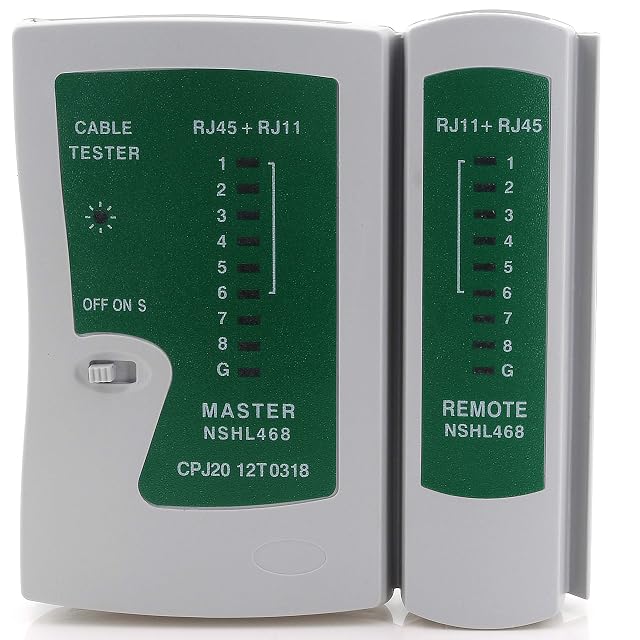
continuity tester · RJ11, RJ12 and RJ45 · ISDN and Cat 6 to Cat 8 named · four named faults · lights for eight conductors on the remote · no power source stated
A continuity tester that names the four faults it looks for one by one, and never says what it runs on.
Best for: A house with both telephone and network wiring in the walls, where a single tester should cover the older sockets as well as RJ45.
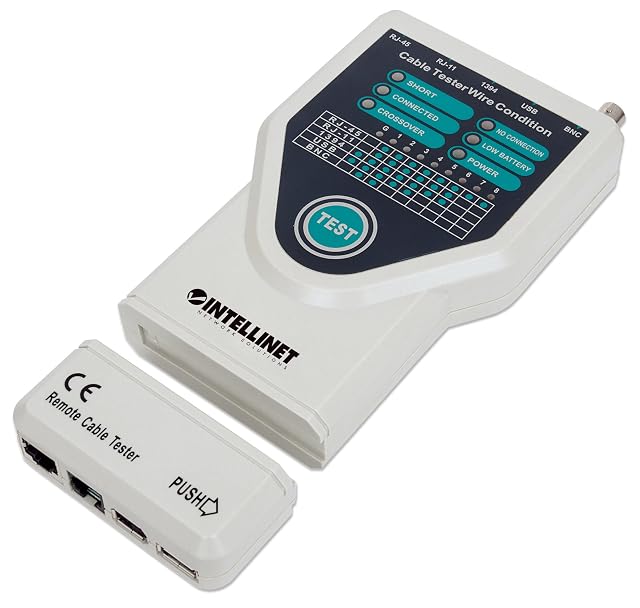
continuity tester · RJ45, RJ11, USB A and B, six-pin FireWire and coaxial · lights for eight conductors and the shield · three faults named · case and coaxial adapter supplied · no remote listed
A tester that reaches beyond network leads to USB, FireWire and coaxial, and whose contents list holds a case and an adapter and no remote unit.
Best for: A bench or a workshop drawer of assorted leads, where the network cables are only part of what needs checking and everything is within reach.
continuity tester · RJ11, RJ12 and RJ45 · separate lights for pins 1 to 8 and for ground · shielding scanned automatically · scan speed low or high · 9 V block, not supplied
A two-piece tester that gives ground its own indicator alongside the eight pins, scans the shield automatically, and lets the scan speed be set.
Best for: Shielded leads and shielded sockets, where whether the screen is actually connected is as much a question as whether the eight conductors are.