Continuity, wire map and length are three different instruments in one word · review
Mcbazel MT-dt-010003, LCD tester for RJ45 with PoE checking and a stated exclusion review
A screen-based RJ45 tester whose last bullet states in writing what it cannot do, and whose second and sixth bullets disagree about what its PoE test measures.
The bottom line A capable screen-based tester with an unusually honest closing bullet and an unresolved contradiction about its own PoE reading. The exclusion is the reason to trust the page and the contradiction is the reason to ask one question.
On the listing
A professional RJ45 network tester checking PoE equipment to the af and at standards including supply voltage and polarity, detecting 10M, 100M and 1000M connections automatically and working with Cat 5e, Cat 6 and Cat 6a leads; automatic identification of short circuits, breaks and crossed connections shown on the LCD, with a loop-back function for return-path problems and a check of voltage and current draw between adapters and attached devices; a built-in continuity test written CONT covering every pair, and a power test analysing supply on the network, both shown clearly on the display; an LCD display and a built-in light for server rooms, cabinets and work under a desk; simple use with the lead plugged into the transmitter and the type of cable and the fault detected automatically, with the screen protector to be removed first; a closing bullet stating that this model contains no cable tracing function, neither toner nor cable finder, and no detection of bandwidth limits, and that the PoE function shows the voltage only and measures neither watts nor amperes; and a calibration procedure using a shielded RJ45 lead between the main unit and the remote unit for the case of pin anomalies at pins 4 and 5 or 7 and 8.
What the sixth bullet rules out
No cable tracing. No toner. No cable finder. No bandwidth limit detection. Written out, in the listing, with a request that the buyer check their own requirement before ordering. Nothing else in this group does that. A page that tells you what it will not do has told you something you can act on.
Voltage only, or voltage and current
The second bullet says the unit checks voltage and current draw between adapters and devices. The sixth says the PoE function shows the voltage and measures neither watts nor amperes. Both are printed and both are reported here. On an instrument bought to answer a question about power, that is the question to settle before it arrives.
The remote that appears in the calibration steps
There is no contents list on this page. The remote unit is mentioned once, inside the instructions for recalibrating the instrument, where a shielded lead is run between the main unit and the remote. That is how its existence is established here, and it is a thin place to have to establish it from.
Before ordering
Ask whether the PoE reading includes current. One bullet says it does and another says it does not, and it is the difference between diagnosing a starved camera and merely confirming that power is present.
Availability
Priced from 39 € to 44 € across the German, French, Italian and Spanish Amazon stores the day this page was checked.
It is stocked on the British Amazon store as well, in that country’s own currency. The range above leaves those out: it counts euro stores and no others.
In the American Amazon catalogue with no live offer against it: the reference exists, nobody is filling it.
Every figure in this section is what Keepa held on the day this page was last updated. Stock and prices move without warning.
Prices quoted in this text were read on 10 September 2026. The live price is at the top of the page.
Where it holds up, and where it stops
Strengths
Rules out cable tracing in writing rather than leaving a buyer to discover it, which is the most useful sentence on the page
Publishes a calibration procedure, key by key, for the case where pins 4 and 5 or 7 and 8 misbehave
Automatic detection of 10M, 100M and 1000M connections alongside the PoE check, so what the socket is running at is read rather than assumed
Compromises
The second bullet says voltage and current are measured, the sixth says voltage only and neither watts nor amperes, and the page never reconciles them
No cells, no rechargeable pack and no contents list anywhere
The remote unit appears only inside the calibration instructions, so what is actually in the box is never stated
Specifications
Tester type
A multifunction tester with an LCD screen — the first four bullets name a PoE test, a continuity test written CONT, a power test and a loop-back function, with results shown on the display and a built-in light for dark places
Connector types accepted
RJ45 — stated in the title and in the first bullet, with Cat 5e, Cat 6 and Cat 6a leads named. No telephone connector and no coaxial connector appears anywhere on the page
Wire map detection
Yes — the second bullet says the tester identifies short circuits, breaks and crossed connections automatically and shows them on the LCD; the sixth names pin anomalies at pins 4 and 5 or 7 and 8 in its calibration instructions, which is the finest detail of pin behaviour published in this group
Split pair detection
Not published on the listing — the faults named are short circuits, breaks and crossings, and a pair that is continuous but wrongly twisted is not among them
Length reporting
Not published on the listing — no distance and no measurement in metres appears in the title or in any of the seven bullets
Tone and probe function
No — the sixth bullet states in as many words that this model contains no cable tracing function, naming both a toner and a cable finder, and no detection of bandwidth limits. It is the only page in this group to rule a function out in writing
Remote units supplied
One — a main unit and a remote unit are named in the calibration procedure of the sixth bullet, which asks for a shielded RJ45 lead between the two. No contents list appears elsewhere on the page
PoE detection
Yes, described two ways. The first bullet gives testing of PoE equipment to the af and at standards including supply voltage and polarity, with automatic detection of 10M, 100M and 1000M connections; the second adds that the unit checks voltage and current draw between adapters and attached devices; the sixth states that the PoE function shows the voltage only and measures neither watts nor amperes. Both statements are recorded here and neither is chosen
Power source
Not published on the listing — no cell type, no cell count and no rechargeable pack appears in the title or in any of the seven bullets
Amazon reference
B0CHRTHX9N (same reference on 6 Amazon marketplaces)
EAN
4895232020874
The questions that come up before an order
Why is a written exclusion worth as much as a feature?
Because the most expensive mistake on this shelf is buying an instrument for a job it does not do. The sixth bullet names two functions the model does not have, cable tracing and bandwidth limit detection, and asks the buyer to check their requirement first. That paragraph prevents more returns than any feature on the page creates sales.
What should be made of the two descriptions of the PoE test?
They are reported and not resolved. One bullet says voltage and current draw are checked between adapters and devices; another says the function shows voltage only and measures neither watts nor amperes. The second is the more restrictive and appears in a bullet written to limit expectations, and the page still says both. That is a question for the seller.
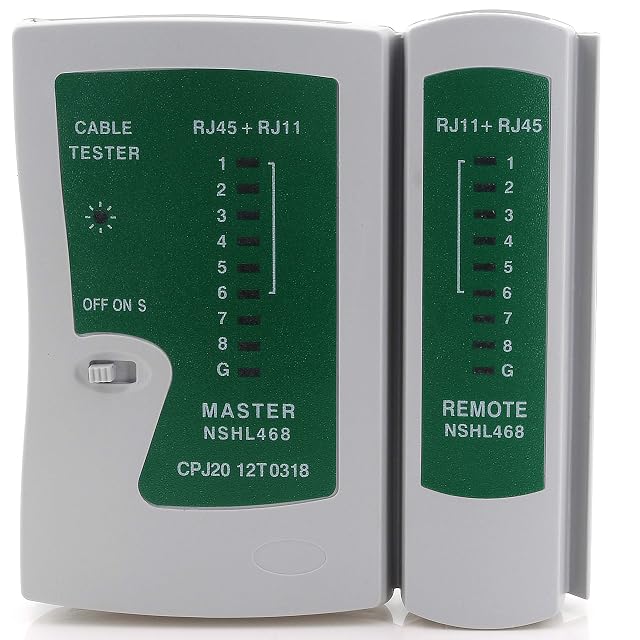
continuity tester · RJ11, RJ12 and RJ45 · ISDN and Cat 6 to Cat 8 named · four named faults · lights for eight conductors on the remote · no power source stated
A continuity tester that names the four faults it looks for one by one, and never says what it runs on.
Best for: A house with both telephone and network wiring in the walls, where a single tester should cover the older sockets as well as RJ45.
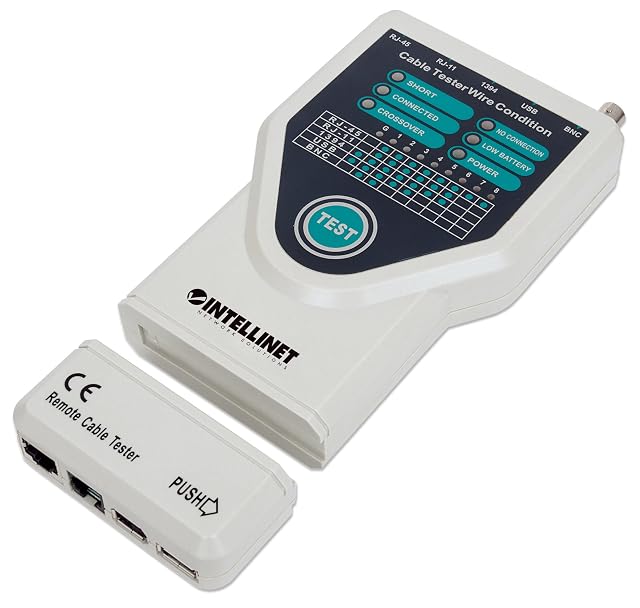
continuity tester · RJ45, RJ11, USB A and B, six-pin FireWire and coaxial · lights for eight conductors and the shield · three faults named · case and coaxial adapter supplied · no remote listed
A tester that reaches beyond network leads to USB, FireWire and coaxial, and whose contents list holds a case and an adapter and no remote unit.
Best for: A bench or a workshop drawer of assorted leads, where the network cables are only part of what needs checking and everything is within reach.
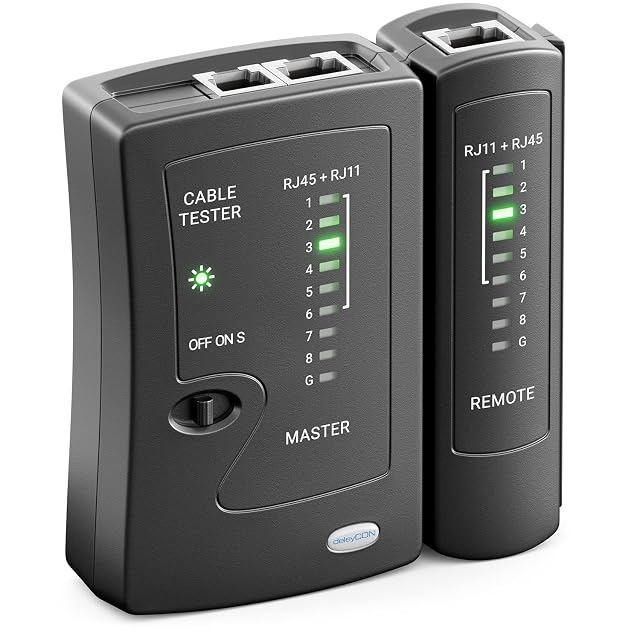
continuity tester · RJ11, RJ12 and RJ45 · separate lights for pins 1 to 8 and for ground · shielding scanned automatically · scan speed low or high · 9 V block, not supplied
A two-piece tester that gives ground its own indicator alongside the eight pins, scans the shield automatically, and lets the scan speed be set.
Best for: Shielded leads and shielded sockets, where whether the screen is actually connected is as much a question as whether the eight conductors are.