Bay count, drive interface and the processor behind the applications · review
Yxk Zero1 review
A two-bay enclosure with a 2.5GbE connection and Docker support, on the thinnest hardware page on this shelf: no processor, no memory figure, no socket count.
Amazon.com listed it on October 26, 2026, but no current offer passed our price check, so no price is quoted. The Amazon.com page exists, but nobody was selling the unit; a listing in that state is often a third-party import.
Models on this shelf that Amazon.com did sell on that date:
Two bays and almost nothing about what is inside. No processor is named — not a model, not a core count, not a clock. No memory figure appears at all. No socket is counted. On a shelf where most listings name their chip by part number, this page names none, and the only hardware figure it publishes is a network rate.
That rate is 2.5GbE, given in the fourth bullet as two and a half times faster than standard gigabit, with 4K streaming offered as the use. The socket is named in the singular and never counted, so whether a second one exists is unstated — the same gap the published TerraMaster leaves, and the one the UGREEN DXP4800 GT above closes with a figure.
Docker is the one piece of software the page commits to. The first bullet calls the unit an entry-level two-bay NAS for beginners and adds “now with Docker support for those ready to explore more”, which places it above the UGREEN DH2300 on exactly the line that listing publishes as a refusal. Beyond Docker the software is described by what it does — a phone app, a desktop client, any web browser, across Windows, macOS, iOS and Android — and never named.
The fourth bullet names flexible RAID modes, automated backups and snapshot recovery, and numbers no level. Snapshots and an array answer different questions: one keeps earlier states of a filesystem, the other keeps the machine running through a dead drive, and neither is a copy of the data on separate hardware. The second bullet states twice over that the drive must be bought separately, with the emphasis the page itself gives it.
The sixth bullet contains the one thing on the page that can be checked against the product record: it describes the unit as “compact at just 2kg”, while the record gives a shipping weight of 1,819 g (64.2 oz) for the boxed unit. The bullet overstates the weight of a unit that, boxed, weighs less than it claims unboxed. The same bullet promises digitally optimized airflow, intelligent thermal control and a whisper-quiet design, and prints no decibel value — on a shelf where exactly one listing does.
Real-time health monitoring with early alerts closes the bullet. No figure in watts, no measurement of the case and no drive size for the two bays.
Where it holds up, and where it stops
Strengths
A 2.5-gigabit connection, faster than the gigabit LinkStations and the DH2300 on this shelf
Docker support is committed to in the first bullet, on a unit sold to beginners — the line the UGREEN DH2300 publishes as a refusal
Names snapshot recovery alongside the array rather than offering the array as if it answered the same question
States twice, with its own emphasis, that the drive is not included
Compromises
No processor, no memory figure and no socket count: the thinnest hardware page on this shelf
The sixth bullet gives 2 kg where the product record's shipping weight, box included, is 1,819 g
Whisper-quiet with no decibel value, and intelligent thermal control with no figure in watts
RAID modes are called flexible and no level is numbered
No current Amazon.com offer passed our price check on October 26, 2026
Specifications
Bay count
Two — stated in the title as a 2-Bay desktop NAS and repeated in the first bullet
Drive interface
Not published on the listing — no drive size in inches and no bus appears in the title or in any of the six bullets. The second states twice that the drive must be purchased separately
Solid-state slot count
Not published on the listing — no M.2 slot and no cache slot of any kind is named on the page
Processor
Not published on the listing — no chip, no model number, no core count and no clock speed appears anywhere in the title or the six bullets
Memory
Not published on the listing — no memory figure of any kind appears on the page
Ethernet port count
Not published on the listing as a figure — the fourth bullet names 2.5GbE connectivity without counting a socket, so whether there is one or two is unstated
Port speed
2.5GbE — stated in the fourth bullet as two and a half times faster than standard 1GbE, offered for fast transfers and 4K streaming without buffering
USB ports
Not published on the listing — no USB socket is named or counted anywhere on the page
Supported redundancy levels
Flexible RAID modes and snapshot recovery, named without a level — stated in the fourth bullet. Snapshots keep earlier states of a filesystem and an array keeps the machine running through a dead drive; neither is a copy of the data on separate hardware
Published operating system
Not named on the listing — the third bullet describes a phone app, a desktop client and any web browser across Windows, macOS, iOS and Android, and the first names Docker support. The software itself is never called anything
Stated idle power
Not published on the listing — no figure in watts appears, and the sixth bullet speaks of intelligent thermal control without one
Stated acoustic figure
Not published on the listing — the sixth bullet calls the design whisper-quiet and prints no decibel value beside it
Stated dimensions
Not published on the listing — the sixth bullet gives the weight as "just 2kg"; the product record gives a shipping weight of 1,819 g (64.2 oz), box included, and no measurement
Amazon reference
B0HGXY1GR1
EAN
0751580777881
On Amazon.com
Amazon.com listed it on October 26, 2026, but no current offer passed our price check, so no price is quoted.
The questions that come up before an order
What processor does it use?
The listing does not say. No chip, no model number, no core count and no clock speed appears anywhere in the title or the six bullets.
How much does it weigh?
The sixth bullet says just 2 kg. The product record gives a shipping weight of 1,819 g (64.2 oz) with the box, so the unit itself weighs less than the bullet states.
Does it support Docker?
Yes. The first bullet states Docker support in as many words, which separates it from the entry-level UGREEN DH2300 on this shelf, whose listing says it does not support Docker.
The buyer this one serves, among network and storage gear
A first two-bay machine for someone who wants Docker and a 2.5-gigabit connection and will accept not knowing what runs it.
What this one costs among network and storage gear
Details checked on October 26, 2026.
What buyers actually choose
Amazon reports what buyers took in the month before this page was last checked: at least 200.
The figure is a floor, rounded by Amazon, and read through Keepa — it says what buyers picked, not what a maker claims.
Sources
Specifications: the manufacturer sheet for network and storage gear and the matching Amazon product page. Prices and availability: Keepa. Every figure on this page names its source.
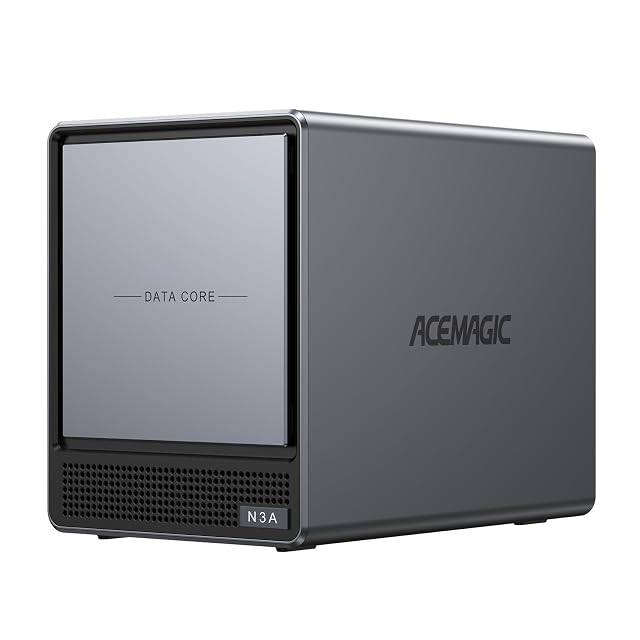
four HDD bays and two M.2 slots · up to 136 TB · 8 GB DDR4 · 128 GB PCIe 3.0 SSD · 2.5G and 1G LAN · processor and software not named
A four-bay enclosure whose Amazon.com listing fits its whole specification into one line — four HDD bays, two M.2 slots, 2.5G and 1G LAN, 8 GB DDR4 and a 128 GB SSD — and names no processor and no software.
Best for: A buyer who already knows this model and the software they will run on it, and wants four HDD bays plus two M.2 slots in one box.
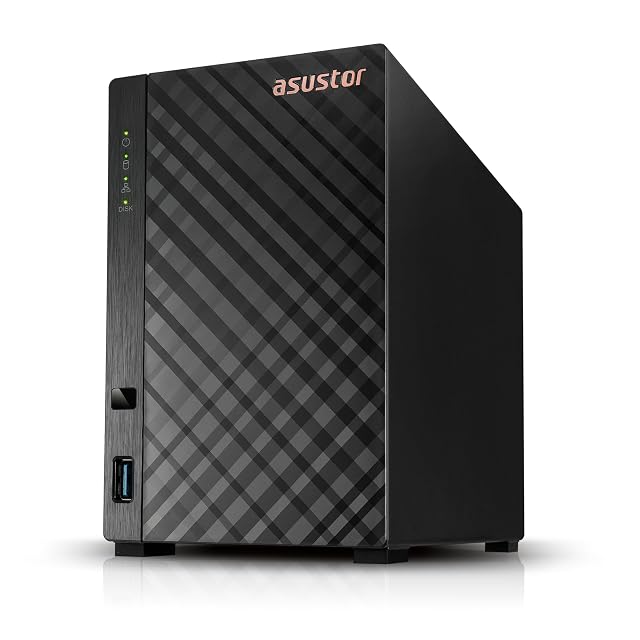
two bays · Realtek RTD1619B, four cores at 1.7 GHz · 1 GB DDR4 · one 1GbE socket · Btrfs and iSCSI snapshots named · sold without drives
A two-bay enclosure whose title states the processor, the memory and the single gigabit socket, and whose page never names the drive interface, an array arrangement or the software that runs it.
Best for: A first enclosure for a household copy of photographs and documents, where one gigabit is enough and where the buyer is content to look up the drive compatibility elsewhere.
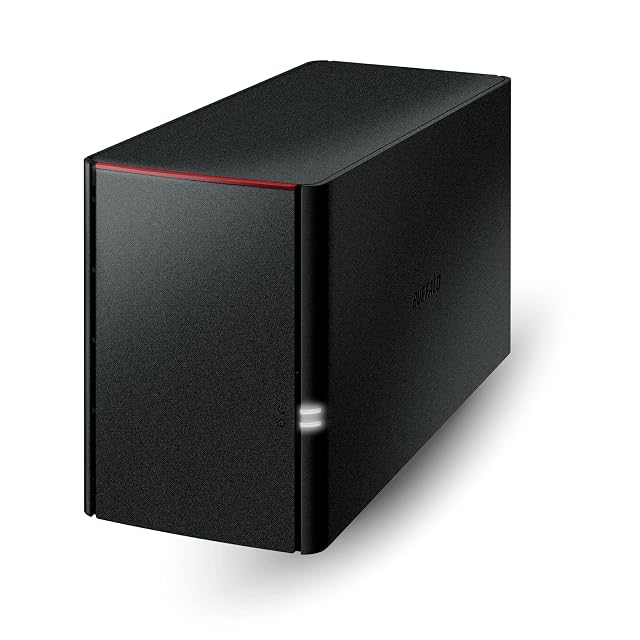
two bays · 4 TB of drives included · ships in RAID 1 with 2 TB usable · $143.00 per usable terabyte · 24 months covering the drives · macOS 15 ceiling
The bottom rung of the LinkStation 220 ladder, and the most expensive terabyte on it: two terabytes usable for $285.99, where the twelve-terabyte version of the same box asks less than a third as much per terabyte.
Best for: The smallest mirrored LinkStation, for someone who wants two terabytes protected and nothing else, and will not want more later.