Bay count, drive interface and the processor behind the applications · review
TERRAMASTER F4-425, four-bay enclosure with a stated 22 dB(A) and a named array scheme review
A four-bay enclosure that publishes an acoustic figure, a per-bay ceiling and the name of its array scheme, and that never says what size of drive its four bays take.
The bottom line Strong on the things people live with — noise, capacity ceilings, the applications it serves — and evasive about the parts a buyer compares. A named chip and a drive size would turn a good page into a complete one.
On the listing
A four-bay multimedia server for home users, sold without drives; an Intel x86 quad-core processor with 4 GB of memory handling 4K transcoding and multitasking; a 2.5-gigabit port for fast transfers and simultaneous users; hardware 4K H.265 decoding with Plex, Emby and Jellyfin, DLNA streaming and an AI photo album; setup from the TNAS Mobile app without a computer, with automatic photo and video backups and real-time synchronisation; operation at 22 dB(A) and tool-free push-lock trays fitted in ten seconds; and up to 120 TB across four bays of 30 TB, more than fifty user accounts, flexible TRAID arrays saving 30 per cent more space than conventional arrangements, an SPC security module, CloudSync for Google Drive, OneDrive and Dropbox, and two-way synchronisation with computers.
22 dB(A), and where it is offered
A decibel figure with a room attached. The fourth bullet does not say the unit is quiet; it prints a value and names a bedroom as the place it suits. No measuring condition comes with it — no load, no distance, no word on whether drives were spinning — so it is a number to ask about rather than a number to trust outright. It is still more than almost every rival prints.
Thirty terabytes a bay, and no bay size
The fifth bullet builds its total from four bays of 30 TB. That ceiling is precise, and the page never says whether those bays take 3.5-inch drives, 2.5-inch drives or both, nor which bus they run on. The arithmetic of what fits is published; the physics of what fits is not.
TRAID, and what an array does
TRAID is named as a flexible arrangement that keeps redundancy while leaving more usable capacity than a conventional scheme. What redundancy does is keep the volume readable when a drive fails, which is uptime. Files that must survive a fire, a theft or a deletion belong on separate hardware, and no arrangement of these four bays produces that.
Before ordering
Ask for the drive size the bays accept and the chip behind the words Intel x86 quad-core. Everything else on this page is unusually well stated, which makes those two blanks stand out rather than blend in.
Availability
Priced from 345 € to 460 € across the German, French, Italian and Spanish Amazon stores the day this page was checked.
In the American and British Amazon catalogues with no live offer against it: the reference exists, nobody is filling it.
Every figure in this section is what Keepa held on the day this page was last updated. Stock and prices move without warning.
Prices quoted in this text were read on 10 September 2026. The live price is at the top of the page.
Where it holds up, and where it stops
Strengths
An acoustic figure in decibels, with the room it is offered for, on a shelf where almost every rival leaves noise to adjectives
The storage arithmetic is complete: a ceiling per bay, a bay count and the total the two produce
Names the media applications it works with rather than promising streaming in general, which is checkable against what the buyer already uses
Compromises
The processor is described as an Intel x86 quad-core and never given a model number, so it cannot be lined up against a named chip
The four bays are never given a drive size, which leaves the most basic question about an enclosure sold empty unanswered
The 2.5-gigabit socket is named in the singular and never counted, so nothing says whether a second network socket exists
Specifications
Bay count
Four — stated in the title as a 4 Bay unit and repeated in the fifth bullet as a 4-Bay NAS
Drive interface
Not published on the listing as a size or a bus — the fifth bullet gives a ceiling of 30 TB per bay and the fourth names push-lock trays fitted in ten seconds, and no inch figure and no bus appears beside either
Solid-state slot count
Not published on the listing — no M.2 slot and no cache slot is named, and the storage arithmetic of the fifth bullet counts only the four bays
Processor
An Intel x86 quad-core processor — stated in the first bullet in exactly those words. No model number and no clock speed follows it anywhere on the page
Memory
4 GB — stated in the first bullet alongside the processor. Whether it can be added to is not stated
Ethernet port count
Not published on the listing as a figure — the first bullet names the 2.5-gigabit port in the singular, which describes one socket without counting the sockets
Port speed
2.5GbE — stated in the first bullet, given as what makes transfers fast and lets several people work at once
USB ports
Not published on the listing — no USB socket is counted, on a page that names Plex, Emby, Jellyfin, DLNA, CloudSync and TerraSync by name
Supported redundancy levels
TRAID, named and not numbered — the fifth bullet calls the arrays flexible, says they save 30 per cent more space than conventional arrangements while keeping redundancy, and gives no level a number. Carrying on through a drive failure is what redundancy does, and it is a different thing from a copy held elsewhere
Published operating system
Not published on the listing by name — the third bullet names the TNAS Mobile app used to set the unit up without a computer, and the software on the enclosure itself is never called anything
Stated idle power
Not published on the listing — no figure in watts appears, on a page that does publish a decibel value
Stated acoustic figure
22 dB(A) — stated in the fourth bullet, offered as making the unit suitable for a quiet room such as a bedroom. It is one of two acoustic figures on this whole shelf
Stated dimensions
Not published on the listing — no measurement of the case is printed, and the fourth bullet describes how quickly a tray goes in rather than how much room the box takes
Amazon reference
B0FMJXMVS8 (same reference on 6 Amazon marketplaces)
EAN
6939236147408
The questions that come up before an order
What does a saving of 30 per cent against a conventional array describe?
It describes usable capacity, not safety. Array schemes differ in how much of the raw total they set aside to survive a drive failure, and a scheme that sets aside less leaves more usable. Both arrangements do the same job — keeping the volume readable through a fault — and neither of them is a copy of the files kept somewhere else.
How useful is a 22 dB(A) figure without a measuring condition?
It is a starting point rather than a comparison. Acoustic figures depend on the load, the distance and whether drives are fitted, and this page states none of the three. It still puts a number where rivals put an adjective, and a listing that prints a figure at all can be asked what conditions it was taken under.
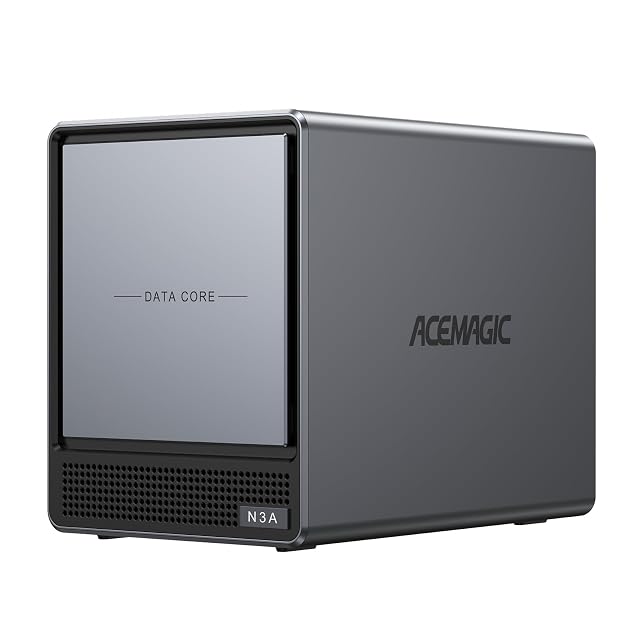
four bays for 3.5-inch drives · two M.2 NVMe slots · AMD R2544 · 8 GB DDR4 and a 128 GB system drive · no operating system supplied · 24 months of warranty
A four-bay enclosure that states its bay size, counts its solid-state slots and supplies no operating system at all, naming three the buyer may install instead.
Best for: A builder who already knows which storage system they want to run and wants the hardware to stay out of the way, rather than a buyer expecting a finished appliance.
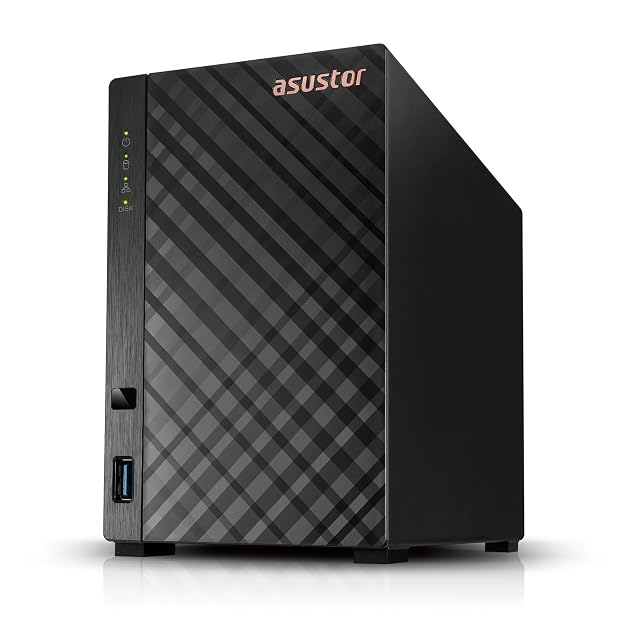
two bays · Realtek RTD1619B, four cores at 1.7 GHz · 1 GB DDR4 · one 1GbE socket · Btrfs and iSCSI snapshots named · sold without drives
A two-bay enclosure whose title states the processor, the memory and the single gigabit socket, and whose page never names the drive interface, an array arrangement or the software that runs it.
Best for: A first enclosure for a household copy of photographs and documents, where one gigabit is enough and where the buyer is content to look up the drive compatibility elsewhere.
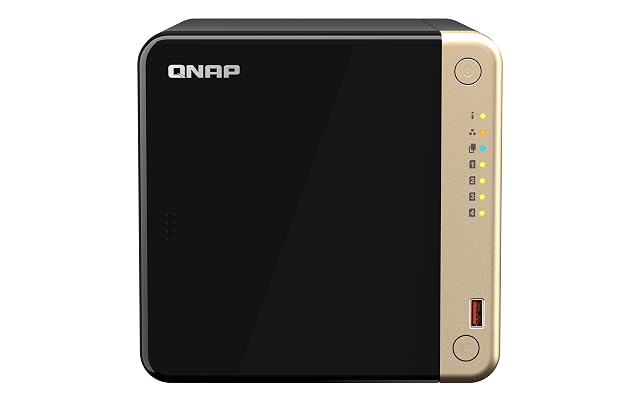
four bays · 8 gb of memory · four bullets that describe no product · title in Spanish on a German shop · reference printed short of the product record
A four-bay enclosure whose page carries a bay count, a memory figure and four bullets that would fit any object at all, printed in a language the shop does not use.
Best for: A buyer who already knows this model from elsewhere and is here only for the price, since the page itself will not tell them what they are buying.