Node count and the link between nodes decide coverage, never the headline number · review
Cudy M11000, BE11000 tri-band Wi-Fi 7 node sold singly review
The most completely specified unit in this group: three band rates, a named backhaul, four multi-gigabit sockets — and a badge 223 Mbit/s larger than the figures printed beneath it.
The bottom line The best-documented radio in this group by a distance, and the one whose two published area figures contradict each other. For a fast line and a house that can take a cable between units, the wired backhaul and the four 2.5G sockets are the reason to look.
On the listing
Tri-band Wi-Fi 7 badged BE11000, with 5765 Mbit/s on 6 GHz, 4324 Mbit/s on 5 GHz and 688 Mbit/s on 2.4 GHz, MLO and 4K-QAM, four 2.5G RJ45 sockets of which one is WAN, wireless and wired backhaul with a dedicated 6 GHz link, fast roaming, a VPN server and client covering WireGuard, OpenVPN, IPsec, ZeroTier, PPTP and L2TP, a 1.5 GHz quad-core processor with 512 MB of DDR4, a cylindrical body of 116 × 202 mm with six fixed internal antennas, and a mains adapter and Ethernet cable supplied.
The arithmetic
5765 plus 4324 plus 688 is 10 777. The badge says 11000. That gap is the whole reason this site writes badges as stated figures rather than as speeds: the number on the carton is an arithmetic convention, rounded upward to a memorable shape, and it belongs to nothing you can plug in.
What is unusual here is that the listing hands you the three parts. Almost nothing else on this shelf does, and it is the parts, not the sum, that tell you which radio your laptop will actually land on.
The backhaul
Named in full: wireless and wired, with 6 GHz reserved for the wireless link between units. That is the sentence a mesh buyer should look for first, and it appears on one listing in eight here.
The area that does not move
110 m² for one unit. 110 m² for two. 110 m² for three. Two readings are possible and the listing settles neither, so the figure is reported as printed and treated as unreliable for the multi-unit packs.
Before ordering
Check the line coming into the building. Four sockets at 2.5 Gbit/s are the reason to choose this over a gigabit system, and on a gigabit line they are capacity that nothing will use.
Availability
Priced from 144 € to 150 € across the German, French, Italian and Spanish Amazon stores the day this page was checked.
It is stocked on the American and British Amazon stores as well, in that country’s own currency. The range above leaves those out: it counts euro stores and no others.
Every figure in this section is what Keepa held on the day this page was last updated. Stock and prices move without warning.
Prices quoted in this text were read on 10 September 2026. The live price is at the top of the page.
Where it holds up, and where it stops
Strengths
Publishes a rate for every one of its three radios, which no other mesh system in this group does
Names the backhaul precisely — wireless and wired, with a 6 GHz radio reserved for the wireless link
Four sockets at 2.5 Gbit/s, one of them WAN, on a unit sold as a single node rather than as a pack
Compromises
The badge reads 11000 and the three published rates come to 10 777, so the carton is 223 Mbit/s ahead of the page
The coverage figure is 110 m² for one unit and 110 m² again for three, which cannot be right for both
No 802.11 designation, on a Wi-Fi 7 unit where the generation letters are the shortest way to check a client will speak to it
Specifications
Wi-Fi generation
Wi-Fi 7 — stated in the title and in the first bullet, alongside MLO and 4K-QAM
IEEE designation
Not published on the listing — the generation is named by number only, and no 802.11 letter pair is printed anywhere in the five bullets
Stated class figure
BE11000 — stated in the title. The bullet publishes all three parts: 5765 Mbit/s on 6 GHz, 4324 Mbit/s on 5 GHz and 688 Mbit/s on 2.4 GHz, which come to 10 777 Mbit/s, so the badge is rounded up by 223
Band plan
Tri-band with all three named and rated — 6 GHz at 5765 Mbit/s, 5 GHz at 4324 Mbit/s and 2.4 GHz at 688 Mbit/s, with MLO and 4K-QAM
Backhaul type
Both, and named — wireless and wired backhaul are stated, with a dedicated 6 GHz radio kept for the wireless one
Node count
One — stated in the title as M11000 1-Pack
Pack composition
A single cylindrical unit, 116 × 202 mm, with a mains adapter and an Ethernet cable in the box; a 2-pack and a 3-pack are named
Stated coverage area
110 m² — stated, and the same 110 m² is stated again for the 2-pack and for the 3-pack, so the published figure does not grow with the number of units
Ethernet port count
Four — stated as four 2.5G RJ45 sockets, one of them WAN
Port speed
2.5 Gbit/s on all four — stated, and described as supporting internet connections up to 2.5 Gbit/s
Separate WAN socket
Yes — stated: of the four 2.5G sockets, one is marked WAN
Amazon reference
B0FH9WKDZN (same reference on 6 Amazon marketplaces)
EAN
6971690793616
The questions that come up before an order
What is a dedicated backhaul radio?
A radio the system keeps for traffic travelling between its own units, so that the airtime your laptop uses is not the same airtime the node uses to reach the one upstream. Naming which band carries it, as this listing does, is more informative than the badge on the front.
Should the coverage figure be read as 110 m² per unit?
The listing does not say so. It gives 110 m² for the single pack and repeats the same figure for the two-pack and the three-pack, which is either an error or a claim that adding units does not add area. We report what is printed rather than choosing between those readings.
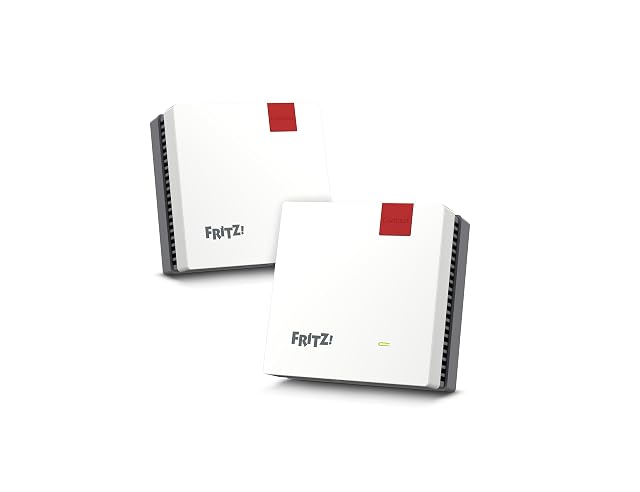
Wi-Fi 6 · up to 3000 Mbit/s stated · two units · seven of eleven lines unpublished · made in Europe
A two-piece set from a well-known European maker whose listing runs on four bullets: a generation, a figure, an installation promise and a sentence about security.
Best for: A buyer who already trusts the maker and wants a mesh pair that will sit behind an existing provider box without an argument.