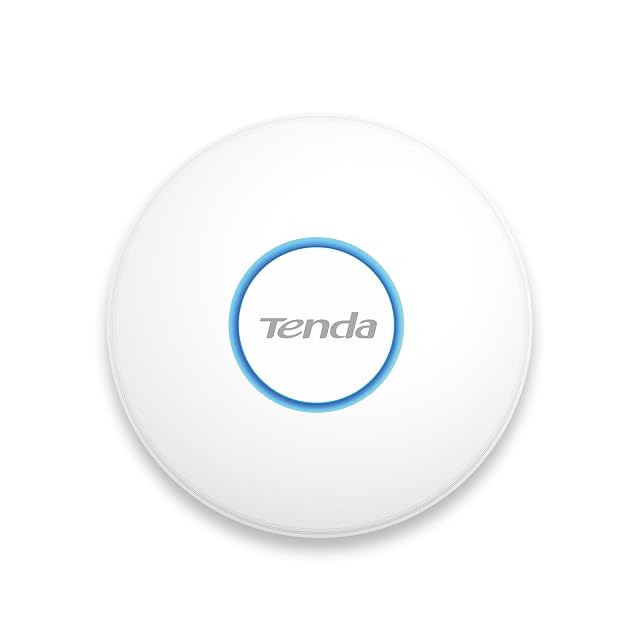
The bottom line Strong where the money goes — a multi-gigabit uplink on existing cable and management that costs nothing extra — and blank on the two lines an installer checks first, the PoE class and the bracket.
On the listing
AX3000 Wi-Fi 6 quoted as a total throughput of 3000 Mbps with 160 MHz channel support; a 2.5-gigabit Ethernet uplink said to remove the gigabit bottleneck and to run on Cat5e, allowing an upgrade without rewiring; three high-gain internal antennas extending coverage into hard-to-reach areas across several floors; NebulaFlex management, switching between a standalone local interface and the maker cloud-based Nebula management at no extra cost and with no licence fee; and a features bullet naming OFDMA, MU-MIMO, band steering, fast roaming with 802.11r, 802.11k and 802.11v, WPA3, cellular interference filtering and mesh networking.
What AX3000 counts
The maker calls it a total throughput, which is an accurate description of an addition and an inaccurate one of a link. The badge sums the theoretical peaks the standard sets for each radio in the unit. What the listing does not do is say how many radios there are or what each contributes.
The line that decides the installation
PoE, unclassed. An access point fed over its network cable draws a defined amount of power, and the class — 802.3af or 802.3at — tells the installer whether the switch already in the building will run it. The word appears twice on this page; the class appears nowhere.
The uplink
2.5 Gbit/s, on Cat5e. That is the specific and checkable claim on this listing, and it is the one worth buying for: the cable stays in the wall and the ceiling above a gigabit.
The 4G and 5G that are not Wi-Fi
The last bullet lists cellular interference filtering. Read quickly, 4G and 5G next to a Wi-Fi specification look like bands. They are not. They are the mobile signals the unit filters out.
Before ordering
Ask the seller which PoE class the unit requires and whether an injector is supplied. That answer, not the badge, decides what the installation costs.
Availability
Priced from 73 € to 89 € across the German, French, Italian and Spanish Amazon stores the day this page was checked.
It is stocked on the American and British Amazon stores as well, in that country’s own currency. The range above leaves those out: it counts euro stores and no others.
Every figure in this section is what Keepa held on the day this page was last updated. Stock and prices move without warning.
Prices quoted in this text were read on 10 September 2026. The live price is at the top of the page.
Where it holds up, and where it stops
Strengths
A 2.5 Gbit/s uplink stated to run on existing Cat5e, which is the line that decides whether a rewire is needed
Management is stated both ways and switchable, with the licence question answered in the same bullet: no extra cost, no licence fee
Names the roaming standards individually — 802.11r, 802.11k and 802.11v — rather than describing roaming as seamless and stopping there
Compromises
PoE is claimed and no class is named, so whether an existing 802.3af switch will run it is the one thing a buyer cannot check
No band plan at all, so what the AX3000 is made of, and whether a 2.4 GHz radio is present, is unpublished
Mounting is not described, on a unit whose whole argument is coverage across several floors
Specifications
Wi-Fi generation
Wi-Fi 6 — stated in the title and in the first bullet
IEEE designation
Not published on the listing for the radio — 802.11r, 802.11k and 802.11v are named for fast roaming, and no 802.11 letter pair is given for the Wi-Fi generation itself
Stated class figure
AX3000 — stated, quoted by the maker as a total throughput of 3000 Mbps with 160 MHz channel support. It is the sum of the theoretical peaks of the radios in the unit, and the listing does not divide it between them
Band plan
Not published on the listing — neither the number of radios nor their frequencies is named; the 4G and 5G in the last bullet refer to filtering cellular interference, not to a Wi-Fi band
Stream count
Not published on the listing — OFDMA, MU-MIMO and band steering are named as features, and no stream figure appears for any radio
PoE standard required
Not published on the listing — PoE appears in the title and in the first line, and neither 802.3af nor 802.3at is named, so the class a switch or injector must supply is unstated
Uplink port speed
2.5 Gbit/s — stated as a 2.5-gigabit Ethernet port described as removing the gigabit bottleneck and as running over existing Cat5e cable
Mounting type
Not published on the listing — coverage across several floors is claimed with three high-gain internal antennas, and no ceiling disc, wall plate or bracket is named
Management method
Standalone local web interface or the maker cloud-based Nebula management — stated as NebulaFlex, switchable between the two, with no additional cost or licence fee
Amazon reference
B0C24Q2RBQ (same reference on 6 Amazon marketplaces)
EAN
4718937630554
The questions that come up before an order
Why does the PoE class matter more than the word PoE?
Because the classes deliver different amounts of power. A unit specified for 802.3at will not settle on a source offering only 802.3af, and the difference decides whether the switch already in the cupboard is enough or whether an injector has to be bought. This listing names the word and not the class.
What does a 2.5 Gbit/s uplink on Cat5e mean in practice?
That the cable already in the wall can carry more than a gigabit without being replaced, which is the expensive part of any upgrade. The listing makes the claim explicitly, tying the port speed to the cable grade rather than leaving the buyer to work it out.
Wi-Fi 6 · AX3000 over 2976 published · both bands rated · PoE+ with an adapter in the box · wall or ceiling, 176 mm disc · 150 m²
The most completely specified access point here: both band rates, both power routes, a mounting choice and a measured body, with only the stream count left out.
Best for: A flat, office or cafe of about 150 m² wanting one well-documented ceiling unit that will run from a plug if no PoE switch exists.
Wi-Fi 6 · 1.5 Gbit/s called an aggregate radio rate · 2×2 MIMO, the only stream count in this family · 802.3af · ceiling or wall
The only access point here to publish a stream count, and the only one whose maker calls its headline figure an aggregate radio rate — which is exactly what it is.
Best for: A ceiling or wall position on a network where the controller already exists, and where an 802.3af switch is already in the cupboard.