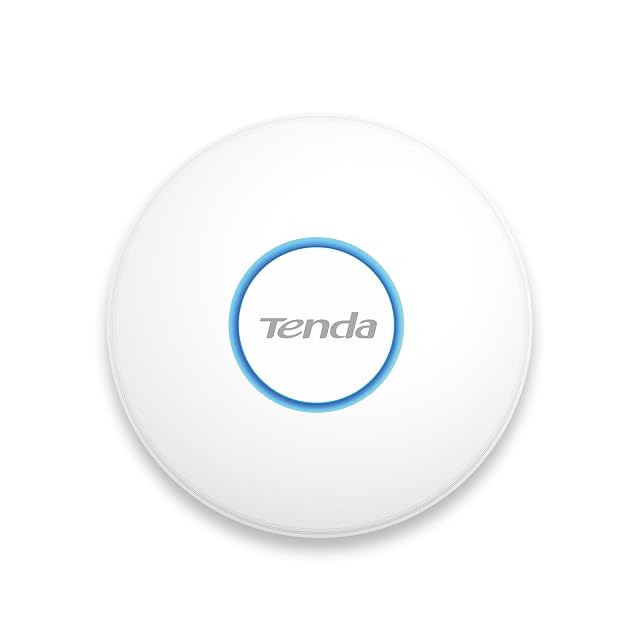
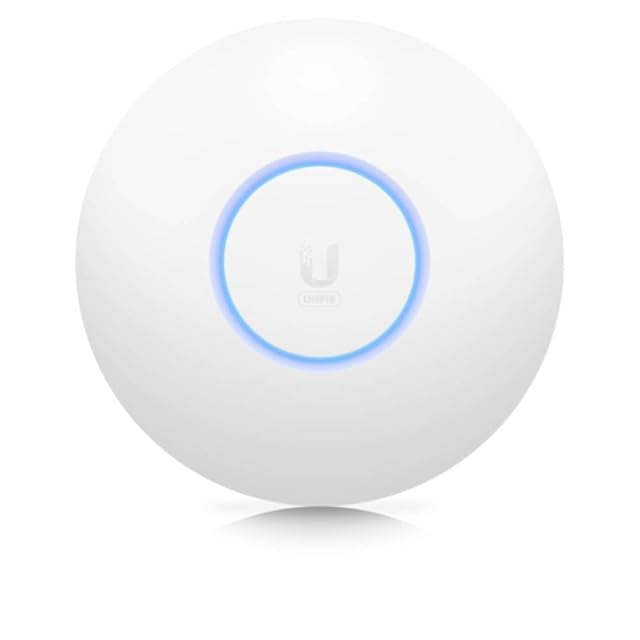
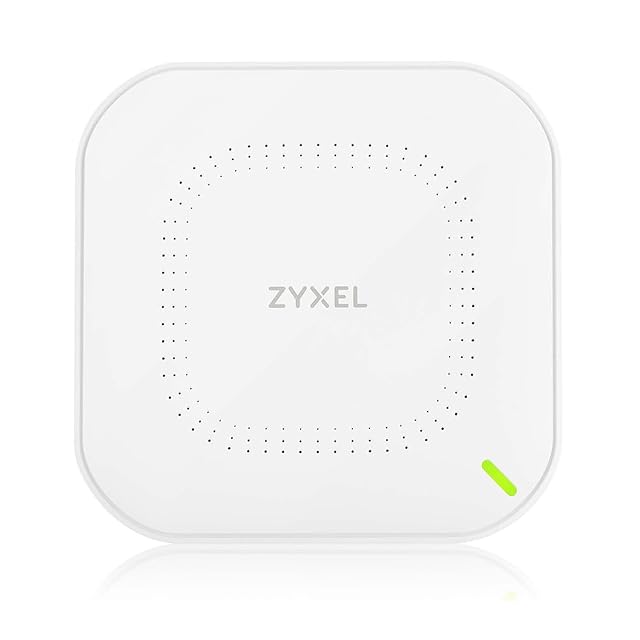
The bottom line The most numerically honest listing in this lot and the vaguest about its bracket. For a site being built out under one controller, having the PoE class printed as 802.3at is worth more than any figure on the page.
On the listing
Simultaneous 574 Mbit/s at 2.4 GHz and 2402 Mbit/s at 5 GHz, stated together as 2976 Mbit/s; Wi-Fi 6 described as letting more connected devices go faster; centralised cloud management through Omada SDN, locally or from the cloud, by web interface or app; a 160 MHz channel named HE160; seamless roaming that leaves video and voice calls unaffected as users move; Omada Mesh linking access points wirelessly for extended reach and flexible deployment; support for both 802.3at PoE+ and DC power with the adapter included; and an ultra-flat body of 160 mm by 33.6 mm.
2976
That is the number in the first bullet. It is 574 plus 2402, and it is what the AX3000 on the carton was rounded from. Every listing on this shelf could publish it and one does.
The figure is still an addition of two theoretical radio peaks and still describes no link. But a page that shows the sum rather than the round number is a page that has not hidden the step where the flattering shape appeared.
The power class, printed
802.3at PoE+. Named by its designation, not by its trade name, with a DC adapter in the box for sites without a PoE switch. That single line answers the question this family generates most often, and the other three listings here do not answer it.
The uplink, and the arithmetic against it
One Gigabit socket against a 5 GHz radio quoted at 2402 Mbit/s. Everything to and from the rest of the network passes through the smaller number.
What is not there
A bracket. The body is measured at 160 mm by 33.6 mm and nothing says how it fixes to a ceiling or a wall, which on a unit meant for a ceiling is the omission to chase.
Before ordering
If a second unit is coming, decide now between a cable and Omada Mesh. Both are stated, and the wireless link costs throughput in exactly the way a repeater does.
Availability
Priced from 89 € to 119 € across the German, French, Italian and Spanish Amazon stores the day this page was checked.
It is stocked on the American and British Amazon stores as well, in that country’s own currency. The range above leaves those out: it counts euro stores and no others.
Every figure in this section is what Keepa held on the day this page was last updated. Stock and prices move without warning.
Prices quoted in this text were read on 10 September 2026. The live price is at the top of the page.
Where it holds up, and where it stops
Strengths
Publishes 2976 Mbit/s, the actual sum of the two radios, instead of leaving the reader with the rounded badge
Names the PoE class by its designation — 802.3at PoE+ — the only unit in this family to do so, and includes the DC adapter as well
States wireless linking between access points under Omada Mesh, so a second unit can go where no cable reaches
Compromises
No mounting hardware is named, so how the flat body attaches to a ceiling is left to the box
The uplink is a single Gigabit socket, well under the 2402 Mbit/s quoted for the 5 GHz radio alone
The stream count appears only inside a marketing sentence about a single stream, never as a specification for the unit
Specifications
Wi-Fi generation
Wi-Fi 6 — stated in the title and in the second bullet
IEEE designation
Not published on the listing for the radio — 802.3at is named for power, and no 802.11 letter pair is printed for the Wi-Fi generation itself
Stated class figure
AX3000 on the title, and 2976 Mbit/s in the first bullet — the listing publishes the sum itself, 574 Mbit/s at 2.4 GHz plus 2402 Mbit/s at 5 GHz, rather than only the rounded badge
Band plan
Two radios, each with a rate — 2.4 GHz at 574 Mbit/s and 5 GHz at 2402 Mbit/s, simultaneous, with a 160 MHz channel named as HE160
Stream count
Not published on the listing — a single stream is mentioned inside the HE160 claim, and no 2×2 or 4×4 figure is given for the unit
PoE standard required
802.3at PoE+ — stated by its designation, with a DC mains adapter supplied as the alternative and included in the box
Uplink port speed
Gigabit — stated in the title as one Gigabit port, without the 1000BASE-T designation behind the word
Mounting type
Not published on the listing — an ultra-flat body of 160 mm by 33.6 mm is stated, and no ceiling bracket, wall plate or fixing is named
Management method
Omada SDN — stated, managing the whole network locally or from the cloud through a web interface or the app, with Omada Mesh linking access points wirelessly for extended reach
Amazon reference
B09TYX13F2 (same reference on 6 Amazon marketplaces)
EAN
4897098683545
The questions that come up before an order
Why is publishing 2976 rather than 3000 worth noticing?
Because it is the arithmetic without the rounding. A class figure adds the theoretical peaks of the radios together, and the round badge on the carton is that total rounded upward. This listing prints the total itself, which is as close as this shelf comes to showing its working.
What does a controller change once there are two access points?
It makes them one network rather than two. Client handover, a single set of credentials and one place to change a setting all come from the controller rather than from the radio. This listing names the controller, the cloud option and the app, which is the whole management answer in one bullet.
Wi-Fi 6 · AX3000 over 2976 published · both bands rated · PoE+ with an adapter in the box · wall or ceiling, 176 mm disc · 150 m²
The most completely specified access point here: both band rates, both power routes, a mounting choice and a measured body, with only the stream count left out.
Best for: A flat, office or cafe of about 150 m² wanting one well-documented ceiling unit that will run from a plug if no PoE switch exists.
Wi-Fi 6 · 1.5 Gbit/s called an aggregate radio rate · 2×2 MIMO, the only stream count in this family · 802.3af · ceiling or wall
The only access point here to publish a stream count, and the only one whose maker calls its headline figure an aggregate radio rate — which is exactly what it is.
Best for: A ceiling or wall position on a network where the controller already exists, and where an 802.3af switch is already in the cupboard.