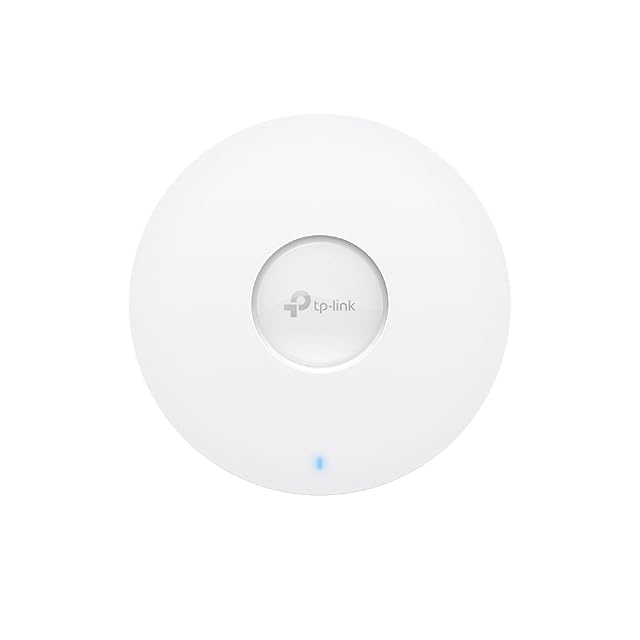
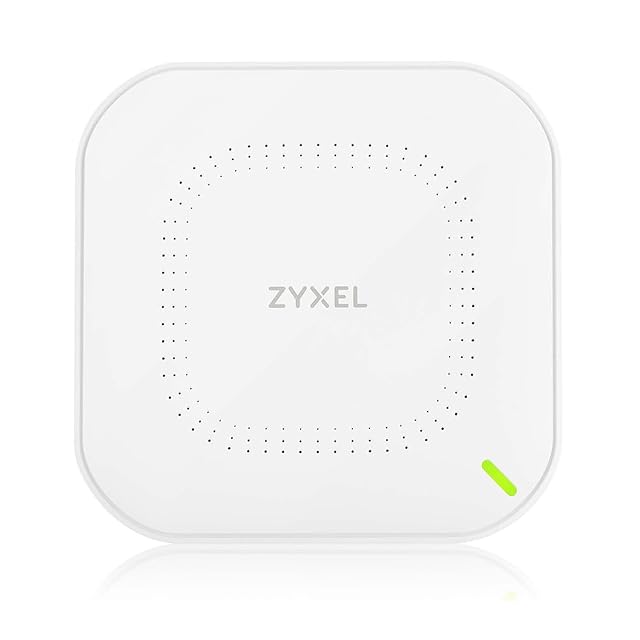
How the unit mounts and how it is powered come before its radio · review
Tenda i27, Wi-Fi 6 access point with a Gigabit uplink review
The most completely specified access point here: both band rates, both power routes, a mounting choice and a measured body, with only the stream count left out.
The bottom line Eight of its nine lines are published, which nothing else in this family manages. The single Gigabit uplink is the ceiling to be aware of, and the supplied adapter is what makes it the easiest of these four to put up.
On the listing
A Wi-Fi 6 access point with MU-MIMO, OFDMA, TWT and BSS colouring; speeds of up to 3000 Mbit/s, made of up to 2402 Mbit/s at 5 GHz and up to 574 Mbit/s at 2.4 GHz; a 160 MHz channel bandwidth and up to eighty simultaneous clients; coverage of up to 150 m² from an independent signal amplifier and built-in 4 dBi antennas, with guidance to mount on a wall or ceiling, avoid obstacles and keep away from microwaves, monitors and printers; fast roaming under 802.11k, 802.11v and 802.11r; a body of 176 mm across and 43.5 mm deep; power from a PoE+ switch or from the supplied mains adapter; and management through a web address or the CloudFi app without changing an IP address.
The badge and its parts
2402 plus 574 is 2976. The badge says AX3000. Twenty-four Mbit/s of rounding, printed openly because the parts are printed too.
The ceiling nobody prints
One Gigabit socket. The 5 GHz radio alone is quoted at 2402 Mbit/s. Everything travelling to or from the rest of the network goes through a socket rated at a thousand. That is not a fault — it is the normal arrangement at this size — but it is the number that decides what the unit actually passes.
Power, both ways
PoE+ from a switch, or the adapter in the box. Naming both, and shipping one, removes the single largest hidden cost of a first access point.
The body, measured
176 mm across, 43.5 mm deep, wall or ceiling. That is what tells an installer whether it fits above a door frame or inside a cupboard, and it is missing from two of the four units in this family.
Before ordering
If the plan is more than one unit, read the roaming bullet rather than the speed one. 802.11k, 802.11v and 802.11r are what make two access points behave as one network, and they are named here individually.
Availability
Priced from 66 € to 77 € across the German, French, Italian and Spanish Amazon stores the day this page was checked.
It is stocked on the American and British Amazon stores as well, in that country’s own currency. The range above leaves those out: it counts euro stores and no others.
Every figure in this section is what Keepa held on the day this page was last updated. Stock and prices move without warning.
Prices quoted in this text were read on 10 September 2026. The live price is at the top of the page.
Where it holds up, and where it stops
Strengths
Publishes a rate for each band, so the twenty-four Mbit/s of rounding in the badge is visible on the same page
States both power routes and supplies the mains adapter, so the unit works whether or not the building has a PoE switch
Gives the body dimensions and the mounting options together, which is what decides where a unit can actually go
Compromises
The uplink is a single Gigabit socket, on a unit whose radios are quoted at 2402 Mbit/s on 5 GHz alone
PoE+ is named without the 802.3at designation, so the class has to be matched by trade name rather than by standard
The device ceiling of eighty clients sits next to a coverage figure of 150 m² without either being tied to the other
Specifications
Wi-Fi generation
Wi-Fi 6 — stated in the title and in the first bullet
IEEE designation
Not published on the listing for the radio — 802.11k, 802.11v and 802.11r are named for fast roaming, and no 802.11 letter pair is given for the generation itself
Stated class figure
AX3000 — stated in the title, with both parts published: up to 2402 Mbit/s at 5 GHz and up to 574 Mbit/s at 2.4 GHz, which come to 2976, so the badge rounds up by 24
Band plan
Two radios, each with a rate — 5 GHz at up to 2402 Mbit/s and 2.4 GHz at up to 574 Mbit/s, with a 160 MHz channel bandwidth stated
Stream count
Not published on the listing — MU-MIMO, OFDMA, TWT and BSS colouring are named, and no stream figure appears for either radio
PoE standard required
PoE+ — stated as the class, with power taken either from a PoE+ switch or from the mains adapter supplied in the box; the 802.3at designation behind the name PoE+ is not printed
Uplink port speed
Gigabit — stated in the title as a Gigabit port, without the 1000BASE-T designation behind the word
Mounting type
Wall or ceiling — stated, with placement guidance about avoiding walls and keeping the unit away from microwaves, monitors and printers, on a body measured at 176 mm across and 43.5 mm deep
Management method
A web interface reached at the maker’s own address, or the CloudFi app — stated, with the listing adding that no IP address needs changing to reach it
Amazon reference
B09M2N5JXT (same reference on 6 Amazon marketplaces)
EAN
6932849429855
The questions that come up before an order
Does a Gigabit uplink cap a unit quoted at AX3000?
For traffic passing through the cable, yes. The radios can be quoted well above a gigabit and everything arriving from or leaving for the rest of the network passes through the one socket. Traffic between two wireless devices attached to the same unit does not. It is the reason the uplink speed is a column of its own here.
What is the mains adapter for if the unit takes PoE?
It removes the dependency on a PoE switch. A unit that ships with an adapter can be installed anywhere there is a socket, and moved onto PoE later when the switch is bought. Some access points do not include one, and it is a real cost difference.
Wi-Fi 6 · 1.5 Gbit/s called an aggregate radio rate · 2×2 MIMO, the only stream count in this family · 802.3af · ceiling or wall
The only access point here to publish a stream count, and the only one whose maker calls its headline figure an aggregate radio rate — which is exactly what it is.
Best for: A ceiling or wall position on a network where the controller already exists, and where an 802.3af switch is already in the cupboard.