The bottom line The band arithmetic is published and the chassis is not. It is the only Wi-Fi 6 repeater here with rated antennas and no named socket, which makes the access point mode in its bullets the thing to confirm before buying.
On the listing
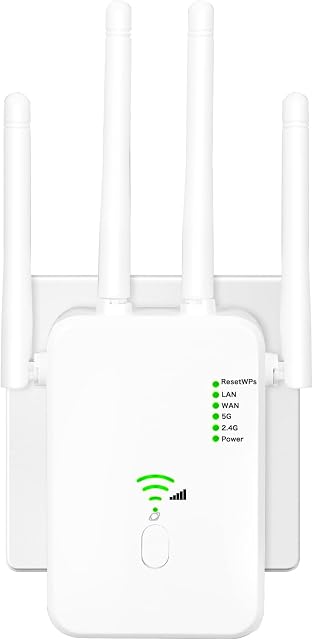
Wi-Fi 6 for stable connections on 2.4 GHz and 5 GHz for streaming, gaming and home working; AX3000 with up to 3000 Mbit/s, made of 574 Mbit/s at 2.4 GHz and 2402 Mbit/s at 5 GHz, for several devices at once without interruption; a smart LED system to help choose the best position and a WPS button for an immediate connection; flexible use as a repeater extending the network or as a new access point; and two 5 dBi external adjustable antennas for even signal strength and reach, backwards compatible with all common routers.
The unit that is not a unit
The title reads AX3000 Mbit/s. AX3000 is a class name; Mbit/s is a unit of rate. Putting them together turns a label into a measurement, and the label was produced by adding two theoretical radio peaks — 574 and 2402 — and rounding the 2976 upward. Both real figures are in the second bullet.
Two antennas, rated
5 dBi, external, adjustable. Most repeaters in this family carry four antennas at 3 dBi, and this one carries two at a higher gain. What neither arrangement publishes is a stream count, which is what would let either be compared properly.
The mode without a socket
The fourth bullet offers a new access point. An access point is fed by a cable. No cable socket is named anywhere in the title or the bullets, so what would feed it is unstated.
Before ordering
If the plan is to run it as an access point rather than a repeater, ask the seller whether it has an Ethernet socket at all. The mode is advertised; the connector it depends on is not.
Availability
No store we queried had a live offer for it the day this page was written.
In the German, British, French, Italian and Spanish Amazon catalogues with no live offer against it: the reference exists, nobody is filling it.
The American Amazon store returned nothing at all, so the buy button there opens a search in that country rather than a page that would not load.
Every figure in this section is what Keepa held on the day this page was last updated. Stock and prices move without warning.
Where it holds up, and where it stops
Strengths
Publishes both band rates, so the twenty-four Mbit/s of rounding in the badge is visible on the page
States two external adjustable antennas with a gain figure of 5 dBi, which most repeaters at this level leave unrated
Names a smart LED system for choosing the position and a WPS button for the connection, both of which are the practical half of a repeater
Compromises
The title writes AX3000 Mbit/s, which treats a class name as a unit of speed
An access point mode is offered and no Ethernet socket is named anywhere, and the mode is defined by the cable that feeds it
Two antennas is the smallest count in this family, against four on most of the unbranded units here
Specifications
Wi-Fi generation
Wi-Fi 6 — stated in the title and in the first bullet
IEEE designation
Not published on the listing — five bullets cover the generation, the rates, the setup, the two modes and the antennas, and no 802.11 letter pair appears among them
Stated class figure
AX3000 — stated, split as 574 Mbit/s at 2.4 GHz and 2402 Mbit/s at 5 GHz, which come to 2976, so the badge rounds up by 24. The title prints the class name with an Mbit/s unit after it, which a class name is not
Band plan
Two radios — stated: 2.4 GHz at 574 Mbit/s and 5 GHz at 2402 Mbit/s, described as usable at the same time by several devices
Stream count
Not published on the listing — both band rates are given and no stream figure appears for either radio
Plug-in or desktop form
Not published on the listing — two external adjustable antennas are described and no bullet says whether the body plugs into a socket or stands on a surface
Ethernet port count
Not published on the listing — no Ethernet socket is named in the title or in any bullet, on a unit that offers an access point mode
Port speed
Not published on the listing — with no socket named, none is given a speed
Access point mode
Yes — stated: the unit either extends an existing network or creates a new access point for maximum stability
Amazon reference
B0GW9RHQ1H (same reference on 5 Amazon marketplaces)
EAN
9120137872910
The questions that come up before an order
Is AX3000 a figure in Mbit/s?
No. It is a class name whose digits happen to be close to a sum expressed in Mbit/s — here 2976, the two published band rates added together. Writing the unit after the class name treats a label as a measurement. The underlying figures are on the page and they are the ones to read.
What do two antennas cost against four?
Fewer antennas usually means fewer spatial streams and a less shapeable pattern. Neither the stream count nor a pattern is published here, so what the difference amounts to on this particular unit cannot be worked out from the page. The gain figure of 5 dBi is higher than the 3 dBi on the four-antenna units in this family.
1200 Mbit/s badge, and 900 plus 300 published · four antennas · repeater, router and AP modes · 15 devices · no Ethernet socket anywhere
A dual-band repeater whose two published rates add up to its badge exactly, and which offers a router mode without naming an Ethernet socket anywhere on the page.
Best for: A wireless-only extension where nothing needs a cable and the badge arithmetic matters more than the brand.
A Wi-Fi 6 repeater whose headline figure is exactly the sum of its two published band rates, and whose product name carries a number the page never explains.
Best for: A household already running the maker’s own router that wants a mesh node with a Gigabit socket and no ambiguity about the arithmetic.