A repeater trades throughput for reach, and the listing rarely says so · review
Tenda A23, Wi-Fi 6 AX1500 plug-in repeater with a Gigabit socket review
A plug-in Wi-Fi 6 repeater that states its socket, its form and its two modes — and closes with a bullet saying a repeater extends coverage rather than speed.
The bottom line The best-documented repeater in this group and the only one whose maker writes down the limit of the category it sells into. For a plug-in unit with a Gigabit socket and no mesh requirement, almost everything is on the page.
On the listing
Dual-band AX1500 with up to 300 Mbit/s at 2.4 GHz and 1201 Mbit/s at 5 GHz; a Gigabit LAN socket for smart televisions, computers, IP cameras and other network devices, aimed at streaming and video surveillance; coverage of 120 to 150 m² in combination with the router, for flats and medium-sized houses; an LED using colour to show signal quality and to help find the best position; compatibility with common routers and providers; switching between wireless repeater mode and access point mode, the latter turning a wired Ethernet connection into a wireless signal; three years of manufacturer warranty with a support address and telephone number; and a closing note that repeaters extend or improve coverage rather than raising speed directly, and that this unit does not currently support mesh.
The bullet at the end
Repeaters extend coverage, not speed. The maker writes it into its own listing, along with the observation that steadier signal can affect throughput. It is the plainest statement of what this category does that appears anywhere in this lot, and it comes from the seller.
The badge and its parts
300 plus 1201 is 1501. The title says AX1500. One Mbit/s apart, which is as close as a rounded badge gets.
Two modes, and which one to want
Repeater mode receives and retransmits on the same radios, spending the air time twice. Access point mode takes a cable and turns it into a network, spending it once. Both are stated here, and where a cable can reach, the second is the reason to buy this rather than a cheaper unit without a socket.
The coverage figure and what it describes
120 to 150 m², stated for the unit working together with the router. That is a figure for a pair, not for this product, and it rests on the maker assumptions about the building it was worked out in.
Before ordering
If devices need to roam smoothly between the router network and this one, read the last bullet again. Mesh is stated as not currently supported, and that is what roaming depends on.
Availability
Priced from 37 € to 38 € across the German, French, Italian and Spanish Amazon stores the day this page was checked.
The American and British Amazon stores returned nothing at all, so the buy button there opens a search in that country rather than a page that would not load.
Every figure in this section is what Keepa held on the day this page was last updated. Stock and prices move without warning.
Prices quoted in this text were read on 10 September 2026. The live price is at the top of the page.
Where it holds up, and where it stops
Strengths
Ends its own bullet list by stating that repeaters extend coverage rather than raising speed, which is the sentence this shelf usually avoids
States that it does not currently support mesh, which is a limitation printed rather than discovered
Publishes both band rates, the socket speed, the form factor and both modes, so eight of nine lines here are filled from the page
Compromises
The Gigabit socket sits under a 5 GHz radio quoted at 1201 Mbit/s, so anything wired at the far end meets the smaller ceiling
The coverage figure of 120 to 150 m² is given for the unit in combination with the router, so it describes a pair rather than this product
No stream count, so the 1201 Mbit/s cannot be traced back to a channel width and a number of streams
Specifications
Wi-Fi generation
Wi-Fi 6 — stated in the title and in the first bullet
IEEE designation
Not published on the listing — eight bullets cover the rates, the socket, the coverage, the LED, router compatibility, the two modes, the warranty and a note on what repeaters do, and no 802.11 letter pair appears
Stated class figure
AX1500 — stated in the title, split as up to 300 Mbit/s at 2.4 GHz and 1201 Mbit/s at 5 GHz. Those come to 1501, so the badge is within one of its own arithmetic
Band plan
Two radios — stated with a rate each: 2.4 GHz at up to 300 Mbit/s and 5 GHz at up to 1201 Mbit/s
Stream count
Not published on the listing — the generation and both band rates are given, and no stream figure appears for either radio
Plug-in or desktop form
Plug-in — stated, described as a repeater for the mains socket
Ethernet port count
One — stated as a Gigabit LAN socket for wired connections to smart televisions, computers, IP cameras and other network devices
Port speed
Gigabit — stated for the single LAN socket, without the 1000BASE-T designation behind the word
Access point mode
Yes — stated, with the unit switching between wireless repeater mode and access point mode; in access point mode a wired Ethernet connection is turned into a wireless signal
Amazon reference
B0FX8KRJQ7 (same reference on 4 Amazon marketplaces)
EAN
6932849423495
The questions that come up before an order
Why does the last bullet matter more than the first?
Because it corrects the expectation the rest of the shelf creates. It states that repeaters are built to extend or improve coverage rather than to raise speed directly, and that a steadier signal can affect throughput. That is the honest description of what the category does.
What does the absence of mesh support change?
A device moving through the house will see two networks rather than one, and will hold on to the weaker one longer than it should. Mesh handles that handover. The listing states plainly that this unit does not currently support it, which is a limitation most listings leave unmentioned.
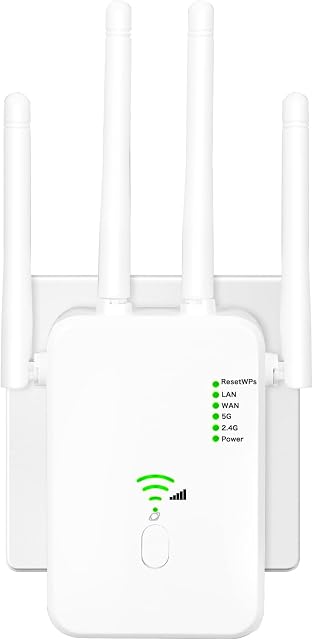
1200 Mbit/s badge, and 900 plus 300 published · four antennas · repeater, router and AP modes · 15 devices · no Ethernet socket anywhere
A dual-band repeater whose two published rates add up to its badge exactly, and which offers a router mode without naming an Ethernet socket anywhere on the page.
Best for: A wireless-only extension where nothing needs a cable and the badge arithmetic matters more than the brand.
A Wi-Fi 6 repeater whose headline figure is exactly the sum of its two published band rates, and whose product name carries a number the page never explains.
Best for: A household already running the maker’s own router that wants a mesh node with a Gigabit socket and no ambiguity about the arithmetic.