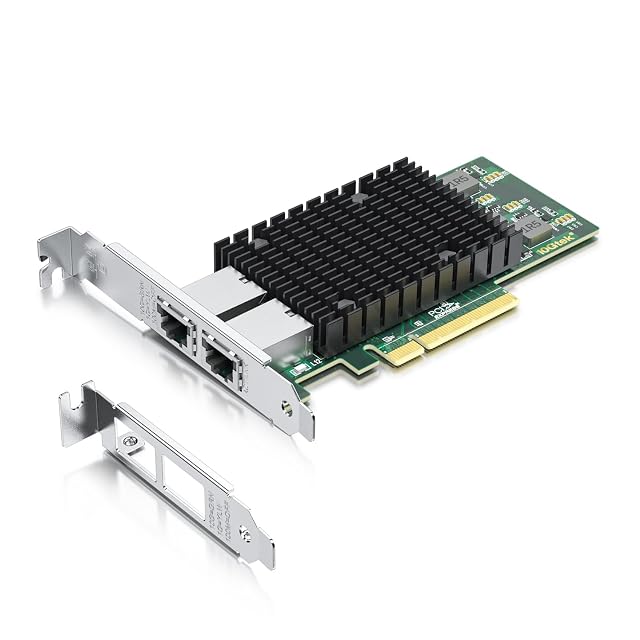
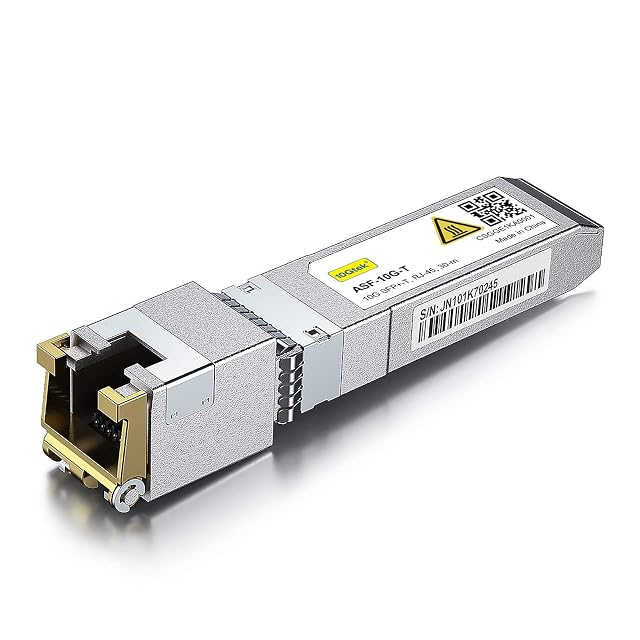
10Gtek names the controller and prints its own limits
Two 10Gtek parts
A dual-socket 10GBASE-T PCIe card, and a copper SFP+ module.
Written for someone planning an installation
The card publishes PCIe 2.1 at ×8, names the controller on it, gives Cat 6A to 100 m and Cat 6 to 55 m, and states in as many words the two intermediate rates it does not support. Cable grade and distance are what decide whether ten gigabits over copper will work at all, and both are on the page.
The bullet spent ruling itself out
The module names its controller, publishes a 2.5 W draw, recommends an ambient below 50 °C and then lists the switch makers it will not work with. A listing that spends a bullet excluding itself from installations is doing work the buyer would otherwise do after delivery.
two RJ45 sockets · 10GBASE-T copper · 100M / 1G / 10G, no 2.5G or 5G · PCIe 2.1 ×8 · Intel X540 · Cat 6A to 100 m, Cat 6 to 55 m
A dual-socket ten-gigabit copper card that publishes its slot, its cable grades and its distances, and states in as many words the two intermediate rates it does not support.
Best for: A server or a workstation with a real ×8 connector and copper runs already in the walls, where ten gigabits are the point and the intermediate rates are not needed.
The copper module that tells you what it costs in watts and where it gets too warm, and then prints ten maker names it will not work with — the only listing on this shelf that spends a bullet on its own limits.
Module form factor
SFP+ — stated in the title, and the first bullet asks that the transceiver be used in a 10G SFP+ port rather than a gigabit one
Module rate
10 Gb/s — stated in the first bullet as the data rate, and carried by the 10GBase-T designation in the title
Optical or copper medium
Copper — stated in the title, which calls it a copper transceiver with an RJ45 socket
Fibre type
Not published on the listing, and a copper module has no fibre to qualify. The second bullet names the cable instead: CAT.6a or CAT7 RJ45 cable, quoted in the same line as the reach
Stated reach
Up to 30 m — stated in the title and in the second bullet, in both cases against the Cat 6a or Cat 7 cable named beside it
Connector type
RJ45 — stated in the title as the socket the module presents
Wavelength
Not published on the listing, and copper carries none. The fifth bullet names the Marvell AQR113C PHY controller in its place and calls it the latest of its kind
Vendor coding stated
Compatibility is claimed for Cisco, Meraki, Ubiquiti except the US-48-500W, Mikrotik, Netgear, Zyxel, QNAP NAS, Synology, D-Link, TP-Link, Supermicro and other open switches. The fourth bullet then names ten makers it is not compatible with: HP-ProCurve, HP-H3C, HP-Aruba, Intel, Arista, Mellanox, Dell Force10, Extreme, Brocade and Juniper
Operating temperature range
Not published on the listing as a range — the fifth bullet states instead that the module can become hot in use because the integrated circuit draws 2.5 W, and recommends using it where the ambient temperature stays below 50 °C
Amazon reference
B01M8O3MAL (same reference on 6 Amazon marketplaces)
EAN
0603149410633
The only listing here that publishes what the module draws, and says what that means in practice
Ten makers are named as incompatible, which is worth more than any list of the compatible ones
The thermal statement is an ambient recommendation, not the working range a datasheet would carry
Best for: A ten-gigabit copper link in a cabinet with air actually moving through it, into a switch outside the ten makers this listing rules out.