BENFEI names the whole chain, cable grade included
The BENFEI pieces here
A USB-C gigabit network adapter, a two-bay SATA dock, a single-bay 2.5-inch enclosure and a four-slot card reader.
The conditions, printed beside the claims
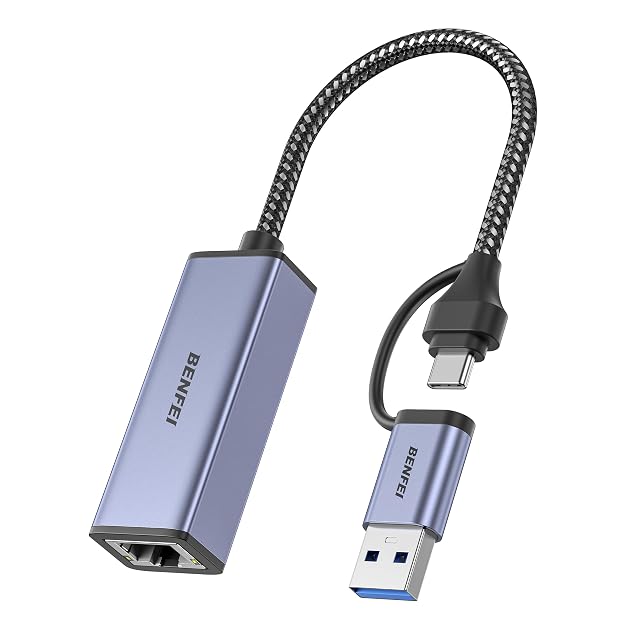
The adapter names four Ethernet standards and then asks for Category 6 cable if the gigabit is to be had — a chain stated by the maker rather than left to the buyer to work out. The dock publishes a 12 V/2.5 A supply rated for two spinning mechanisms and a power switch that protects them while a drive is being fitted, and gives the cloning rule its own bullet: the button held three seconds, and a destination equal to or larger than the source.
The reader that rules out what its own slots suggest
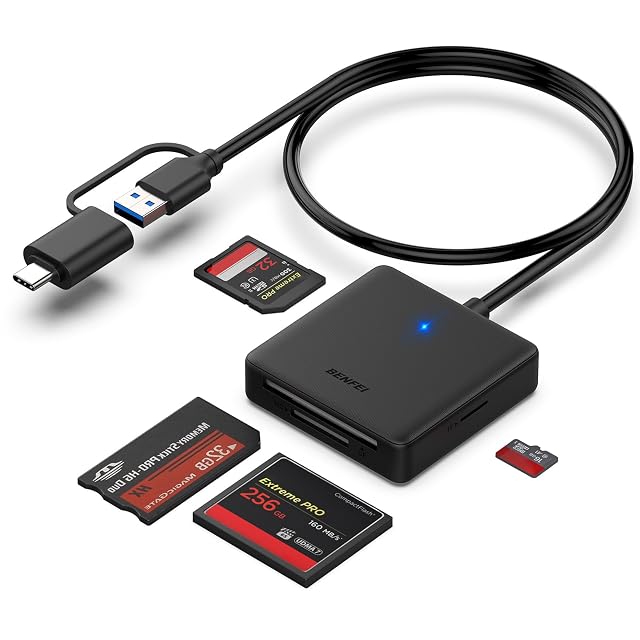
The card reader states that its 160 MB/s belongs to one bus mode and that the rate finally obtained depends on the card and the port. It then names three card formats it will not accept, two of which its own slot list appears to cover — which is the line to read before buying it for an older camera.
A term of months, and two headline rates
Every one of these listings states an eighteen-month warranty, which is rare on shelves where a term is usually left to the seller. Both storage listings then quote their own speed twice in different words — USB 3.0 in a title against USB 3.1 Gen 1 in a bullet, 6 Gbps in a title against 5 Gbit/s below it — and the adapter never names its chip.
USB 3.0 · 5 Gbit/s bus stated · USB-C plug · 10/100/1000 Mbit/s · 802.3, 802.3u, 802.3ab and 802.3az named · Category 6 asked for · 18-month warranty
A gigabit adapter that names four Ethernet standards and then asks for Category 6 cable if the gigabit is to be had, which is the chain stated by the maker rather than by us.
Best for: A laptop with a Type-C socket and no Ethernet, on a network already wired with Category 6 or better, where the gigabit is the whole requirement.
A four-slot reader that reads all four at once, publishes the condition on its own rate, and then names three card formats it will not accept — two of which its slot list appears to cover.
Host interface standard
USB 3.0 — stated in the first bullet, which describes an integrated USB-C and USB 3.0 reader, and again in the second, which names a USB 3.0/2.0 slot or a Type-C slot as the two ways of connecting. Backward compatibility with USB 2.0 and 1.1 is stated in the second bullet
Stated link rate
Up to 160 MB/s in UHS-I mode — stated in the second bullet. The same bullet ends with the maker’s own note that the final data transfer speed depends on the card and on the type of USB port, which makes it one of two listings on this shelf to qualify its own figure in writing. No rate in gigabits per second is published
Connector type
Type-A and Type-C — stated in the first bullet as a 2-in-1 design, with the second naming the newest USB Type-C slot (Thunderbolt 3) alongside a USB 3.0 or 2.0 socket
Internal or external form
External — described throughout as an adapter used with a computer or a laptop. No bay mounting and no motherboard header is named
Slot count
Four — stated in the first bullet, which names access to four different card types: SD, microSD (TF), MS and CF
Formats accepted
SD, microSD or TF, Memory Stick and CompactFlash — stated in the first bullet. The fourth bullet then carries a marked exclusion: not compatible with Memory Stick (standard), Memory Stick Micro (M2) or CF Type I. The two halves of that are printed on the same page and the listing does not reconcile them, so both are reported here as written
Simultaneous slot access
Four cards at once — stated in the third bullet, which calls it a simultaneously working reader able to read four cards at the same time. It is the joint highest count on this shelf
Stated protocol support
UHS-I — named in the second bullet as the mode the 160 MB/s figure belongs to. No UHS-II mode is claimed
Cable arrangement
Not published on the listing — no lead is described and no length is given. The product is called an adapter throughout, and the fourth bullet lists laptops and phones as hosts without saying how the reader reaches them
Amazon reference
B08P517NW5 (same reference on 6 Amazon marketplaces)
EAN
6971785942189
Four card types in one body, including CompactFlash, which three readers on this shelf do not take at all
States that the final speed depends on the card and the port, in its own words
The exclusion note names formats the slot list appears to cover, and the page never squares the two
Best for: A drawer holding cards from three generations of camera — CompactFlash from an older body, SD from a newer one, microSD from a drone — where one reader has to take all of them.
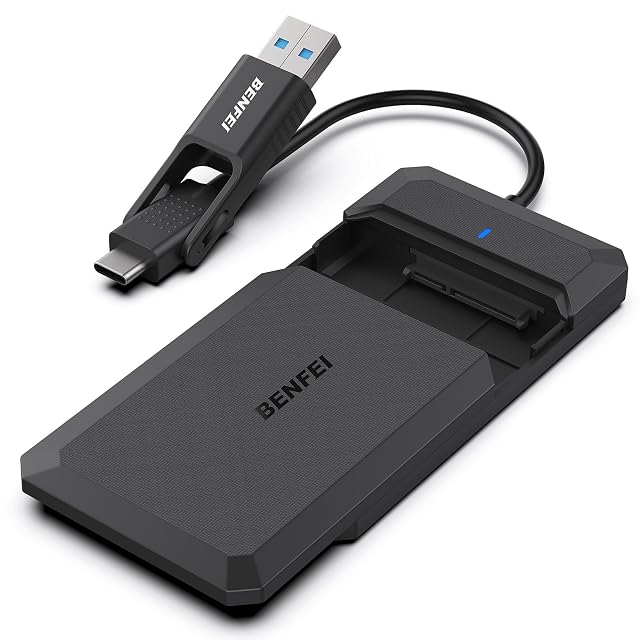
The cheapest enclosure in this hub, with a plug of each kind on the end of it and a drive that slides in behind a cover — and a headline rate that is quoted two different ways.
Supported drive size
2.5-inch SATA I, II and III drives — stated in the title and in the first bullet, which names transferring files between computers, to a PS4 or as an external USB drive as its uses. The fourth gives a ceiling of 6 TB
Supported drive height
7 mm and 9.5 mm — stated in the fourth bullet, which says the enclosure is specifically designed for 2.5-inch drives of those two thicknesses
Bay count
One — a single 2.5-inch drive, described in the third bullet as slid in behind a cover that is pushed out and closed again
Interface standard
USB C 3.2 Gen 2, with a Type-A plug as well — stated in the title. The second bullet adds backward compatibility with USB 2.0 and 1.1 ports
Stated link rate
Two figures are published. The title gives up to 6 Gbps; the second bullet gives up to 5 Gbit/s with UASP SATA III support. Neither is withdrawn and the listing does not reconcile them
Connector type
Type-C and Type-A — stated in the title and in the third bullet, which describes the plug design as making connection to a laptop, a phone or a tablet straightforward
Power source
From the lead — no mains adapter is named anywhere, which is the ordinary arrangement for a 2.5-inch enclosure. No current figure is published
Case material
Not published on the listing — no aluminium, no ABS and no plastic is named in any of the five bullets
Cooling
Not published on the listing — no fan, no vent and no heat statement appears. The third bullet describes the cover sliding out and the drive going in, and the material that would carry the heat is not named either
UASP support
Stated — the second bullet names UASP SATA III support and claims it is 70 % faster than conventional USB 3.0. The same maker’s docking station on the docks shelf of this site puts the figure at 20 %
Tool-free access
Tool-free — the third bullet describes sliding the cover out, plugging the drive in, closing the cover and starting, and adds that the enclosure is hot-swappable
Amazon reference
B0C73VYQCW (same reference on 6 Amazon marketplaces)
EAN
6971785942868
Both plug types on the enclosure, so no adapter is needed for an older machine
Publishes both supported drive heights rather than only the thicker one
Six gigabits in the title and five in the bullets, with nothing reconciling them
Best for: A spare laptop drive being turned into a pocket disc, on a household with machines of two different ages.
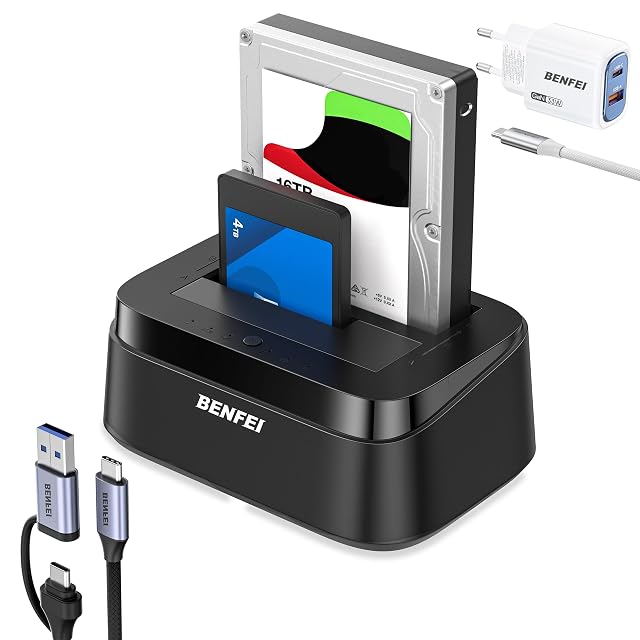
The dock that publishes the two things most of this shelf leaves out — a 12 V/2.5 A supply rated for two spinning drives, and a power switch to protect them while they are fitted.
Bay count
Two — stated in the title and in the first bullet, which describes reading, writing and transferring in parallel between two 2.5-inch or 3.5-inch drives
Supported drive sizes
2.5-inch and 3.5-inch — stated in the title and in the first bullet
Supported drive interfaces
SATA hard discs and solid-state drives — stated in the title and in the first bullet. No SATA revision is named
Solid-state slot support
Not published on the listing — no M.2 position is named. Solid-state drives are supported in the two SATA bays and no separate slot exists
Offline cloning
Stated — the second bullet says the CLONE button is held for three seconds to transfer all data from the source drive to the destination without a computer, and notes that the destination must be equal to or larger than the source
Interface standard
Two designations are published: the title says USB 3.0 and the third bullet says USB 3.1 Gen 1. Both are printed and neither is withdrawn
Stated link rate
Up to 5 Gbit/s — stated in the title and in the third bullet
Connector type
Type-C — stated in the title as a USB-C docking station. No cable is named in any bullet
UASP support
Stated — the third bullet names UASP, the USB Attached SCSI Protocol, and claims it speeds transfers by up to 20 % against conventional USB 3.0. The same maker’s 2.5-inch enclosure on the enclosures shelf of this site puts the figure at 70 %
Power supply
A dedicated 12 V/2.5 A adapter — stated in the fourth bullet, which says it gives a stable supply to both bays and reliable operation even with two demanding 3.5-inch hard discs. It is the higher of the two current ratings published on this shelf
Per-bay controls
A single integrated power switch is stated in the fourth bullet, described as protecting the drives while they are connected and removed, with an instruction to switch the unit off before fitting or removing a drive. No per-bay switch and no per-bay indicator is published
Amazon reference
B0GTVMFGPT (same reference on 5 Amazon marketplaces)
EAN
6971785945371
Publishes the power supply with both figures, 12 V and 2.5 A
A power switch, with an instruction saying when to use it
USB 3.0 in the title and USB 3.1 Gen 1 in the bullets, with nothing reconciling them
Best for: Two 3.5-inch mechanisms running at once, where the supply rating and the switch are the reasons to pay more than the cheaper docks here cost.