A single router is judged on its band plan and its port speeds, not on a class number · review
NETGEAR Nighthawk RAX36, the only router here that publishes its processor and its channel width review
The only router on this shelf that publishes the processor inside it and the channel width behind its class figure — and the only one here with a USB socket.
The short conclusion The only router on this shelf that explains itself rather than labeling itself: a processor, a stream count, a channel width and a USB socket, with the modem requirement stated plainly. The VPN it advertises in its title is the one thing it never specifies.
Two figures on this page appear on no other listing on this shelf, and both explain things a class number cannot.
The first is in the description: a 1.7 GHz quad-core processor, offered for concurrent real-time work — streaming, gaming, audio and video calls at the same time. A router is a small computer, and what decides whether it stumbles when twenty devices are busy is that computer rather than the radios. Ten listings sit on this shelf and this is the only one that names the chip’s speed and core count at all.
The second is 160 MHz channel support, also in the description. The intro to this section says each Wi-Fi generation brings a wider channel, and the width is half of where a class figure comes from: AX3000 at four streams is reached with 160 MHz channels and is not reached with 80. A page that publishes the width is publishing the condition on its own headline, and nothing else here does.
The class figure is AX3000, up to 3 Gbps, dual-band, with four streams named in the description as an AX4 four-stream design. The second bullet gives the Wi-Fi 6 claim and the description adds that Wi-Fi 6 is 2.7 times the speed of the previous standard — a multiplier against a named baseline, which is better than one against nothing. No IEEE clause number appears, so 802.11ax is left to be inferred, as on the other NETGEAR here.
The fifth bullet gives four 1G Ethernet ports for computers, consoles and players. The title adds a USB 3.0 socket and built-in VPN. The USB socket is the only one on this shelf: it is what turns a router into a place to leave a drive for the household, and no other listing here has one. The VPN is named in the title and nowhere specified — no protocol, no client-or-server distinction — where the TP-Link on this shelf names OpenVPN and PPTP.
The third and fourth bullets are unusually direct about what the unit is not: it does not include a built-in cable modem, a separate modem with coaxial inputs is required, and it connects to an existing modem and replaces the Wi-Fi router. Compatible with any provider up to 1 Gbps including cable, satellite, fiber and DSL — which is also a ceiling stated, since a connection faster than a gigabit would meet the WAN socket before it met the radios.
The first bullet gives coverage up to 2,000 square feet for up to 25 devices. That is the largest coverage figure of the three routers on this shelf, and a coverage figure on a single router is the least standardized number on any box — the intro to the mesh shelf of this site says so, and there at least the nodes justify it. Here it is one box and a claim.
At $97.00 and 1,080 g (38.1 oz) this is the most expensive and heaviest of the three American routers here, and 288 by 237 by 120 mm (4.72 in) makes it the largest.
Availability
Priced at roughly $97 on the American Amazon store the day this page was checked.
Every figure in this section is what Keepa held on the day this page was last updated. Stock and prices move without warning.
Prices quoted in this text were read on 7 October 2026. The live price is at the top of the page.
Where it holds up, and where it stops
Strengths
The only router on this shelf that publishes its processor: a 1.7 GHz quad-core, which is what decides behavior when the house is busy
The only one that publishes a channel width — 160 MHz — which is the condition behind its own class figure
The only USB socket on this shelf, at USB 3.0, for leaving a drive on the network
Four streams published, which no other listing here gives
States plainly that no cable modem is built in and that a separate modem with coaxial inputs is required
Gives the provider ceiling as up to 1 Gbps, which is the honest bound on the WAN socket
Compromises
The built-in VPN is named in the title and never specified — no protocol and no client-or-server distinction
No IEEE clause number, so 802.11ax has to be inferred
No separate WAN port counted, and no antenna arrangement described at all
A 2,000 square foot coverage claim on one box, which is the least standardized figure any router prints
The most expensive, heaviest and largest of the three American routers on this shelf
Specifications
Wi-Fi generation
Wi-Fi 6 — stated in the title and in the second bullet, with the description adding that it is 2.7 times the speed of the previous standard
IEEE designation
Not published on the listing — neither 802.11ax nor any other clause number appears, so the generation is given only by its marketing name, as on the other NETGEAR router here
Stated class figure
AX3000, up to 3 Gbps, dual-band — stated in the title and in the second bullet. The description adds the condition that explains it: 160 MHz channel support, which is what a four-stream AX3000 needs. It is the only listing on this shelf to publish a channel width
Band count
Two — the title gives dual-band gigabit internet. No 6 GHz band is claimed
Stream count
Four — the description names an AX4 four-stream design. It is the only stream count published on this shelf
WAN port speed
Not published as a separate rating — the fourth bullet gives compatibility with any provider up to 1 Gbps, which is a ceiling on the socket rather than a rating of it. No WAN port is counted apart from the four LAN ports
LAN port speed
1G — stated in the fifth bullet for all four sockets
Port count
Four 1G Ethernet ports — stated in the title and in the fifth bullet. Whether a fifth WAN socket exists is not stated, although the third and fourth bullets describe connecting to an existing modem
USB ports
One USB 3.0 — stated in the title. It is the only USB socket published on this shelf, and it is what allows a drive to be shared across the household from the router itself
Antenna arrangement
Not published on the listing — no antenna count and no statement of internal or external appears, on a unit measuring 288 by 237 by 120 mm (4.72 in)
Amazon reference
B0DK7RVXHP
EAN
0606449159561
The questions that come up before an order
Why does the processor matter?
A router is a small computer, and what decides whether it slows down with twenty devices busy is that computer rather than the radios. The description gives a 1.7 GHz quad-core, and no other listing on this shelf names a chip at all.
What does 160 MHz channel support mean for the AX3000 figure?
A four-stream AX3000 figure is reached with 160 MHz channels and not with 80. Publishing the width is publishing the condition on the headline, which this is the only listing here to do.
Which VPN does it run?
The title says built-in VPN and the page never says which. The TP-Link router on this shelf names OpenVPN and PPTP, so the comparison cannot be made from this page alone.
The buyer this one serves, among network and storage gear
A busy household wanting a router that will not stumble under load, with a drive left on the USB socket.
What this one costs among network and storage gear
Details checked on October 7, 2026.
What buyers actually choose
Amazon reports what buyers took in the month before this page was last checked: at least 500.
The figure is a floor, rounded by Amazon, and read through Keepa — it says what buyers picked, not what a maker claims.
Sources
Specifications: the manufacturer sheet for network and storage gear and the matching Amazon product page. Prices and availability: Keepa. Every figure on this page names its source.
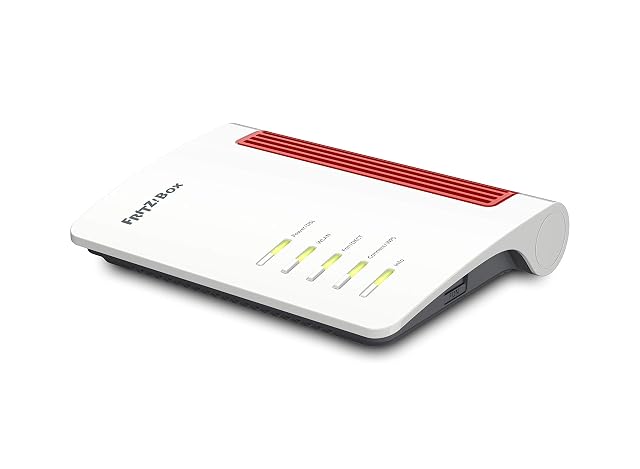
Wi-Fi 6 · 2.4 Gbit/s stated, exactly 1800 plus 600 · DSL modem built in · VoIP and DECT · not one Ethernet socket counted
The only router here with a modem and a telephone exchange inside it, and the only one whose headline figure is exactly the sum of the two rates printed beneath it.
Best for: A household on a DSL line that wants the modem, the telephony and the radios in one box rather than three.