Topology first, then the gap between the VA figure and the watt figure · review
Tripp Lite AVR900U, two waveforms for two modes and a USB cable in the box review
The only listing on this shelf that publishes a different waveform for mains mode and for battery mode, with the 89–145 V window its regulator corrects and a USB cable already in the box.
The first bullet ends with a sentence that no other listing on this shelf attempts: “Features Pure Sine Wave in AC mode and PWM Sine Wave output in battery mode.”
Two waveforms, named separately, for the two states the unit has. The Smart-UPS publishes a pure sine wave without saying in which mode, and the three Back-UPS units publish no waveform at all. The distinction is the whole substance of the row: a line-interactive unit passes the mains through most of the time, so the waveform that matters is the one it produces when the mains has gone — and this page says it is a pulse-width-modulated sine rather than a true one. That is a smaller claim than “pure sine wave” and it is the honest version of it.
The second bullet gives the automatic voltage regulation with its window: input voltages between 89 V and 145 V are corrected without switching to battery. A regulation claim without a window is a word; with a window it can be set against the supply in the building. Line-interactive is the topology that makes regulation possible; of the other two units on this shelf that name it, the Eaton publishes its window and the Smart-UPS does not.
Twelve outlets, six on battery and surge and six surge-only, stated in the first bullet — the highest socket count in this group. Nine hundred volt-amperes and four hundred and eighty watts, a ratio of 0.53, which is the lowest in this group and means the watt figure bounds the load sooner than the VA figure suggests.
The fourth bullet is the one that separates this from the Back-UPS units on this shelf: a USB port with the cable included, connecting to a computer running PowerAlert software for unattended file saving and system shutdown, with the software named and free to download. The Eaton 5S700G publishes a USB port and its software too; this one publishes the port, the cable, the software and what the software does.
The third bullet names the replacement battery as the Tripp Lite RBC51 cartridge, gives a five-foot power cord and bottom mounting tabs for a wall, and claims EMI and RFI filtering. The fifth gives three years of manufacturer’s warranty and a $100,000 lifetime connected equipment insurance — the second-largest cover figure in this group, behind the rackmount unit’s $150,000.
The description names the topology outright: a line-interactive system. It also gives the honest caveat about runtime — backup time varies according to load — and then gives one: as long as 47 minutes for an energy-efficient desktop computer with a small LCD monitor. The load is named by its equipment rather than in watts, where three of the four APC units in this group give a runtime at a stated wattage and the smallest gives fifteen minutes at a hundred watts.
At $149.54 on October 26, 2026 it was the second-lowest price on this shelf, after the APC BE425M.
Prices quoted in this text were read on October 26, 2026. The live price is at the top of the page.
Where it holds up, and where it stops
Strengths
The only listing on this shelf that publishes a waveform for each mode, and names the battery-mode one as a PWM sine rather than claiming pure sine throughout
Publishes the voltage window its regulator corrects, 89 V to 145 V — the only window on this shelf for a 120 V supply
Twelve outlets, the most in this group, split six on battery and six surge-only
A USB port with the cable in the box and the shutdown software named, which is the complete arrangement rather than a socket
Names the replacement cartridge as the RBC51, with wall-mount tabs and a five-foot cord
Three years of warranty and $100,000 of lifetime connected equipment insurance
Compromises
The one runtime, 47 minutes, is tied to a described desktop rather than to a load in watts, so it cannot be set beside the APC figures at 100 or 150 W
The lowest VA-to-watt ratio in this group at 0.53, level with its own stablemate here, so the 900 on the box overstates what it will carry
No battery chemistry, voltage or capacity — only the cartridge number
"Fluctuations" is misspelled in the second bullet
Nearly seven kilograms, which is heavy for a desk and awkward for the wall tabs it offers
Specifications
Topology
Line-interactive — stated in the description as a line-interactive UPS system with AVR protection. The Smart-UPS and the Eaton 5S700G on this shelf are line-interactive too
Stated classification
Not published on the listing — no IEC classification and no VFD, VI or VFI designation appears, although the line-interactive topology and the AVR window together describe the same behavior
VA rating
900 VA — stated in the title and in the first bullet
Watt rating
480 W — stated in the title and in the description, which puts the ratio at 0.53 — the lowest in this group, shared with the other Tripp Lite unit on this shelf. The watt figure bounds the load sooner than the VA figure suggests
Stated runtime at a named load
As long as 47 minutes for an energy-efficient desktop computer with a small LCD monitor — stated in the description, which names the load by its equipment and gives no wattage for it, after saying that backup time varies according to load
Output waveform
Two, named by mode — pure sine wave in mains mode and a pulse-width-modulated sine wave on battery, stated in the first bullet. It is the only listing on this shelf that separates the two states, and the battery figure is the smaller and more honest of the two claims
Socket count
Twelve, split — six with battery backup and surge protection and six surge-only, stated in the first bullet. It is the highest socket count in this group
Socket type
NEMA, for a 120 V supply — the description gives 120 V outright, which the Back-UPS listings on this shelf leave implied. Every other unit on this shelf has NEMA outlets for a 120 V wall, except the Eaton 5S700G with IEC C13 at 230 V
Battery type
Not published on the listing — no chemistry, no voltage and no capacity in ampere-hours appears. Only the replacement cartridge is named
Battery replaceability
Easily replaceable, with the part named — the third bullet gives the Tripp Lite RBC51 cartridge. Four of the seven units on this shelf name their cartridge
Communication port
USB, with the cable included — stated in the fourth bullet, connecting to a computer running PowerAlert software for unattended file saving and system shutdown, with the software named and free to download. The Eaton 5S700G also names a USB port and its software; this one names the port, the cable, the software and its purpose
Amazon reference
B001126QE0
EAN
0000373321399
On Amazon.com
Amazon.com had an offer at $150 on October 26, 2026.
Where this unit differs
Put against the median of its own group on this site — not against every network product sold.
Stated runtime at a named loadAs long as 47 minutes for an energy-efficient desktop computer with a small LCD monitor — stated in the description, which names the load by its equipment and gives no wattage for it, after saying that backup time varies according to load+124 % against the median of this group
Watt rating480 W — stated in the title and in the description, which puts the ratio at 0.53 — the lowest in this group, shared with the other Tripp Lite unit on this shelf. The watt figure bounds the load sooner than the VA figure suggests-11 % against the median of this group
The questions that come up before an order
What waveform does it produce on battery?
A pulse-width-modulated sine wave, stated in the first bullet, which also gives a pure sine wave in mains mode. No other listing on this shelf separates the two modes, and the battery one is the figure that matters.
What does the AVR actually correct?
Input voltages between 89 V and 145 V, stated in the second bullet, without switching to battery. The Eaton 5S700G publishes a wider window, 175 to 275 V, for a 230 V supply; the Smart-UPS publishes none.
How long will it run?
Only in words. The description gives as long as 47 minutes for an energy-efficient desktop computer with a small LCD monitor, after saying that backup time varies according to load. No wattage is attached, where the APC units on this shelf publish runtimes at 100 or 150 W.
Will it shut my computer down?
Yes, through the supplied USB cable and the free PowerAlert software, named in the fourth bullet for unattended file saving and system shutdown.
Against the rest of the network and storage gear
This network and storage gear share the category and the price bracket. Only what each one states is shown; an incomplete column would mislead.
Model
Price
Topology
Stated classification
VA rating
Watt rating
Tripp Lite AVR900U, two waveforms for two modes and a USB cable in the box
$150
Line-interactive — stated in the description as a line-interactive UPS system with AVR protection. The Smart-UPS and the Eaton 5S700G on this shelf are line-interactive too
Not published on the listing — no IEC classification and no VFD, VI or VFI designation appears, although the line-interactive topology and the AVR window together describe the same behavior
900 VA — stated in the title and in the first bullet
480 W — stated in the title and in the description, which puts the ratio at 0.53 — the lowest in this group, shared with the other Tripp Lite unit on this shelf. The watt figure bounds the load sooner than the VA figure suggests
Standby — stated in the description as a standby UPS system. The mains passes straight through and the unit intervenes only on failure, so there is no voltage regulation. The APC BE900G3 is the other standby unit named as such on this shelf
Not published on the listing — no IEC classification and no VFD, VI or VFI designation appears, although the standby topology describes the same behavior
850 VA — stated in the title and in the first bullet
450 W — stated in the title and in the first bullet, which puts the ratio at 0.53
Line-interactive — stated in the title and in the first bullet, which is the topology that makes voltage regulation possible. The Smart-UPS and the Tripp Lite AVR900U on this shelf are line-interactive too
Not published on the listing — no IEC classification and no VFD, VI or VFI designation appears, although the line-interactive topology and the published window describe the behavior
700 VA — stated in the title and in the first bullet
420 W — stated in the title and in the first bullet, which puts the ratio at 0.60
What separates the models, in network and storage gear
If price decides: this model, at $150.
Highest VA rating in the table: APC BE900G3, a 6 ms transfer time and USB-C charging on the front (900 VA — stated in the title and in the first bullet. It is the figure on the box rather than the load the unit will carry).
Highest Watt rating in the table: APC BE900G3, a 6 ms transfer time and USB-C charging on the front (540 W — stated in the title and in the first bullet alongside the VA figure, which puts the ratio at 0.60).
The buyer this one serves, among network and storage gear
A computer that must save and shut down by itself, where knowing the battery-mode waveform and the regulation window matters more than a runtime figure.
What this one costs among network and storage gear
Details checked on October 26, 2026.
What buyers actually choose
Amazon reports what buyers took in the month before this page was last checked: at least 100.
The figure is a floor, rounded by Amazon, and read through Keepa — it says what buyers picked, not what a maker claims.
Sources
Specifications: the manufacturer sheet for network and storage gear and the matching Amazon product page. Prices and availability: Keepa. Every figure on this page names its source.
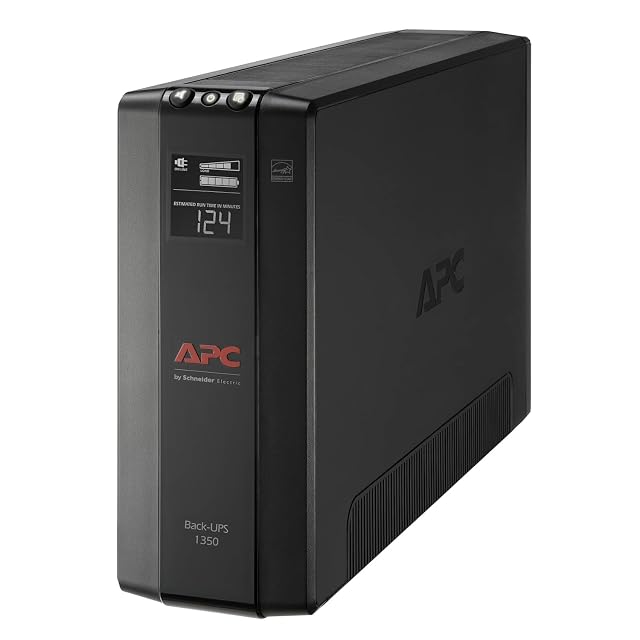
topology not published · 1350 VA and 810 W · over 54 minutes at 100 W · ten NEMA outlets, five on battery · coaxial and Ethernet surge protection · AVR from 88 V, ±13 per cent · ENERGY STAR at 92 per cent · battery APCRBC123 named
The longest runtime on this shelf at over fifty-four minutes, the only efficiency figure here, and the only listing that names compatibility with an actively corrected power supply.
Best for: A desk that has to keep working through an outage rather than shut down during one, with an actively corrected power supply in the computer.
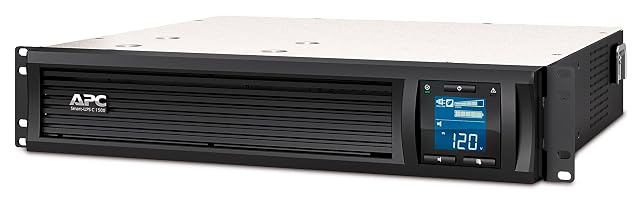
line-interactive · 1500 VA and 900 W pure sine wave · runtime not published · six NEMA 5-15R out, NEMA 5-15P in · 2U rack with rails · cloud portal with notifications and firmware · 2 years plus 2 years battery plus 1 more if registered · $150,000 cover
The only rackmount unit on this shelf, publishing a pure sine wave, its input plug as well as its outputs, and a warranty split three ways — on a page whose cloud service is free for six months in one place and two years in another.
Best for: A cabinet that already holds the switch and the network drive, where the rails, the sine wave and the remote firmware are the reasons to spend four times the money.
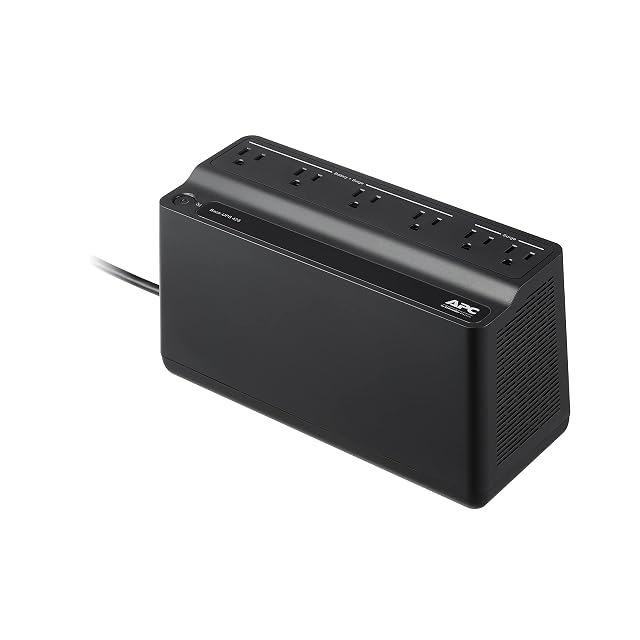
topology not published · 425 VA and 255 W · 15 minutes at 100 W · waveform not published · six NEMA outlets, four on battery · 180 joules · building wiring fault indicator · three years and $75,000 cover
The lowest price on this shelf, with a runtime at a named load, a joule rating and a lamp that warns about the wiring in the wall — and neither its topology nor its waveform.
Best for: A router and a modem in a flat where the socket is somebody else’s work and the wiring lamp earns its keep.