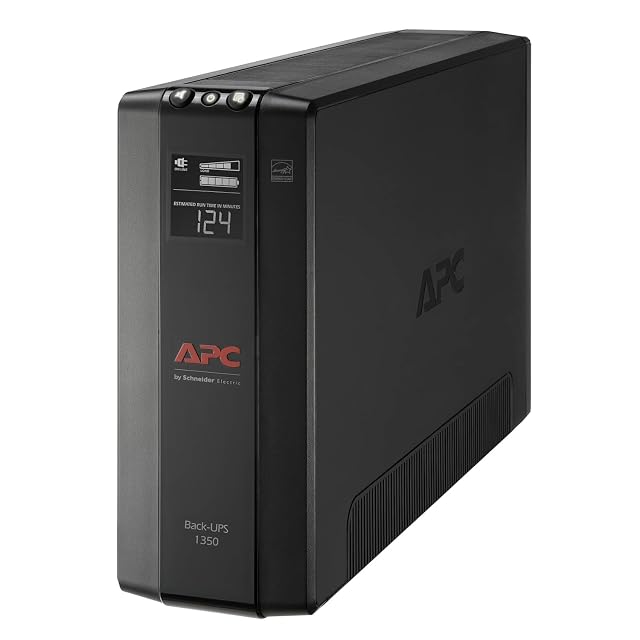
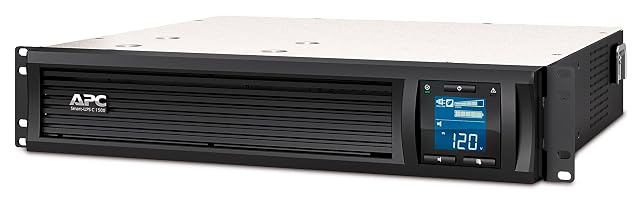
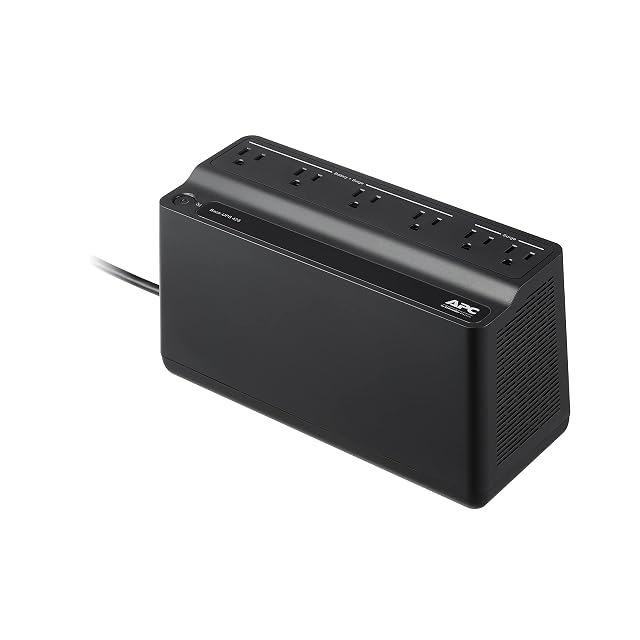
The second bullet is the whole argument for this unit: “Network Battery Backup lets you receive alerts through email or text, silence alarms, restart the UPS, and view outlet banks through web browser or Eaton’s free Brightlayer app.”
An email or a text message when the mains fails. Across the seven units on this shelf, two publish a USB port and software that can shut a computer down — the Tripp Lite AVR900U and the Eaton 5S700G — and the Smart-UPS sends notifications through its cloud portal; this is the only one that names email and text messages. For a unit sold for a retail kiosk, a point-of-sale terminal or a security camera — all named in the second and fifth bullets — being told from elsewhere is the difference between an outage and an outage someone knows about. Silencing the alarm and restarting the unit remotely are in the same list.
The third bullet gives the setup, and it is unlike anything else here: scan a QR code on the unit to add it to the application, and transfer custom network settings from a mobile telephone over NFC for configuring several units the same way. Holding a phone against a UPS to configure it is not a feature this shelf has seen before.
The specification underneath is modest and in one place incomplete. Eight hundred and fifty volt-amperes and four hundred and fifty watts, a ratio of 0.53 — the same low ratio as its stablemate on this shelf. The description names the topology as standby, which is the simpler and cheaper arrangement: the mains passes straight through and the unit intervenes only when it fails, so there is no voltage regulation.
The outlet line needs reading twice. The title says five outlets; the first bullet says “5-outlets of low-maintenance battery backup and surge protection”, which reads as all five being on battery. The three APC units on this shelf all split their outlets explicitly between battery and surge-only, and that split is what decides whether a runtime figure survives a printer. This page does not make the split, and it publishes no runtime figure at any load either — so neither half of that calculation is available.
What it does publish is 190 joules of surge protection, a resettable circuit breaker against overloads, EMI and RFI filtering, and automatic restart once power returns “regardless of battery charge level” — which is a real distinction, since some units will not restart on an empty battery. The fourth bullet names the replacement battery as the Eaton AG-0761 cartridge.
The fifth bullet gives the mounting as keyhole slots in a 100 by 100 mm (3.94 in) VESA pattern. That is the monitor-mount standard, and naming it means any VESA bracket will take the unit — the only listing on this shelf to give its mounting as a standard rather than as a description.
At $173.66 and 3,198 g (112.8 oz) this is the third-most expensive American listing here. The product record gives 762 by 203 by 152 mm (5.98 in), a 762 mm (30 in) figure that is the five-foot extension cord in the title rather than the body of the unit.
Prices quoted in this text were read on October 26, 2026. The live price is at the top of the page.