The bottom line Honest about its band rates and generous with its sockets, and a dual-band design carrying a three-unit mesh. Where one node can reach the modem by cable that matters less; where all three must relay over the air, it is the thing to weigh.
On the listing
Three Wi-Fi 6 Deco X50 units badged AX3000, with 2402 Mbit/s at 5 GHz and 574 Mbit/s at 2.4 GHz, more than 150 simultaneous devices, AI-driven mesh with coverage to 604 m², three Gigabit sockets on each unit, compatibility named against specific provider and modem brands, app setup in which the second and third units join by being switched on, WPA3 with the maker security suite, and the ability to add further Deco models to the same network.
The badge and its parts
2402 plus 574 is 2976. The badge says 3000. Both numbers are printed on the same page, twenty-four apart, and the smaller one is the honest arithmetic of two theoretical radio peaks added together. Very few listings on this shelf let you see that subtraction.
Two bands, three units
Dual-band on a mesh set is a design decision with a cost. The 5 GHz radio serves the devices around a unit and also carries traffic on to the next unit, and both uses draw on the same air time. Systems that avoid this keep a third radio aside. This one does not have a third radio, and the listing does not say whether a cable may be used between units instead.
The wired side
Three Gigabit sockets on each unit, stated per unit — the clearest socket line in this group. What is not stated is which of the three takes the cable from the modem, and whether that socket differs from the other two.
Before ordering
604 m² and four to six bedrooms describe the same house two ways, both from the maker’s own assumptions. Measure the distance the third unit will sit from the second: on a dual-band system that hop is where the throughput goes.
Availability
Priced from 183 € to 214 € across the German, French, Italian and Spanish Amazon stores the day this page was checked.
It is stocked on the British Amazon store as well, in that country’s own currency. The range above leaves those out: it counts euro stores and no others.
The American Amazon store returned nothing at all, so the buy button there opens a search in that country rather than a page that would not load.
Every figure in this section is what Keepa held on the day this page was last updated. Stock and prices move without warning.
Prices quoted in this text were read on 10 September 2026. The live price is at the top of the page.
Where it holds up, and where it stops
Strengths
Publishes a rate for each band, so the badge can be checked against the numbers it was made from
Three Gigabit sockets on every unit, counted per unit rather than heaped together for the pack
States compatibility with named provider modems, which is the specific version of a claim most listings leave vague
Compromises
Dual-band on a three-unit set means the radio serving your laptop is also the one reaching the next unit, and the listing never addresses that
No socket is designated for the incoming line, so which of the nine takes the modem cable is unstated
A ceiling of more than 150 devices sits next to an area of 604 m² without either being tied to a pack size
Specifications
Wi-Fi generation
Wi-Fi 6 — stated in the title and in the first bullet
IEEE designation
Not published on the listing — the generation is given by number, and no 802.11 letter pair is printed among the seven bullets
Stated class figure
AX3000 — stated in the title, with the bullet publishing both parts: 2402 Mbit/s at 5 GHz and 574 Mbit/s at 2.4 GHz, which come to 2976, so the badge rounds up by 24
Band plan
Dual-band with both radios rated — 2402 Mbit/s at 5 GHz and 574 Mbit/s at 2.4 GHz, stated in the first bullet
Backhaul type
Not published on the listing — the bullets describe devices moving automatically between Decos, and nothing says whether a band is reserved for the link between units or whether a cable may be used instead
Node count
Three — stated in the title as a 3-pack
Pack composition
Three identical Deco X50 units — stated; the listing adds that further Decos of other models can join the same network
Stated coverage area
Up to 604 m² — stated, alongside more than 150 simultaneous devices and a recommendation for homes of four to six bedrooms
Ethernet port count
Three per unit — stated in the title, so nine across the pack
Port speed
Gigabit — stated in the title for the three sockets on each unit, without the 1000BASE-T designation behind the word
Separate WAN socket
Not published on the listing — the three sockets on each unit are described as a group, and none is marked for the incoming line
Amazon reference
B09LVG58VX (same reference on 5 Amazon marketplaces)
EAN
4897098687086
The questions that come up before an order
Why is 2976 printed and 3000 on the box?
Because the badge is rounded. The two published rates are the theoretical peaks of the two radios, calculated from the channel width and stream count the standard defines; adding them gives 2976, and the marketing figure is the nearest round number above it. Both are on this page, which is more than most listings show.
What does dual-band cost on a three-unit set?
The 5 GHz radio has to do two jobs at once — serve the devices near it and carry traffic on towards the next unit. Air time spent on one is not available to the other. A third radio would separate them; this system does not have one, and the listing does not discuss the trade.
Wi-Fi 7 · BE11000 badge over 10 777 Mbit/s published · dedicated 6 GHz backhaul · four 2.5G sockets, one WAN · 110 m² stated
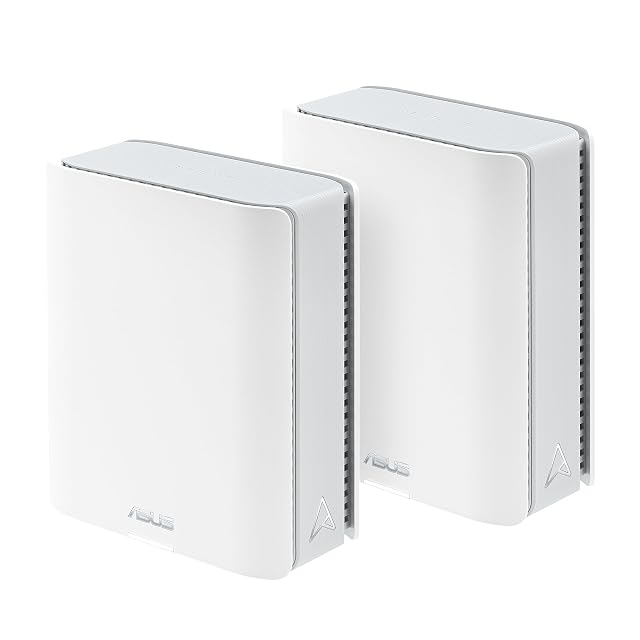
The most completely specified unit in this group: three band rates, a named backhaul, four multi-gigabit sockets — and a badge 223 Mbit/s larger than the figures printed beneath it.
Best for: A household on a multi-gigabit line that wants every socket faster than a gigabit and a 6 GHz lane kept clear between nodes.
Wi-Fi 6 · up to 3000 Mbit/s stated · two units · seven of eleven lines unpublished · made in Europe
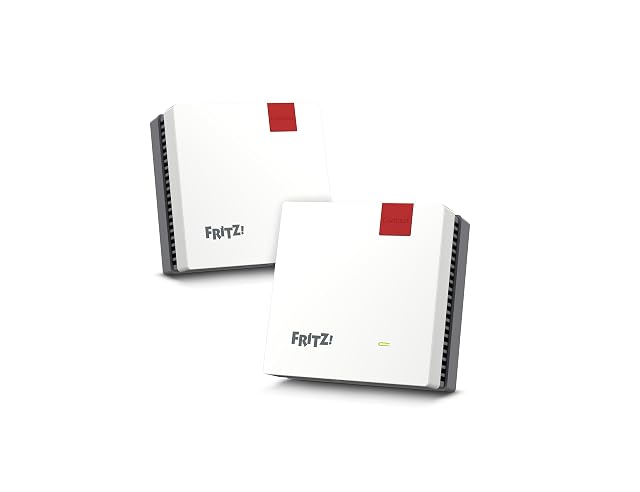
A two-piece set from a well-known European maker whose listing runs on four bullets: a generation, a figure, an installation promise and a sentence about security.
Best for: A buyer who already trusts the maker and wants a mesh pair that will sit behind an existing provider box without an argument.