Node count and the link between nodes decide coverage, never the headline number · review
Tenda Nova MW12, three-node tri-band mesh system review
A three-node tri-band system that publishes an area, a device ceiling and a socket count, and never names the Wi-Fi generation its class figure belongs to.
The bottom line Generous with the numbers a buyer counts — area, devices, sockets, stations — and silent on the ones that describe the radio. If the plan is three units and a cable in each room, that trade is a reasonable one.
On the listing
A three-station mesh system badged AC2100 and tri-band, 600 m² of coverage, expansion to twelve stations and 2200 m², up to 100 simultaneous devices, nine Gigabit sockets across the pack, setup and control through the Tenda Wi-Fi app with a station added in three steps, seamless roaming between stations, Alexa voice control, a service telephone number, and a three-year manufacturer warranty.
What AC2100 counts
The badge is the sum of the theoretical peaks of the radios inside, worked out from the channel width and the stream count the standard defines for each one. This listing publishes the sum and none of the parts. On a tri-band unit that leaves the most interesting question open: whether the extra radio is a second helping for clients or a lane kept clear for traffic heading back to the first station.
The socket count
Nine, in the title. Divided evenly that is three per station, which would be generous. The listing does not divide them, and it does not say which socket the modem plugs into.
The area, and where it comes from
600 m² for three stations and 2200 m² for twelve are the maker figures, resting on the maker assumptions about the building. They are useful as a ratio — roughly 180 m² per station on the maker’s own arithmetic — and they are not a measurement of your house.
Before ordering
If the units will be spread across floors, ask whether any two can be joined by a cable. A wired link between stations removes the halving that an over-the-air link costs, and this listing does not say whether the system accepts one.
Availability
Priced from 85 € to 100 € across the German, French, Italian and Spanish Amazon stores the day this page was checked.
In the American and British Amazon catalogues with no live offer against it: the reference exists, nobody is filling it.
Every figure in this section is what Keepa held on the day this page was last updated. Stock and prices move without warning.
Prices quoted in this text were read on 10 September 2026. The live price is at the top of the page.
Where it holds up, and where it stops
Strengths
Publishes an area, a device ceiling and a socket count on one page, which is three more numbers than most of this shelf offers
Names the expansion limit — twelve stations and 2200 m² — so the ceiling of the system is known before the first one is plugged in
Carries a three-year manufacturer warranty and a service telephone number and address in the bullets
Compromises
No Wi-Fi generation and no 802.11 designation anywhere, so the AC prefix is the only clue to what the radios speak
The nine Gigabit sockets are counted as a single heap, and which of the three stations carries which is not said
Tri-band is claimed and no radio is given a rate, so what the third band is for cannot be read off the page
Specifications
Wi-Fi generation
Not published on the listing — the class figure carries an AC prefix and no generation number is claimed anywhere for the units themselves
IEEE designation
Not published on the listing — no 802.11 letter appears in the title or in the seven bullets, which describe compatibility by naming internet providers instead
Stated class figure
AC2100 — stated in the title and repeated in the bullets as AC2100 speeds; the listing does not say how the figure divides between the three radios
Band plan
Tri-band — stated in the title; the three frequencies are not named and none of them is given a rate
Backhaul type
Not published on the listing — the bullets describe stations working together and a device moving to the nearest one, without saying whether a radio is set aside for the link between stations
Node count
Three — stated in the title as a 3-pack, and described in the bullets as Nova stations
Pack composition
Three stations, described as working together rather than as a router plus satellites; the listing states the system extends to twelve stations in total
Stated coverage area
600 m² for the three-station pack — stated, with 2200 m² given for a twelve-station maximum and a ceiling of 100 simultaneous devices
Ethernet port count
Nine across the pack — stated in the title as 9× Gigabit Port; the listing does not say how the nine divide between the three stations
Port speed
Gigabit — stated in the title for all nine sockets, without the 1000BASE-T designation behind the word
Separate WAN socket
Not published on the listing — the nine sockets are counted as one group and none of them is designated for the incoming line
Amazon reference
B08BTHZWXY (same reference on 6 Amazon marketplaces)
EAN
6932849428476
The questions that come up before an order
What does the AC prefix on a class figure mean?
It marks the generation family the figure was calculated under, in the same way AX and BE mark later ones. The prefix on its own does not give the generation number, the channel width or the stream count, and this listing publishes none of the three.
Why does a third band matter on a mesh system?
On a two-band system, the radio that talks to your laptop is also the radio carrying traffic back towards the router, so the airtime is spent twice. A third radio can be reserved for that return trip. Whether this system reserves one is not stated here.
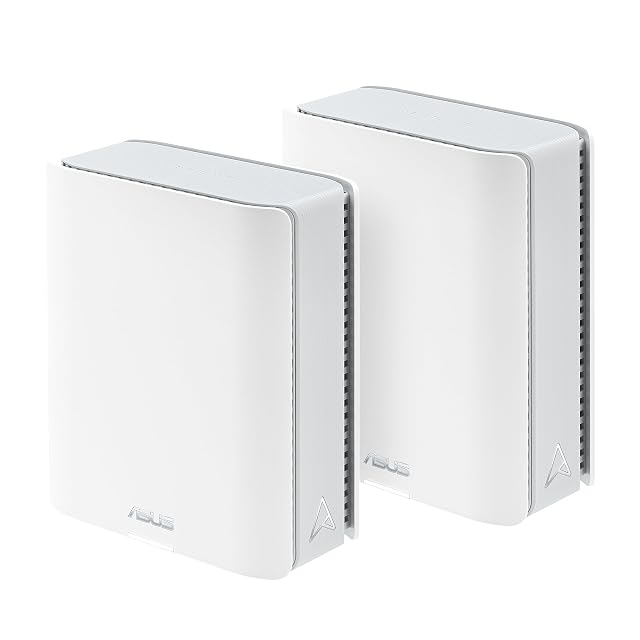
Wi-Fi 7 · BE11000 badge over 10 777 Mbit/s published · dedicated 6 GHz backhaul · four 2.5G sockets, one WAN · 110 m² stated
The most completely specified unit in this group: three band rates, a named backhaul, four multi-gigabit sockets — and a badge 223 Mbit/s larger than the figures printed beneath it.
Best for: A household on a multi-gigabit line that wants every socket faster than a gigabit and a 6 GHz lane kept clear between nodes.
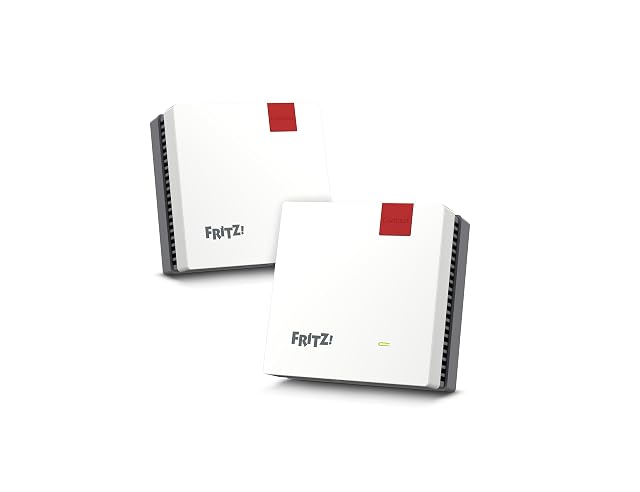
Wi-Fi 6 · up to 3000 Mbit/s stated · two units · seven of eleven lines unpublished · made in Europe
A two-piece set from a well-known European maker whose listing runs on four bullets: a generation, a figure, an installation promise and a sentence about security.
Best for: A buyer who already trusts the maker and wants a mesh pair that will sit behind an existing provider box without an argument.