Resolution and refresh rate are one figure, and the switching method is the other · review
UGREEN AK700, two-computer DisplayPort switch driving two screens review
A two-computer switch that carries two DisplayPort screens for each machine, states plainly that it has no HDMI socket, and names the machines it will not drive in pairs.
The bottom line A carefully written page for a narrow job: two machines, two DisplayPort screens, peripherals that follow. The two warnings it prints, about HDMI and about certain laptops, are worth more than most of the specifications on this shelf.
On the listing
Two desktop computers sharing two DisplayPort screens and four USB devices, with a copying or an extending arrangement to choose between, HDCP 2.3 supported and able to fall back to HDCP 1.4 depending on the screen, and a stated note that this switch has no HDMI socket; a DisplayPort 1.4 path quoted at up to 8K at 60 Hz, backwards compatible with 8K at 30 Hz, 4K, 1080p, 720p and 480p, with HDR10 and HDR10+ supported; four USB 3.0 sockets, three type A and one type C, at up to 5 Gbps and backwards compatible, with the peripherals following the machine automatically when it is changed; two switching methods, a button on the unit and a desk controller, with operating systems named; and a box containing two USB-A leads, a desk control and a 12 V 2 A adapter with interchangeable plugs.
The note that saves a wrong order
No HDMI socket. It is in the first bullet, in its own note, on a product whose shelf is full of HDMI switches. Anyone whose screens are HDMI will read it and buy something else, which is the entire purpose of putting it there.
Two screens per machine
This is the specification that separates the unit from the four-computer boxes beside it. It accepts fewer machines and gives each of them a pair of screens, in a copying or an extending arrangement, with the peripherals moving across as the machine changes.
The limit that is not the switch
The fourth bullet names laptop processors that will not drive two displays at all, adding that a docking station does not raise the number either. That limit sits in the computer. A switch cannot add an output a machine does not have, and the page says so rather than leaving it to be discovered.
What is in the box, and what is not
Two USB-A leads, a desk control and an adapter with plugs for several countries. No DisplayPort lead, which is the one that carries the picture.
Before ordering
Count the DisplayPort leads already on the desk. Two screens and two machines can want as many as four, and none of them arrives in this box.
Availability
Priced from 63 € to 77 € across the German, French, Italian and Spanish Amazon stores the day this page was checked.
It is stocked on the American and British Amazon stores as well, in that country’s own currency. The range above leaves those out: it counts euro stores and no others.
Every figure in this section is what Keepa held on the day this page was last updated. Stock and prices move without warning.
Prices quoted in this text were read on 10 September 2026. The live price is at the top of the page.
Where it holds up, and where it stops
Strengths
Two screens for each machine, with a choice between copying and extending, which is the arrangement a desk with two monitors actually needs
Says outright in the first bullet that there is no HDMI socket, which is the return this listing prevents
Names the machines it will not drive in pairs — the fourth bullet states that certain laptop processors will not support two displays, whatever is plugged in
Compromises
Two computers only, so a third machine has no home on this unit
No DisplayPort lead is listed among the contents, so the leads that carry the picture have to be found separately
No audio connection of any kind is named
Specifications
Port count
Two — stated in the title and in the first bullet as two desktop computers
Maximum resolution
8K — stated in the title and in the second bullet as up to 8K at 60 Hz, backwards compatible with 8K at 30 Hz, 4K, 1080p, 720p and 480p. It is the ceiling of the switch alone; the computers and the screens each impose their own
Refresh rate
60 Hz at 8K, with 8K at 30 Hz also named — stated in the second bullet as pairs, which is the form in which the two figures can be read together
Video connector type
DisplayPort 1.4 — stated in the second bullet; the first bullet states in as many words that this switch has no HDMI socket
Screens per computer
Two — stated in the first bullet, where two DisplayPort screens are shared by the two machines, in either a copying or an extending arrangement
USB port count
Four — stated in the third bullet as three USB-A sockets and one USB-C
USB generation
USB 3.0, quoted at up to 5 Gbps and backwards compatible with USB 2.0 and 1.1 — stated in the third bullet, which adds that the connected peripherals follow the machine when it is changed
Switching method
Two — a button on the unit and a desk controller, stated in the fourth bullet as a single press to change machine
Audio support
Not published on the listing — no audio socket and no channel arrangement is named; the second bullet describes HDR10 and HDR10+ and the first names HDCP 2.3 for the video path instead
Cables supplied
Two USB-A leads, one desk control and a 12 V 2 A power adapter with interchangeable plugs — stated in the fifth bullet. No DisplayPort lead is named among the contents
Amazon reference
B0DXF5Z23S (same reference on 6 Amazon marketplaces)
EAN
6941876258512
The questions that come up before an order
What is the difference between the copying and the extending arrangement?
Copying puts the same picture on both screens. Extending treats them as one wider workspace, with different windows on each. This listing names both and lets the choice be made at the switch, which is what makes a two-screen desk worth the extra sockets.
Why does the listing warn about certain laptop processors?
Because the number of separate displays a machine can drive is fixed in its own hardware, and no switch or dock raises it. The fourth bullet says so plainly for the processors it names. It is a limit of the computer rather than of the switch, and stating it is the honest thing for a two-screen product to do.
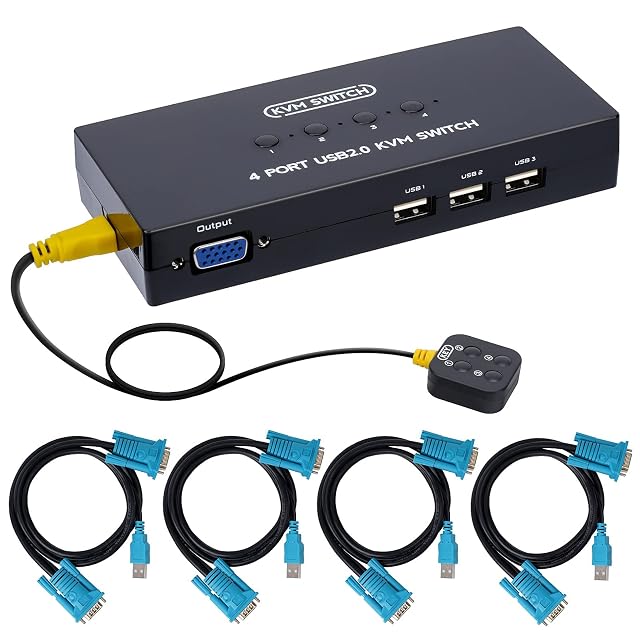
four computers · one VGA screen · 1920 by 1440 · three USB 2.0 sockets · button or wired controller · four combined leads supplied
A four-computer VGA switch supplied with four combined leads and a desk controller, quoting a resolution above the usual 1080p ceiling and no refresh rate at all.
Best for: A desk running three or four machines on one screen where the switching should happen from the hand rather than from the unit, and where the keyboard is a plain one.
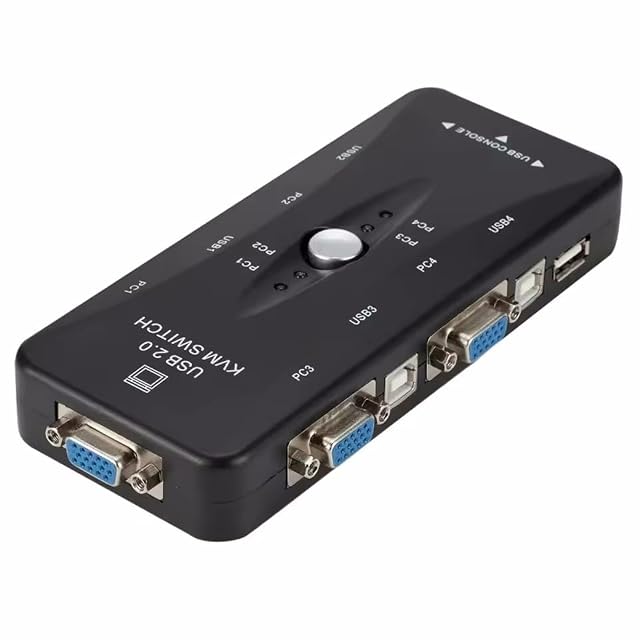
four computers · one VGA screen · 1920 by 1080 · push button only · a hub of uncounted sockets · no refresh rate printed
A four-computer VGA switch worked by a button on the front, whose resolution is printed in a form that leaves no room for a refresh rate.
Best for: A workshop or a back office keeping several older machines on one VGA screen, where a button on the front is the whole interface that is wanted.
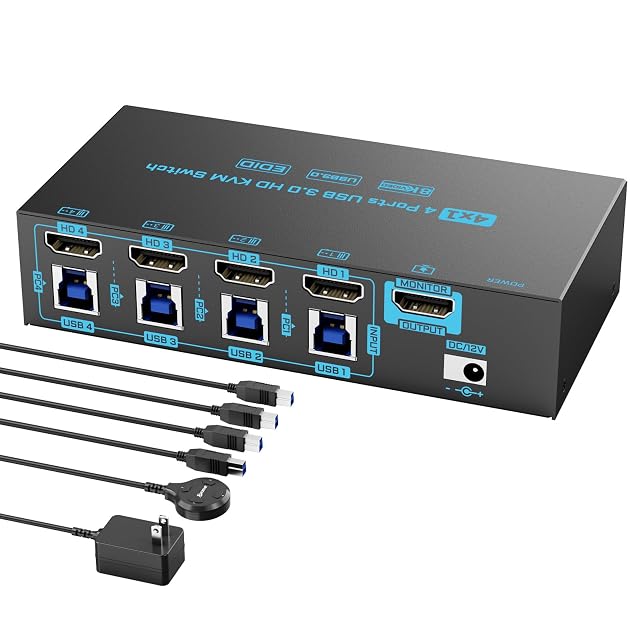
four computers · one screen · 8K at 60 Hz and 4K at 144 Hz · HDMI 2.1 · four USB 3.0 at 5 Gbps · panel button or wired controller · four USB leads and an adapter supplied
A four-computer HDMI switch that publishes two resolution and rate pairs, supplies its USB leads and a power adapter, and says outright that the final figure depends on the machines.
Best for: A desk of four machines on one screen where fast peripherals move between them, and where the window arrangement has to survive every change of machine.