Resolution and refresh rate are one figure, and the switching method is the other · review
DGODRT KS204V, four-computer VGA switch with a wired desk controller review
A four-computer VGA switch supplied with four combined leads and a desk controller, quoting a resolution above the usual 1080p ceiling and no refresh rate at all.
A four-computer VGA switch letting four machines share one screen and three USB 2.0 devices such as a keyboard, mouse, printer, scanner and drives; a resolution of up to 1920 by 1440 with support for a very wide screen, DDC support and automatic identification, plug and play with no driver and no external power supply; compatibility given as Windows, macOS and Linux; two switching methods, a wired desk controller and a panel button, with an indicator light showing the machine under control; and four combined leads joining VGA and USB in one, with a warning against illuminated mechanical keyboards on account of the current they draw.
Four leads for four machines
That single line separates this from most of the shelf. A combined lead serves one computer, and a page that supplies as many leads as it accepts computers is a page that has thought about the first evening.
A resolution without its pair
1920 by 1440 is quoted and no rate in Hz is. The two figures belong together, because a ceiling stated at one resolution and an unstated rate can be met in more ways than one. What the page does say is that the switch is the limit and not the source: the machine and the screen impose theirs on top.
No external supply, and what that costs
The unit draws what it needs from the computers, which is why there is no brick to find room for and why the page warns against a keyboard that lights up. Both facts come from the same design decision, and the listing states them both.
Before ordering
Look at the keyboard already on the desk. If it is illuminated and mechanical, this is the switch to ask about first.
Where it holds up, and where it stops
Strengths
Four combined leads for four computers, so the box contains what the switch needs rather than half of it
Two switching methods, one of which reaches the desk, so machines can be changed without leaning towards the unit
Stated as needing no driver and no external power supply, which removes two of the things that go wrong on a crowded desk
Compromises
No refresh rate is published, so the resolution figure stands alone and cannot be read as the pair it belongs to
The USB sockets are named as 2.0 with no rate quoted, so what a drive would do between machines is unstated
The fifth bullet advises against an illuminated mechanical keyboard because of the current it draws, which is a real limit on a switch with no external supply
Specifications
Port count
Four — stated in the title and in the first bullet as four computers or laptops managed from one place
Maximum resolution
1920 by 1440 — stated in the second bullet, which adds that a very wide screen is also supported. It is the ceiling of the switch alone; the computers and the screen each impose their own
Refresh rate
Not published on the listing — no figure in Hz appears in the title or in any of the five bullets, so the resolution stands without the second half of the pair
Video connector type
VGA — stated in the title and in the first bullet, with one screen at the output
Screens per computer
One — stated in the title as four computers sharing one screen
USB port count
Three — stated in the first bullet as three USB 2.0 devices, named as a keyboard, a mouse, a printer, a scanner and drives
USB generation
USB 2.0 — stated in the first bullet; no transfer rate is quoted alongside it
Switching method
Two — a wired desk controller and a button on the front panel, stated in the fourth bullet, with an indicator light showing which computer is under control
Audio support
Not published on the listing — no audio socket and no speaker or microphone connection appears in the title or in any of the five bullets
Cables supplied
Four combined leads, each carrying VGA and USB in one — stated in the title and described in the fifth bullet as keeping the desk tidy
Amazon reference
B092Q2DVC2
EAN
0751031441835
On Amazon.com
Amazon.com had an offer at $33 on October 26, 2026.
The questions that come up before an order
Why would a keyboard be too much for a KVM switch?
Because a switch drawing its own power from the computers has a limited amount to pass on, and an illuminated mechanical keyboard can ask for more than a plain one. The fifth bullet on this page says so directly. It is the trade that comes with a unit needing no external supply, and it is better read before ordering than discovered afterwards.
What does a wired desk controller add over a button?
Reach. The switch can go behind the machines where the leads are short and tidy, while the control sits by the hand. On a desk with four computers that is the difference between a small movement and a stretch, and this listing supplies both methods rather than one.
Our score
7.8/ 10
The best-equipped of the VGA switches here: four leads in the box, two ways to switch and no power brick. The unpublished refresh rate and the warning about keyboards are the two lines to read before ordering.
Against the rest of the network and storage gear
This network and storage gear share the category and the price bracket. Only what each one states is shown; an incomplete column would mislead.
Model
Price
Port count
Maximum resolution
Refresh rate
Video connector type
DGODRT KS204V, four-computer VGA switch with a wired desk controller
$33
Four — stated in the title and in the first bullet as four computers or laptops managed from one place
1920 by 1440 — stated in the second bullet, which adds that a very wide screen is also supported. It is the ceiling of the switch alone; the computers and the screen each impose their own
Not published on the listing — no figure in Hz appears in the title or in any of the five bullets, so the resolution stands without the second half of the pair
VGA — stated in the title and in the first bullet, with one screen at the output
Two — stated in the title and in the first bullet as two computers sharing one monitor and one keyboard and mouse set
4K — stated in the title and in the second bullet as up to 4K at 60 Hz, backwards compatible with 3840 by 2160 at 30 Hz, 1920 by 1080 at 60 Hz and 1920 by 1080 at 30 Hz. The same bullet requires that the computers and the screen support 4K themselves
60 Hz at 4K — stated in the second bullet as a pair, which is the form in which the two figures can be read together, with 30 Hz named at the same resolution as the fallback
HDMI — stated in the title and in the first bullet, which requires an HDMI port on each computer and on the monitor and warns that conversion cables or adapters may give an unstable or flickering picture. The second bullet asks for an HDMI 2.0 lead no longer than 3.3 feet
Three — stated in the title and in the first bullet as three computers sharing two DisplayPort monitors and four USB 3.0 devices. It is the only three-computer unit on this shelf
8K, given as 7680 by 4320 — stated in the title and in the second bullet at 30 Hz, with 3840 by 2160 at 144 Hz also named and lower resolutions supported. The same bullet states that the sources, the monitors and the DisplayPort leads must all support the figure to reach it
30 Hz at 8K and 144 Hz at 4K — stated in the second bullet as pairs, which is the form in which the two figures can be read together. The same maker’s HDMI 2.1 unit on this shelf publishes 60 Hz at 8K and the same 144 Hz at 4K
DisplayPort 1.4 — stated in the title and in the second bullet, with two DisplayPort inputs required from each machine and two DisplayPort outputs to the screens
Two — stated in the title and in the first bullet as two desktop computers
8K — stated in the title and in the second bullet as up to 8K at 60 Hz, backwards compatible with 8K at 30 Hz, 4K, 1080p, 720p and 480p. It is the ceiling of the switch alone; the computers and the screens each impose their own
60 Hz at 8K, with 8K at 30 Hz also named — stated in the second bullet as pairs, which is the form in which the two figures can be read together
DisplayPort 1.4 — stated in the second bullet; the first bullet states in as many words that this switch has no HDMI socket
What separates the models, in network and storage gear
If price decides: CMSTEDCD GMXUS-SW219S, at $17.
The buyer this one serves, among network and storage gear
A desk running three or four machines on one screen where the switching should happen from the hand rather than from the unit, and where the keyboard is a plain one.
What this one costs among network and storage gear
A reference exists on these Amazon stores: France, Germany, Italy, Spain, United Kingdom, United States. Listed is not the same as in stock — availability changes daily.
Details checked on September 10, 2026.
What buyers actually choose
Amazon reports what buyers took in the month before this page was last checked: at least 50.
The figure is a floor, rounded by Amazon, and read through Keepa — it says what buyers picked, not what a maker claims.
Sources
Specifications: the manufacturer sheet for network and storage gear and the matching Amazon product page. Prices and availability: Keepa. Every figure on this page names its source.
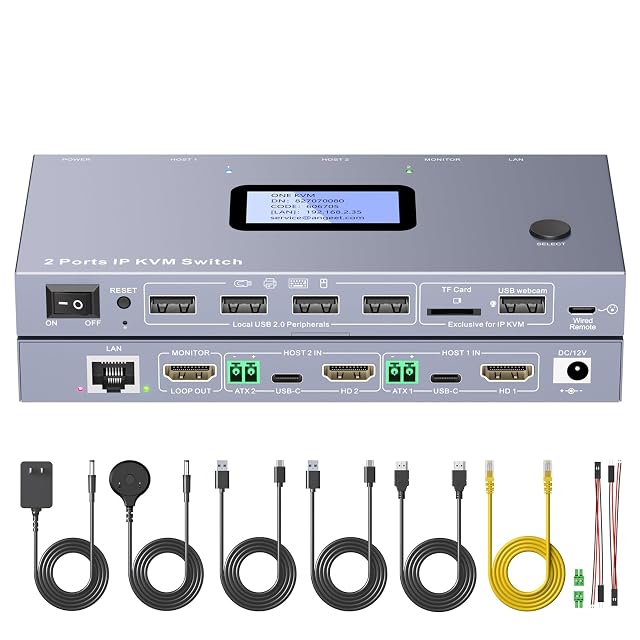
two computers · one screen · 3840 by 2160 at 60 Hz · HDMI · button, wired remote, web or app · every lead in the box
A two-computer switch whose packing list is the only complete one on this shelf, down to the HDMI lead and the jumper wires for remote power, and whose web access and app are given two different reaches in one bullet.
Best for: A pair of desktop machines that have to be reached, switched and powered on from somewhere else, with nothing left to buy.
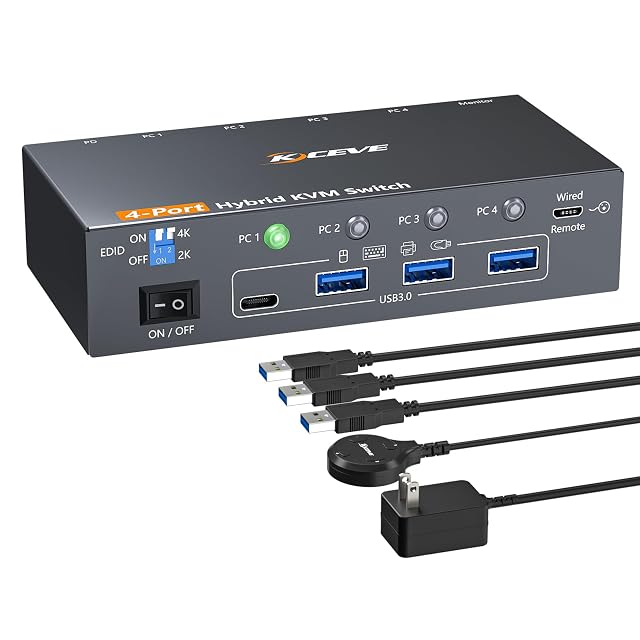
four computers · one screen · 4K at 60 Hz and 2K at 100 Hz · one DisplayPort, one USB-C and two HDMI inputs · four USB 3.0 at 5 Gbps · button or wired remote
A four-computer switch whose inputs are of three different kinds, quoting its resolutions and refresh rates as pairs and never listing what is in the box.
Best for: A desk where the four machines do not share a video socket between them, and where a drive has to follow whichever one is in use.
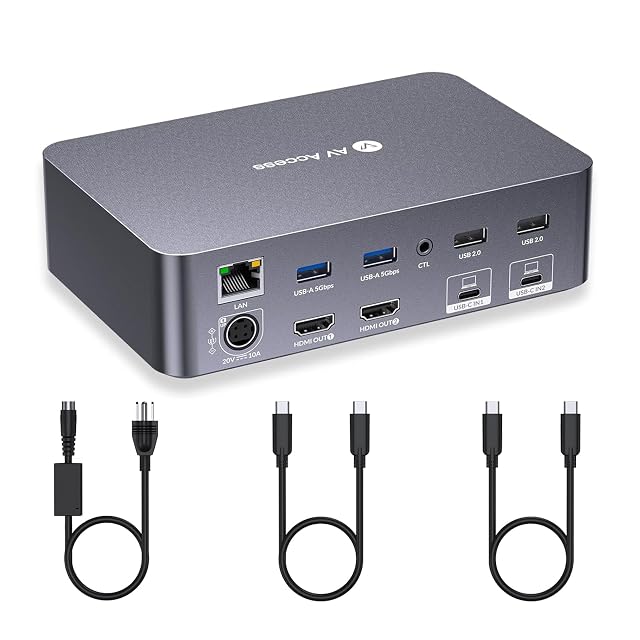
two laptops · two HDMI screens each · 4K over USB-C · seven USB sockets · Ethernet, SD and headset · 60 W charging each
A docking station that switches as well, carrying two screens, Ethernet, an SD slot, a headset jack and 60 W of charging for each laptop, and publishing no refresh rate at all.
Best for: A desk where a work laptop and a personal one share two screens, the network, the card reader and a charger as well as the keyboard.