Skip to content

AOOCOO KC-401C-AO-DE, four-computer switch with mixed video inputs review

A four-computer switch whose inputs are of three different kinds, quoting its resolutions and refresh rates as pairs and never listing what is in the box.

The bottom line The most flexible input arrangement here and the clearest way of quoting a video ceiling, held back by a page that never says what arrives in the box. Four different leads is a shopping list worth writing before ordering.

On the listing

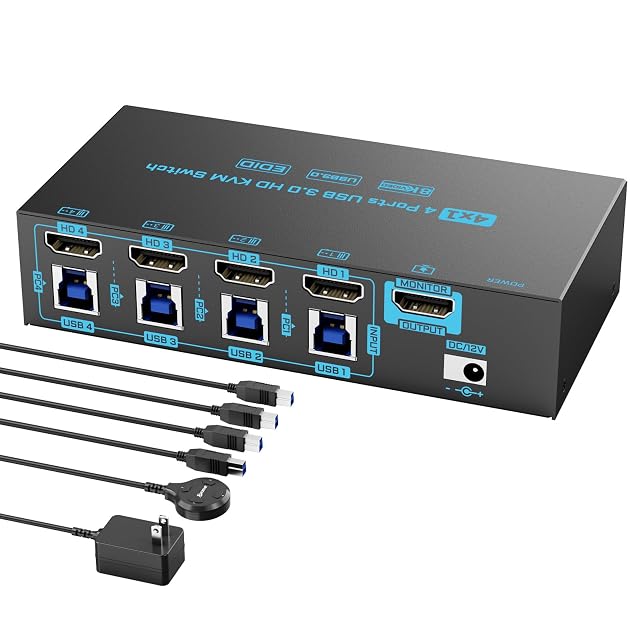
A switch connecting four computers, one laptop and three desktop machines, to a single HDMI screen, controlled by one keyboard and mouse; HDMI 2.0 with 4K at 60 Hz, 2K at 100 Hz and 4:4:4 colour subsampling, backwards compatible, with connectable inputs given as one DisplayPort, one USB-C and two HDMI; an EDID function that can be turned on or off, holding the screen settings and leaving the window arrangement undisturbed when machines are changed; four USB 3.0 sockets at 5 Gbps, compatible with USB 2.0 and 1.1, recognising mice, keyboards, printers, drives, scanners and cameras; and two switching methods, a select button on the unit and a wired remote of 1.5 m.

Pairs, properly quoted

4K at 60 Hz. 2K at 100 Hz. Two ceilings, each with its rate attached. That is how the figures belong on the page, because a resolution quoted without a rate can be met at a rate nobody wants. Both remain limits of the switch: whatever the machine sends and whatever the screen accepts still apply on top.

Three kinds of input

One DisplayPort, one USB-C and two HDMI. This is a switch for a desk whose machines do not match, and it means the leads do not match either. Each computer needs the one its own socket takes.

The EDID switch

A screen that vanishes when the switch moves elsewhere is the reason windows rearrange themselves. Holding its identity stops that, and this unit lets the behaviour be turned off as well as on, which matters when a machine refuses to cooperate with it.

What is not listed

The box. A power supply and a remote are named in the title; the bullets name grades of lead to use and never say which of them, if any, is included.

Before ordering

Write down which socket each machine will use, then ask the seller which of those leads comes in the box. On a switch with three kinds of input, that list is the purchase.

Availability

Priced at roughly 70 € on the German, French, Italian and Spanish Amazon stores the day this page was checked.

In the American Amazon catalogue with no live offer against it: the reference exists, nobody is filling it.

The British Amazon store returned nothing at all, so the buy button there opens a search in that country rather than a page that would not load.

Every figure in this section is what Keepa held on the day this page was last updated. Stock and prices move without warning.

Prices quoted in this text were read on 10 September 2026. The live price is at the top of the page.
Where it holds up, and where it stops

Strengths

  • Publishes its resolutions and refresh rates as pairs, 4K at 60 Hz and 2K at 100 Hz, which is the form that can actually be compared
  • Four USB 3.0 sockets at a stated 5 Gbps, so a drive moved between machines is worth moving
  • The EDID function can be switched on or off, and the listing says the window arrangement survives a change of machine

Compromises

  • The inputs are of three different kinds, so each machine needs the lead its own socket demands rather than four of the same
  • Nothing lists the contents of the box, and the bullets name lead grades to use without saying which arrive
  • No audio connection of any kind is named, on a unit otherwise well described

Specifications

Port countFour — stated in the title and in the first bullet as four computers, given as one laptop and three desktop machines
Maximum resolution4K — stated in the title and in the second bullet, quoted as 4K at 60 Hz with 2K at 100 Hz also named, and described as backwards compatible. It is the ceiling of the switch alone; the computers and the screen each impose their own
Refresh rate60 Hz at 4K and 100 Hz at 2K — stated in the title and in the second bullet as pairs, which is the form in which the two figures can be read together
Video connector typeMixed inputs — one DisplayPort, one USB-C and two HDMI, stated in the second bullet, with HDMI 2.0 named for the switch and an HDMI screen given at the output in the first bullet
Screens per computerOne — stated in the title and in the first bullet, where four machines share a single screen
USB port countFour — stated in the fourth bullet as four USB 3.0 sockets
USB generationUSB 3.0, quoted at 5 Gbps and compatible with USB 2.0 and USB 1.1 — stated in the fourth bullet, which names mice, keyboards, printers, drives, scanners and cameras as being recognised automatically
Switching methodTwo — a select button on the unit and a wired remote of 1.5 m, stated in the fifth bullet, with plug and play and no driver required
Audio supportNot published on the listing — no audio socket, no channel count and no audio format is named in the title or in any of the five bullets
Cables suppliedNot published on the listing as a list — the title names a power supply and a wired remote, while the second and fourth bullets tell the buyer which grades of lead to use without saying whether any of them is in the box
Amazon referenceB0GH7PMBP8 (same reference on 5 Amazon marketplaces)
EAN0740122798811

The questions that come up before an order

What does an EDID function do on a switch?

It holds the identity of the screen so that each computer keeps seeing one even when the switch is pointed elsewhere. Without it, machines are told the screen has gone and rearrange their windows accordingly. This listing states that the function can be turned on or off and that the window layout survives a change of machine.

Do mixed inputs cause a problem?

They change what has to be bought. One DisplayPort, one USB-C and two HDMI inputs means each machine needs a lead matching its own socket, rather than four identical ones. It is an advantage where the machines genuinely differ and an inconvenience where they do not, and this page states the arrangement clearly enough to plan around.