Resolution and refresh rate are one figure, and the switching method is the other · review
DXchip KVM302DP-02 review
The only three-computer unit on this shelf, carrying two DisplayPort screens for each machine, and the DisplayPort twin of the same maker’s HDMI model with a lower 8K ceiling and the same 4K one.
Three computers. No other listing on this shelf has three: eight units here take four computers and four take two. Three machines on two screens is an odd shape and this is the only unit that fills it.
Both screens are DisplayPort 1.4, and both are shared by all three machines, stated in the first bullet. The second gives the ceiling as 7680 by 4320 at 30 Hz and 3840 by 2160 at 144 Hz, as pairs, and adds the usual condition: the sources, the screens and the leads must all support the figure for it to be reached.
That is worth setting against the same maker’s other unit on this shelf. The HDMI 2.1 DXchip publishes 8K at 60 Hz and 4K at 144 Hz. This DisplayPort one publishes 8K at 30 Hz and 4K at 144 Hz. Same brand, two sockets, the same 4K pair and half the rate at 8K. Neither is the better unit outright: the choice is which socket the machines have, and only then what the 8K line says.
The USB side is four USB 3.0 sockets at up to 5 Gbps, stated in the third bullet, which describes file transfer between the connected computers and names keyboards, mice, drives, printers and cameras. The fifth bullet adds a 12 V power port for high-current USB devices and — as on the DXchip HDMI unit — a separate power switch, used to restart the unit when the signal needs recognizing again instead of unplugging and replugging it.
What the page never does is list the box. The sixth bullet says instead that each computer needs two DisplayPort leads and one USB lead to be connected, which is nine leads for three machines, and it advises connecting the computers directly to the screens first to confirm that multi-screen output works at all. Nothing on the page says whether any of those nine leads arrives. The fourth bullet names the 1.5 m (5 ft) wired controller alongside the panel button as the two switching methods, with indicator lights showing the active machine, and the compatibility list runs to laptops, desktops, a PlayStation 4, a Raspberry Pi and a DVR across Windows, macOS and ChromeOS.
Twelve months of after-sales service is stated in the last bullet. No weight and no dimensions are published anywhere on the listing, which on a unit that has to sit among nine leads is a gap worth noting.
Where it holds up, and where it stops
Strengths
The only three-computer unit on this shelf, where everything else is at four or two
Two DisplayPort screens shared by all three machines, with both resolutions published as readable pairs
A separate power switch for restarting the unit when the signal needs recognizing, which only it and the DXchip HDMI unit have
A 12 V power port for high-current USB devices, alongside four USB 3.0 sockets at a stated 5 Gbps
Says plainly that the sources, the monitors and the leads all have to support the figure before the ceiling is reached
Compromises
Nothing lists the contents of the box, on a unit the page itself says needs nine leads for three machines
The 8K ceiling is 30 Hz, half the rate the same maker’s HDMI unit on this shelf publishes at the same resolution
No audio connection of any kind is named anywhere on the page
No weight and no dimensions are published, which on a three-machine installation is a real omission
Specifications
Port count
Three — stated in the title and in the first bullet as three computers sharing two DisplayPort monitors and four USB 3.0 devices. It is the only three-computer unit on this shelf
Maximum resolution
8K, given as 7680 by 4320 — stated in the title and in the second bullet at 30 Hz, with 3840 by 2160 at 144 Hz also named and lower resolutions supported. The same bullet states that the sources, the monitors and the DisplayPort leads must all support the figure to reach it
Refresh rate
30 Hz at 8K and 144 Hz at 4K — stated in the second bullet as pairs, which is the form in which the two figures can be read together. The same maker’s HDMI 2.1 unit on this shelf publishes 60 Hz at 8K and the same 144 Hz at 4K
Video connector type
DisplayPort 1.4 — stated in the title and in the second bullet, with two DisplayPort inputs required from each machine and two DisplayPort outputs to the screens
Screens per computer
Two — stated in the title and in the first bullet, where three machines share two DisplayPort monitors. The sixth bullet asks that each computer be connected to the two screens directly first, to confirm multi-screen output is supported
USB port count
Four — stated in the title and in the third bullet as four USB 3.0 sockets, for keyboards, mice, drives, printers and cameras
USB generation
USB 3.0, quoted at up to 5 Gbps — stated in the third bullet, which describes transferring files between the connected computers at that rate
Switching method
Two — a physical button and a wired controller of 1.5 m (5 ft), stated in the fourth bullet, with indicator lights showing the active computer. The fifth bullet adds a separate power switch for restarting the unit when the signal needs recognizing again
Audio support
Not published on the listing — no audio socket, no channel arrangement and no audio format is named in the title or in any of the six bullets
Cables supplied
Not published on the listing as a list — no bullet names the contents of the box. The sixth states instead that each computer needs two DisplayPort leads and one USB lead, which is nine for three machines, and the last gives twelve months of after-sales service
Amazon reference
B0GYS9NM91
EAN
0737745085954
On Amazon.com
Amazon.com had an offer at $86 on October 26, 2026.
Where this unit differs
Put against the median of its own group on this site — not against every network product sold.
Maximum resolution8K, given as 7680 by 4320 — stated in the title and in the second bullet at 30 Hz, with 3840 by 2160 at 144 Hz also named and lower resolutions supported. The same bullet states that the sources, the monitors and the DisplayPort leads must all support the figure to reach it+100 % against the median of this group
Refresh rate30 Hz at 8K and 144 Hz at 4K — stated in the second bullet as pairs, which is the form in which the two figures can be read together. The same maker’s HDMI 2.1 unit on this shelf publishes 60 Hz at 8K and the same 144 Hz at 4K-50 % against the median of this group
Video connector typeDisplayPort 1.4 — stated in the title and in the second bullet, with two DisplayPort inputs required from each machine and two DisplayPort outputs to the screens-33 % against the median of this group
The questions that come up before an order
How many leads does it need?
The sixth bullet states that each computer needs two DisplayPort leads and one USB lead, which is nine for three machines. No bullet says whether any of them is in the box.
How does it compare with the maker’s HDMI model?
Both publish 4K at 144 Hz. This DisplayPort unit publishes 8K at 30 Hz where the HDMI 2.1 one publishes 8K at 60 Hz. The HDMI model takes four computers on one screen; this one takes three on two screens.
What is the separate power switch for?
The fifth bullet states that pressing it restarts the switch when the signal needs recognizing again, instead of unplugging and replugging the unit. Only the DXchip HDMI unit on this shelf publishes one as well.
Against the rest of the network and storage gear
This network and storage gear share the category and the price bracket. Only what each one states is shown; an incomplete column would mislead.
Model
Price
Port count
Maximum resolution
Refresh rate
Video connector type
DXchip KVM302DP-02
$86
Three — stated in the title and in the first bullet as three computers sharing two DisplayPort monitors and four USB 3.0 devices. It is the only three-computer unit on this shelf
8K, given as 7680 by 4320 — stated in the title and in the second bullet at 30 Hz, with 3840 by 2160 at 144 Hz also named and lower resolutions supported. The same bullet states that the sources, the monitors and the DisplayPort leads must all support the figure to reach it
30 Hz at 8K and 144 Hz at 4K — stated in the second bullet as pairs, which is the form in which the two figures can be read together. The same maker’s HDMI 2.1 unit on this shelf publishes 60 Hz at 8K and the same 144 Hz at 4K
DisplayPort 1.4 — stated in the title and in the second bullet, with two DisplayPort inputs required from each machine and two DisplayPort outputs to the screens
Two — stated in the title and in the first bullet as two desktop computers
8K — stated in the title and in the second bullet as up to 8K at 60 Hz, backwards compatible with 8K at 30 Hz, 4K, 1080p, 720p and 480p. It is the ceiling of the switch alone; the computers and the screens each impose their own
60 Hz at 8K, with 8K at 30 Hz also named — stated in the second bullet as pairs, which is the form in which the two figures can be read together
DisplayPort 1.4 — stated in the second bullet; the first bullet states in as many words that this switch has no HDMI socket
Four — stated in the title and in the first bullet as four computers or laptops managed from one place
1920 by 1440 — stated in the second bullet, which adds that a very wide screen is also supported. It is the ceiling of the switch alone; the computers and the screen each impose their own
Not published on the listing — no figure in Hz appears in the title or in any of the five bullets, so the resolution stands without the second half of the pair
VGA — stated in the title and in the first bullet, with one screen at the output
Two — stated in the title and in the first bullet as two controlled computers, with remote switching between the two hosts
3840 by 2160 — stated in the ninth bullet together with its rate. It is the ceiling of the switch alone; the computers and the screen each impose their own
60 Hz at 3840 by 2160 — stated in the ninth bullet as a pair, which is the form in which the two figures can be read together. The same bullet quotes a delay of under 60 ms, which is the maker’s claim and not a measurement made here
HDMI — stated in the second bullet, which names HDMI, USB and DuPont leads between the unit and the two computers; the eighth adds a local monitor loop-out
What separates the models, in network and storage gear
If price decides: DGODRT KS204V, four-computer VGA switch with a wired desk controller, at $33.
The buyer this one serves, among network and storage gear
Three machines that have to share the same pair of DisplayPort screens, where the eight-K line matters less than the socket.
What this one costs among network and storage gear
Details checked on October 26, 2026.
Sources
Specifications: the manufacturer sheet for network and storage gear and the matching Amazon product page. Prices and availability: Keepa. Every figure on this page names its source.
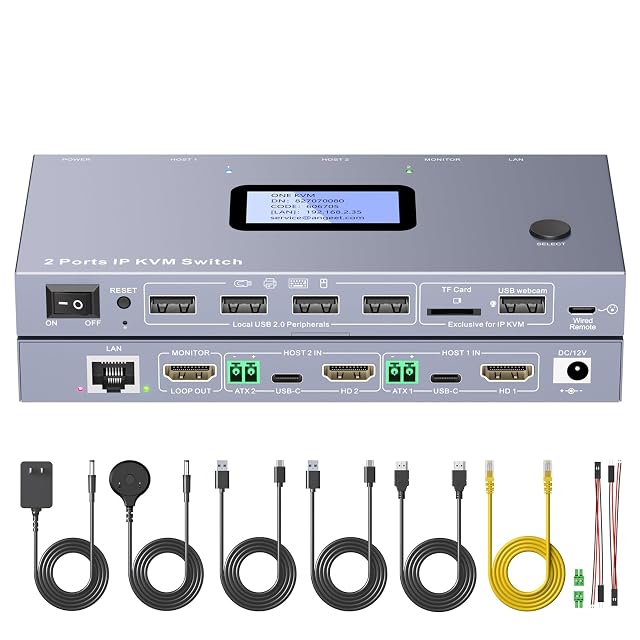
two computers · one screen · 3840 by 2160 at 60 Hz · HDMI · button, wired remote, web or app · every lead in the box
A two-computer switch whose packing list is the only complete one on this shelf, down to the HDMI lead and the jumper wires for remote power, and whose web access and app are given two different reaches in one bullet.
Best for: A pair of desktop machines that have to be reached, switched and powered on from somewhere else, with nothing left to buy.
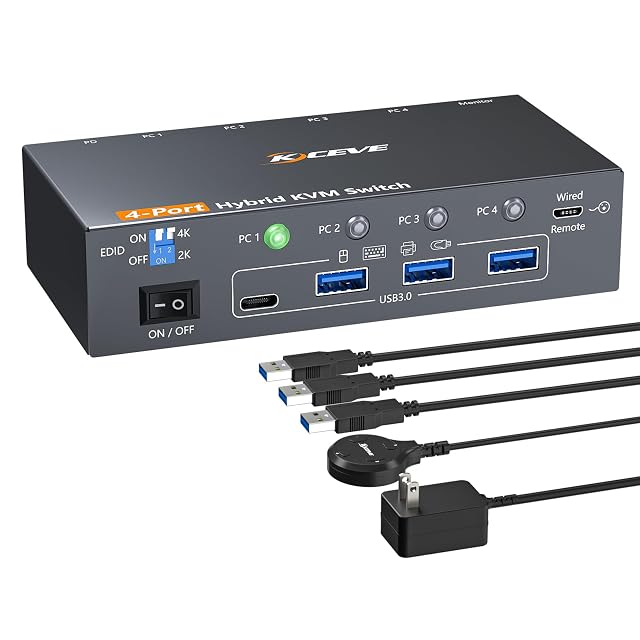
four computers · one screen · 4K at 60 Hz and 2K at 100 Hz · one DisplayPort, one USB-C and two HDMI inputs · four USB 3.0 at 5 Gbps · button or wired remote
A four-computer switch whose inputs are of three different kinds, quoting its resolutions and refresh rates as pairs and never listing what is in the box.
Best for: A desk where the four machines do not share a video socket between them, and where a drive has to follow whichever one is in use.
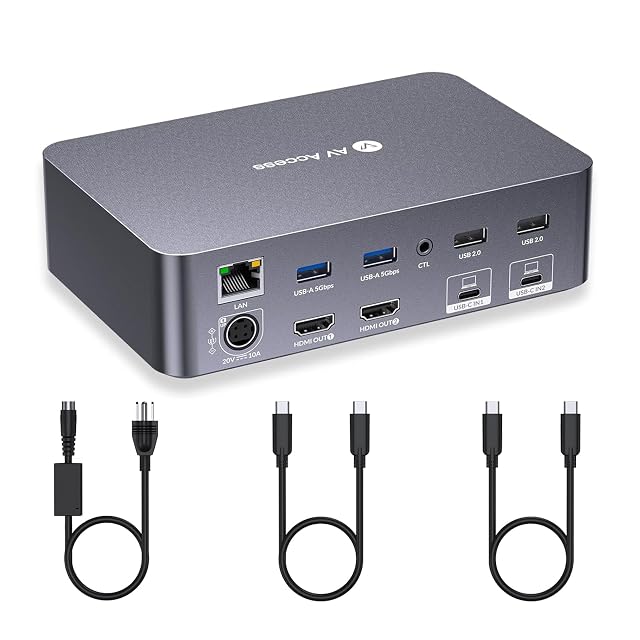
two laptops · two HDMI screens each · 4K over USB-C · seven USB sockets · Ethernet, SD and headset · 60 W charging each
A docking station that switches as well, carrying two screens, Ethernet, an SD slot, a headset jack and 60 W of charging for each laptop, and publishing no refresh rate at all.
Best for: A desk where a work laptop and a personal one share two screens, the network, the card reader and a charger as well as the keyboard.