Resolution and refresh rate are one figure, and the switching method is the other · review
ROFAVEZCO EZ-SW41H21-KVMU3P, four-computer HDMI switch with hotkey and infrared control review
A four-computer HDMI switch offering three ways to change machine, including a keyboard shortcut, whose own page gives its bandwidth and content protection two different values.
The bottom line The most convenient switching arrangement on this shelf, printed on a page that contradicts itself twice about what its video path carries. The keyboard shortcut is the reason to want it; the bandwidth is the question to ask before ordering.
On the listing
A four-port switch controlling four computers with one keyboard, mouse and screen, named for computers, consoles and security systems across the usual operating systems; standard HDMI 2.1 with HDR10 and a stated three-dimensional effect, up to 8K at 60 Hz and 4K at 120 Hz, and audio formats given as Dolby Atmos, DTS X, Dolby TrueHD, DTS-HD Master Audio and PCM 7.1; plug and play with a power supply, with the sources joined to the switch inputs and the display to the output, and each machine joined to a host socket by a USB 3.0 type A to type A lead; three control methods, a keyboard hotkey, an infrared remote and a button; and a bandwidth given as 48 Gbps in the bullet heading and 18 Gbps in the text below it, with HDCP 2.3 in the first place and HDCP 2.2 in the second.
Two figures for the same path
48 Gbps, and 18 Gbps. They appear within three lines of each other, in the same bullet. Both are reported here because both are printed, and neither is chosen. The same bullet gives content protection as HDCP 2.3 in its heading and HDCP 2.2 in its body. On a page where every other number is stated once, these two are stated twice and differently.
Three ways to change machine
A keyboard shortcut, an infrared remote, and a button on the front. The first is the one that changes a working day, because the hands never leave the keys. This is desk hardware doing the job desk hardware is for: moving a screen, a keyboard and a mouse between machines without anything being replugged.
The sockets that are not counted
Four USB 3.0 leads come in the box, one for each machine, and the number of USB sockets on the unit itself never appears. What is stated is the shape of the connection: type A at both ends, one lead from each computer.
The audio, named properly
Five formats are listed by name rather than summarised. They travel on the video path; no separate audio socket appears on this page.
Before ordering
Ask the seller which bandwidth figure is right, 48 or 18. It is the number that decides what the switch can carry, and this page gives it twice.
Availability
Priced from 110 € to 120 € across the German, French, Italian and Spanish Amazon stores the day this page was checked.
The American and British Amazon stores returned nothing at all, so the buy button there opens a search in that country rather than a page that would not load.
Every figure in this section is what Keepa held on the day this page was last updated. Stock and prices move without warning.
Prices quoted in this text were read on 10 September 2026. The live price is at the top of the page.
Where it holds up, and where it stops
Strengths
Three switching methods including a keyboard shortcut, so a machine can be changed without reaching for anything at all
Four USB 3.0 leads in the box, one for each machine, with the connector type stated at both ends
Names the audio formats the video path carries individually rather than describing the sound as supported and stopping there
Compromises
The bandwidth is given as 48 Gbps in the title and in the heading of the fifth bullet, and as 18 Gbps in the body of that same bullet
Content protection is given as HDCP 2.3 in the same heading and HDCP 2.2 two lines below it, and the page never resolves which applies
The USB sockets on the unit are never counted, so what the four supplied leads plug into is unstated
Specifications
Port count
Four — stated in the title and in the first bullet as four computers controlled from one keyboard, mouse and screen
Maximum resolution
8K — stated in the title and in the second bullet as up to 8K at 60 Hz and 4K at 120 Hz. It is the ceiling of the switch alone; the computers and the screen each impose their own
Refresh rate
60 Hz at 8K and 120 Hz at 4K — stated in the title and in the second bullet as pairs, which is the form in which the two figures can be read together
Video connector type
HDMI 2.1 — stated in the title and in the second bullet, with four inputs and one output described in the third
Screens per computer
One — stated in the title as four computers sharing one screen
USB port count
Not published on the listing as a count — USB 3.0 is named in the title and in the first, third and fifth bullets, four USB 3.0 leads are supplied, and no bullet says how many USB sockets the unit itself carries
USB generation
USB 3.0 — stated in the title and in three bullets, with the leads given as type A to type A; no transfer rate is quoted for the USB path
Switching method
Three — a keyboard hotkey, an infrared remote and a button on the unit, stated in the fourth bullet
Audio support
Carried over the video path — the second bullet names Dolby Atmos, DTS X, Dolby TrueHD, DTS-HD Master Audio and PCM 7.1 among the supported formats; no separate audio socket is named anywhere on the page
Cables supplied
Four USB 3.0 leads, type A to type A — stated in the title and in the third bullet, which also names a power supply. No video lead is named among the contents
Amazon reference
B0F4R9X7VG (same reference on 4 Amazon marketplaces)
EAN
0635403250877
The questions that come up before an order
What does hotkey switching change?
It moves the control onto the keyboard already under the hand, so a machine can be changed without reaching for a button or a remote. On a desk used all day that is the difference between a habit and an interruption. This unit offers it alongside an infrared remote and a button, so the method can be chosen rather than accepted.
Why do two bandwidth figures on one page matter?
Because the figure sets what the video path can carry, and the two printed here are far apart. The title and the heading of the fifth bullet say 48 Gbps; the body of that bullet says 18 Gbps. Both are reported here because both are published, and nothing on the page decides between them.
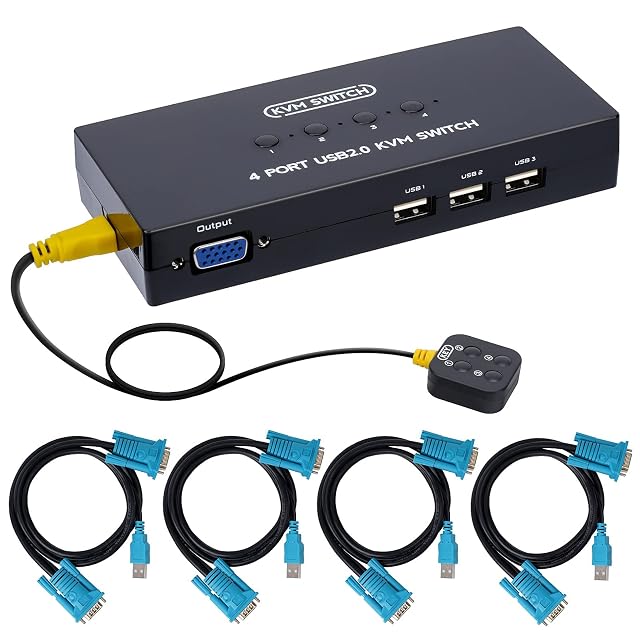
four computers · one VGA screen · 1920 by 1440 · three USB 2.0 sockets · button or wired controller · four combined leads supplied
A four-computer VGA switch supplied with four combined leads and a desk controller, quoting a resolution above the usual 1080p ceiling and no refresh rate at all.
Best for: A desk running three or four machines on one screen where the switching should happen from the hand rather than from the unit, and where the keyboard is a plain one.
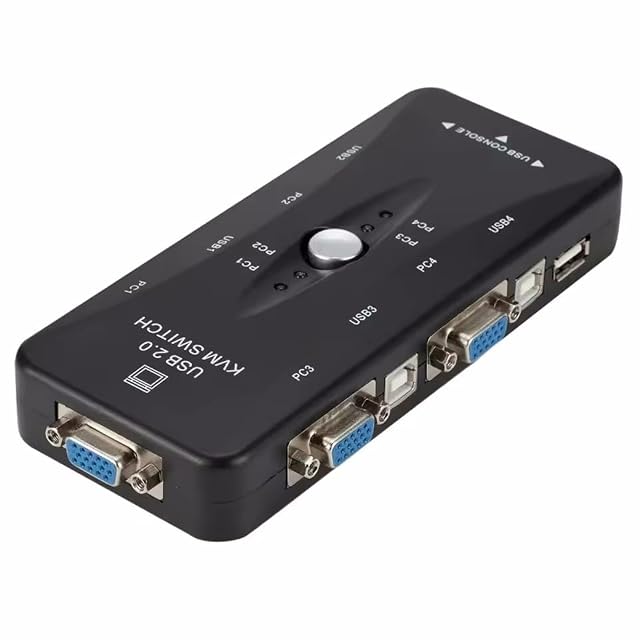
four computers · one VGA screen · 1920 by 1080 · push button only · a hub of uncounted sockets · no refresh rate printed
A four-computer VGA switch worked by a button on the front, whose resolution is printed in a form that leaves no room for a refresh rate.
Best for: A workshop or a back office keeping several older machines on one VGA screen, where a button on the front is the whole interface that is wanted.
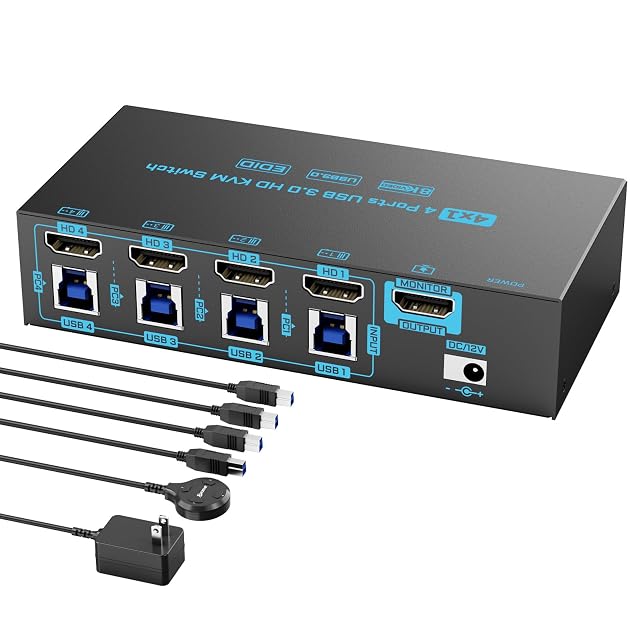
four computers · one screen · 8K at 60 Hz and 4K at 144 Hz · HDMI 2.1 · four USB 3.0 at 5 Gbps · panel button or wired controller · four USB leads and an adapter supplied
A four-computer HDMI switch that publishes two resolution and rate pairs, supplies its USB leads and a power adapter, and says outright that the final figure depends on the machines.
Best for: A desk of four machines on one screen where fast peripherals move between them, and where the window arrangement has to survive every change of machine.