Resolution and refresh rate are one figure, and the switching method is the other · review
DXchip ZX-KVM8401B002, four-computer HDMI switch with an EDID emulator review
A four-computer HDMI switch that publishes two resolution and rate pairs, supplies its USB leads and a power adapter, and says outright that the final figure depends on the machines.
The bottom line A four-machine switch that describes its own limits honestly and packs the USB half of the job. The four video leads it does not include are the purchase to plan alongside it.
On the listing
A four-port HDMI switch controlling four computers from one screen and one wired or wireless keyboard and mouse set, plug and play; resolutions of up to 8K at 60 Hz and 4K at 144 Hz, backwards compatible with 4K at 30 Hz and 1080p, with a note that the final figure depends on the graphics cards, the screens, the leads and the adapters; an EDID chip whose emulation is turned on and off by holding the first button for three seconds, leaving the window arrangement undisturbed; four USB 3.0 sockets at up to 5 Gbps, described as a four-in, four-out USB switch, with a note that each machine needs its own USB lead to the switch; compatibility across the usual operating systems and two switching methods, a panel button and a wired desk controller, with indicator lights; a 12 V power socket and a separate power button that restarts the unit without unplugging anything; and a box containing the switch, four USB 3.0 leads, a 12 V adapter and a wired remote of 1.5 m, with a twelve-month warranty.
A ceiling described as a ceiling
The final resolution depends on the graphics cards, the screens and the leads. That sentence is on the maker’s own page, and it is the correct way to read every figure on this shelf. The switch publishes what it can pass; what actually appears is the lowest limit in the chain, and the switch is only one link in it.
Two pairs, both stated
8K at 60 Hz, and 4K at 144 Hz. Two ceilings with their rates attached, which is what allows a comparison rather than a guess. A page quoting one figure without the other is describing half a video path.
The USB half, complete
Four leads in the box for four machines. The fourth bullet is honest about why they are needed: the shared sockets only work for a machine that has its own USB lead running to the switch. That is four more connections behind the desk, and four fewer things to order.
The power button
A separate switch that restarts the unit without unplugging it. Small, and the thing that turns a lost signal into a two-second fix.
Before ordering
Count four video leads into the budget. Everything else needed is in the box.
Availability
Priced from 73 € to 94 € across the German, French, Italian and Spanish Amazon stores the day this page was checked.
In the American Amazon catalogue with no live offer against it: the reference exists, nobody is filling it.
The British Amazon store returned nothing at all, so the buy button there opens a search in that country rather than a page that would not load.
Every figure in this section is what Keepa held on the day this page was last updated. Stock and prices move without warning.
Prices quoted in this text were read on 10 September 2026. The live price is at the top of the page.
Where it holds up, and where it stops
Strengths
Says plainly that the final resolution depends on the graphics cards, the screens and the leads, which is the maker stating the ceiling is a ceiling
Four USB 3.0 leads in the box, one for each machine, so the USB half of the installation is complete on delivery
The EDID emulator can be turned on or off from the front panel, without software and without opening anything
Compromises
No video lead is in the box, so four of them have to be found before the switch does anything
No audio connection is named anywhere, on a page that describes the video path in detail
The fourth bullet requires a USB lead from every machine for the shared sockets to work, which is four more connections behind the desk
Specifications
Port count
Four — stated in the title and in the first bullet as four computers sharing one screen and one keyboard and mouse set
Maximum resolution
8K — stated in the title and in the second bullet as 8K at 60 Hz and 4K at 144 Hz, backwards compatible with 4K at 30 Hz, 1080p and below. It is the ceiling of the switch alone, and the second bullet says in as many words that the final figure depends on the graphics cards, the screens and the leads
Refresh rate
60 Hz at 8K and 144 Hz at 4K — stated in the title and in the second bullet as pairs, which is the form in which the two figures can be read together
Video connector type
HDMI 2.1 — stated in the title and in the first bullet, with four inputs and one output
Screens per computer
One — stated in the title and in the first bullet, where four machines share a single screen
USB port count
Four — stated in the fourth bullet as four USB 3.0 sockets for a keyboard, a mouse, a printer, a scanner, a camera or other devices
USB generation
USB 3.0, quoted at up to 5 Gbps — stated in the fourth bullet, which describes the unit as a four-in, four-out USB switch as well as a four-in, one-out video switch
Switching method
Two — a panel button and a wired desk controller of 1.5 m, stated in the fifth bullet, with indicator lights showing the active machine; the third bullet adds that holding the first button for three seconds turns the EDID emulation on or off
Audio support
Not published on the listing — no audio socket, no channel arrangement and no audio format is named in the title or in any of the seven bullets
Cables supplied
Four USB 3.0 leads, a 12 V power adapter and a wired remote of 1.5 m — stated in the seventh bullet, which also gives a twelve-month warranty; no video lead is named among the contents
Amazon reference
B0FSZ9KD46 (same reference on 5 Amazon marketplaces)
EAN
0714855572901
The questions that come up before an order
What does the EDID emulator change day to day?
It keeps each computer believing a screen is attached even when the switch is pointed at another machine. Without it, windows are rearranged every time the picture goes away and comes back. This unit lets the emulation be turned on and off by holding a button for three seconds, which matters when one machine disagrees with it.
Why does the listing say the final resolution depends on other equipment?
Because it does, and it is unusual for a page to say so. The switch publishes a ceiling. The graphics card decides what is sent, the screen decides what is accepted, and the leads decide what survives the journey. The lowest of those is what appears, and a switch cannot raise any of them.
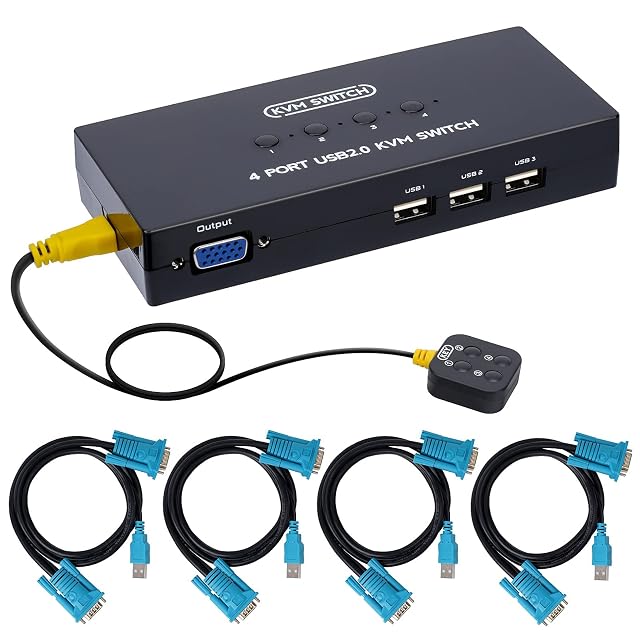
four computers · one VGA screen · 1920 by 1440 · three USB 2.0 sockets · button or wired controller · four combined leads supplied
A four-computer VGA switch supplied with four combined leads and a desk controller, quoting a resolution above the usual 1080p ceiling and no refresh rate at all.
Best for: A desk running three or four machines on one screen where the switching should happen from the hand rather than from the unit, and where the keyboard is a plain one.
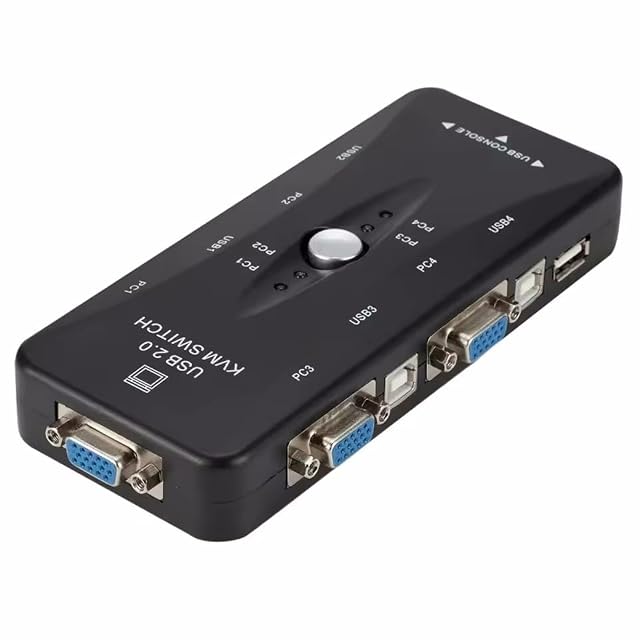
four computers · one VGA screen · 1920 by 1080 · push button only · a hub of uncounted sockets · no refresh rate printed
A four-computer VGA switch worked by a button on the front, whose resolution is printed in a form that leaves no room for a refresh rate.
Best for: A workshop or a back office keeping several older machines on one VGA screen, where a button on the front is the whole interface that is wanted.
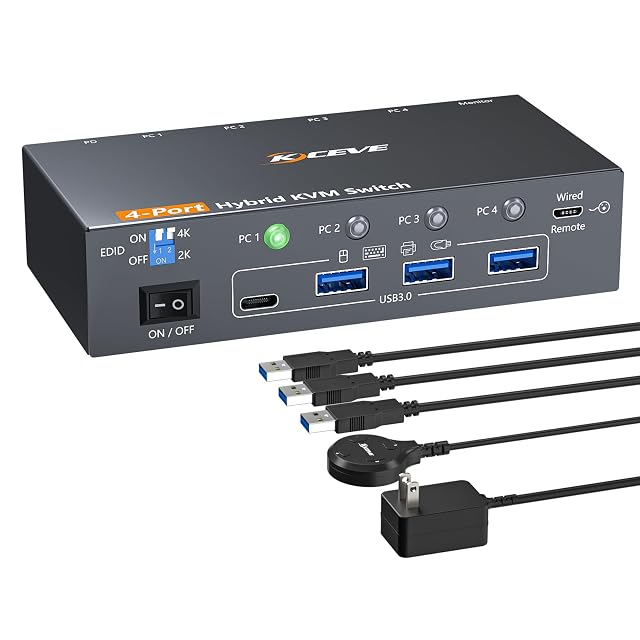
four computers · one screen · 4K at 60 Hz and 2K at 100 Hz · one DisplayPort, one USB-C and two HDMI inputs · four USB 3.0 at 5 Gbps · button or wired remote
A four-computer switch whose inputs are of three different kinds, quoting its resolutions and refresh rates as pairs and never listing what is in the box.
Best for: A desk where the four machines do not share a video socket between them, and where a drive has to follow whichever one is in use.