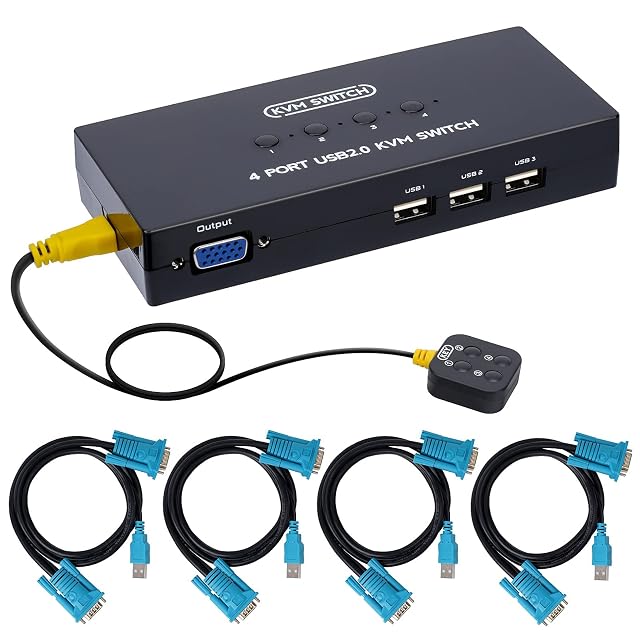
The bottom line The simplest thing on this shelf: four VGA machines, one screen, one button. It is priced accordingly and specified accordingly, and the missing refresh rate is the line to weigh before an older screen is trusted to it.
On the listing
A VGA switch with four inputs, one output and one hub; four VGA computers or laptops sharing a single VGA screen with a USB keyboard and mouse; manual switching by push button, described as changing the input source without replugging the VGA lead; a resolution written as 1920@1080P; and a hub for USB devices such as a printer or a flash drive, shared between the machines to reduce the number of leads on the desk.
The figure with no room for a second
1920@1080P. The @ sign is how a refresh rate is normally introduced, and here it separates the width from the height instead. Whatever was intended, the result is that no rate in Hz appears anywhere on this page. The pair of figures that describes a video path has been printed as one.
What a KVM is, and is not
This is a piece of desk hardware carrying video sockets between machines. It moves a screen, a keyboard and a mouse from one computer to another; it does not improve or process what passes through it, and the ceiling it publishes is its own, sitting under whatever the computer and the screen allow.
The hub, uncounted
A hub is named three times and never counted. Neither the number of sockets nor the USB generation appears, so whether a flash drive will move usefully between machines cannot be read here.
Before ordering
Ask what comes in the box. Four VGA machines need four leads, and nothing on this page says whether any of them arrive with the switch.
Availability
Priced from 15 € to 20 € across the German and French Amazon stores the day this page was checked.
It is stocked on the British Amazon store as well, in that country’s own currency. The range above leaves those out: it counts euro stores and no others.
In the American, Italian and Spanish Amazon catalogues with no live offer against it: the reference exists, nobody is filling it.
Every figure in this section is what Keepa held on the day this page was last updated. Stock and prices move without warning.
Prices quoted in this text were read on 10 September 2026. The live price is at the top of the page.
Where it holds up, and where it stops
Strengths
The switching method is stated plainly and needs nothing else: a button on the unit, with no software, no driver and no remote to lose
A hub is included rather than sold separately, so a printer or a flash drive can be shared between the four machines
Four VGA inputs on one output is the cheapest way to keep older machines on one screen, and the page does not pretend to be more than that
Compromises
The resolution is printed as 1920@1080P, which mixes the two halves of a resolution into the form normally used for a refresh rate, so no rate can be read from the page at all
The hub is named without its sockets being counted, and no USB generation is given, so what it will carry is unknown
Nothing says what is in the box, so whether any lead arrives with the switch has to be asked
Specifications
Port count
Four — stated in the title as four in, one out, and again in the first and second bullets as four VGA computers or laptops
Maximum resolution
1920 by 1080 — stated in the title and in the third bullet, both times written as 1920@1080P. It is the ceiling of the switch alone; the computers and the screen each impose their own
Refresh rate
Not published on the listing — the resolution is printed as 1920@1080P, where the @ sign normally introduces a refresh rate and here separates the two halves of the resolution instead, and no figure in Hz appears anywhere on the page
Video connector type
VGA — stated throughout, with four VGA inputs and one VGA output named in the first and second bullets
Screens per computer
One — stated in the second and fifth bullets, where four machines share a single VGA screen
USB port count
Not published on the listing as a count — the first, second and fourth bullets name one hub for USB devices such as a printer or a flash drive, without saying how many sockets that hub carries
USB generation
Not published on the listing — no USB 2.0 or USB 3.x generation and no transfer rate appear in the title or in any of the five bullets
Switching method
A manual push button on the unit — stated in the first bullet as a manual push-button type and described in the third as a button that changes the input source without replugging anything. No remote control and no keyboard shortcut is named
Audio support
Not published on the listing — no audio socket, no speaker connection and no microphone connection is named anywhere on the page
Cables supplied
Not published on the listing — no bullet lists the contents of the box, and the only reference to leads is the claim that the VGA cable no longer has to be replugged
Amazon reference
B0F4QRZF2L (same reference on 6 Amazon marketplaces)
EAN
0768622991570
The questions that come up before an order
Why does a refresh rate matter as much as a resolution?
Because the two are quoted together for a reason: a switch rated for a high resolution only at a low rate is a different object from one rated for both. Reading them as a pair is how the ceiling of the switch is understood. This page prints a resolution in a form that leaves no room for the second figure.
Is the resolution on the page the resolution I will get?
It is the ceiling of the switch and nothing more. The computer sending the picture and the screen receiving it each impose their own limits, and the lowest of the three is what appears. A switch cannot raise what a machine sends or what a screen accepts.
four computers · one VGA screen · 1920 by 1440 · three USB 2.0 sockets · button or wired controller · four combined leads supplied
A four-computer VGA switch supplied with four combined leads and a desk controller, quoting a resolution above the usual 1080p ceiling and no refresh rate at all.
Best for: A desk running three or four machines on one screen where the switching should happen from the hand rather than from the unit, and where the keyboard is a plain one.
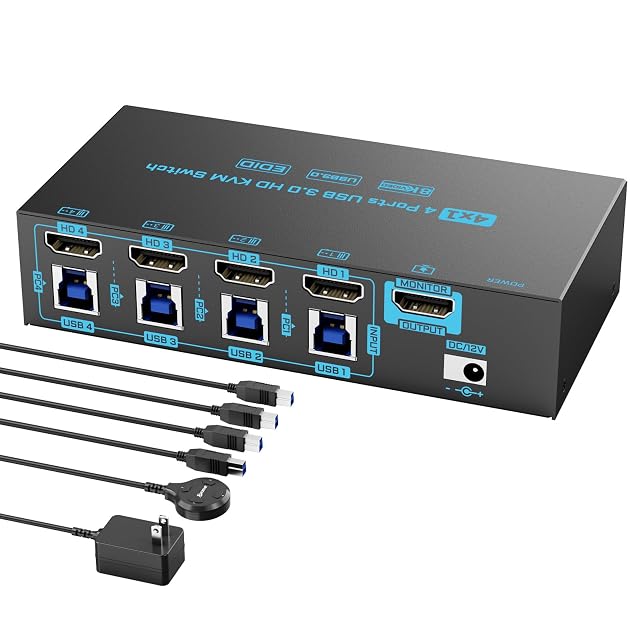
four computers · one screen · 8K at 60 Hz and 4K at 144 Hz · HDMI 2.1 · four USB 3.0 at 5 Gbps · panel button or wired controller · four USB leads and an adapter supplied
A four-computer HDMI switch that publishes two resolution and rate pairs, supplies its USB leads and a power adapter, and says outright that the final figure depends on the machines.
Best for: A desk of four machines on one screen where fast peripherals move between them, and where the window arrangement has to survive every change of machine.
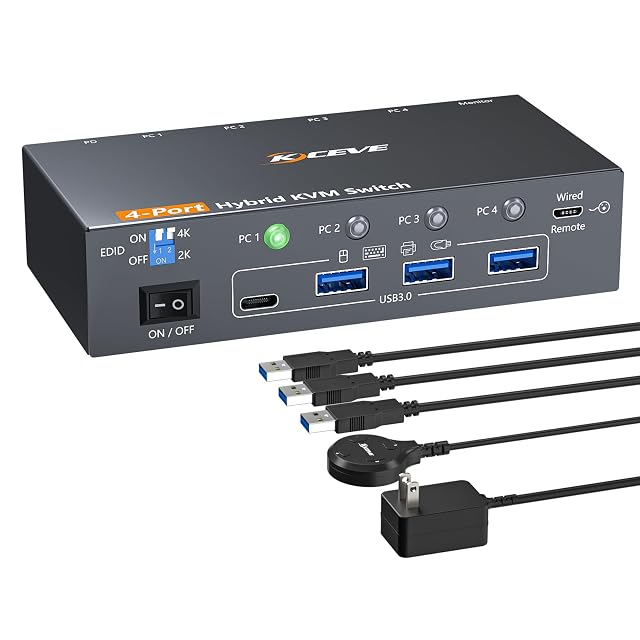
four computers · one screen · 4K at 60 Hz and 2K at 100 Hz · one DisplayPort, one USB-C and two HDMI inputs · four USB 3.0 at 5 Gbps · button or wired remote
A four-computer switch whose inputs are of three different kinds, quoting its resolutions and refresh rates as pairs and never listing what is in the box.
Best for: A desk where the four machines do not share a video socket between them, and where a drive has to follow whichever one is in use.