The stated rate belongs to the standard; the wiring of the building decides the rest · review
TP-Link TL-PA7017P KIT, gigabit-socket pair with the outlet given back review
A HomePlug AV2 pair that prints its own headline figure and then explains, in the next sentence, that a half or a third of it is what is usually obtained.
The bottom line The most carefully written page in this group, and the only one whose maker explains its own figure. The pass-through socket and the gigabit port are the two practical reasons to prefer it, and the warnings in the first bullet are worth reading before either.
On the listing
A powerline adapter set at 1000 Mbit/s with an integrated socket, a gigabit port, plug-and-play working and compatibility with all HomePlug AV and AV2 adapters, named for media streaming; four things to know before buying — that powerline devices cannot work across separate electricity meters, that every unit should go straight into a wall socket rather than an extension strip, that they should not sit near washing machines or air conditioners, and that an old electrical installation is better served by a mesh range from the same maker; a note that the theoretical channel data rate of 1000 Mbit/s derives from the HomePlug AV2 specification and that a half or a third of it is what is usually obtained, with a square-bracketed line saying this model has no wireless; an integrated socket up to 16 A usable as an ordinary outlet with a noise filter reducing interference; a patented energy-saving mode cutting consumption by up to 85 per cent, plug and play with no configuration, and one gigabit Ethernet port on each unit; and a box holding two TL-PA7017P adapters, two RJ45 leads and a quick installation guide.
The maker does the arithmetic itself
The theoretical rate of 1000 Mbit/s derives from the HomePlug AV2 specification, and a half or a third of it is usually what is obtained. That sentence belongs to TP-Link, not to this page. It is the position of this hub written by the seller: the number on the box is a property of the specification, and the wiring of the building decides the rest.
The socket you get back
Rated to 16 A, with a noise filter, and described as taking the appliance that was there before. In a bedroom with two outlets and a bed against one wall, that single feature is the difference between a kit that gets used and one that gets unplugged.
Four warnings before the first bullet
Not across meters. Not into an extension strip. Not beside a washing machine. And if the wiring is old, buy something else. The last of the four sends the buyer to a different range, which is an unusual thing for a first bullet to do and a useful one.
Before ordering
Check that both sockets sit on the same side of the meter. It is the first line of the first bullet and it is the failure nothing else on the page can fix.
Availability
Priced from 50 € to 68 € across the German, French, Italian and Spanish Amazon stores the day this page was checked.
It is stocked on the American and British Amazon stores as well, in that country’s own currency. The range above leaves those out: it counts euro stores and no others.
Every figure in this section is what Keepa held on the day this page was last updated. Stock and prices move without warning.
Prices quoted in this text were read on 10 September 2026. The live price is at the top of the page.
Where it holds up, and where it stops
Strengths
The maker states the arithmetic behind its own headline figure and the fraction usually obtained, which is the single most useful sentence on this shelf
Gives the outlet back, rated to 16 A with a noise filter, so a socket in a room that only has two is not lost
The first bullet lists what stops powerline working before it lists what makes it work: meters, extension strips, washing machines and old wiring
Compromises
The gigabit socket carries no designation and no figure, on a page that is otherwise precise about numbers
No maximum number of paired units, so a third and a fourth adapter are bought on the strength of the standard name alone
The first bullet points buyers with old wiring towards a different range from the same maker, which is honest and is also a sale this kit may not be right for
Specifications
Powerline standard
HomePlug AV2 — stated in the second bullet as the specification the rate is derived from, with the title adding compatibility with all HomePlug AV and AV2 adapters
Stated peak rate
1000 Mbit/s — stated in the title and explained in the second bullet, which says in as many words that the theoretical channel data rate of 1000 Mbit/s is derived from the HomePlug AV2 specification and that a half or a third of it is what is usually obtained
Pass-through socket
Yes — stated in the third bullet as an integrated socket rated up to 16 A, usable as an ordinary outlet so that the appliance previously plugged in there keeps its place, with an integrated noise filter named as what reduces interference on the powerline link
Ethernet port count
One per unit — stated in the fourth bullet as one gigabit Ethernet port on each unit
Port speed
Gigabit — stated in the title and in the fourth bullet as a gigabit Ethernet port; no BASE-T designation and no figure in Mbit/s is printed for the socket itself
Kit composition
Two TL-PA7017P adapters, two RJ45 Ethernet leads and a quick installation guide — stated in the fifth bullet
Wi-Fi at the far end
None — stated in the second bullet in square brackets: this model has no wireless. It is the only one of the five kits here to rule it out in writing
Stated maximum number of paired units
Not published on the listing — the title names compatibility with all HomePlug AV and AV2 adapters and no bullet gives a figure for how many may be joined at once
Amazon reference
B0859MDSFX (same reference on 6 Amazon marketplaces)
EAN
1210002614214
The questions that come up before an order
Why would a maker halve its own headline figure in public?
Because the alternative is a return. The second bullet says the 1000 Mbit/s comes out of the HomePlug AV2 specification and that a half or a third is normal, which is exactly what this hub says about every rate of this kind. A page that says it first is a page that has counted the cost of not saying it.
What does the noise filter in the pass-through socket do?
It sits between whatever is plugged into the adapter and the mains, so that an appliance drawing dirty current does not degrade the powerline link running through the same outlet. It is the reason a pass-through socket is better than a nearby socket for anything with a motor or a switching supply in it.
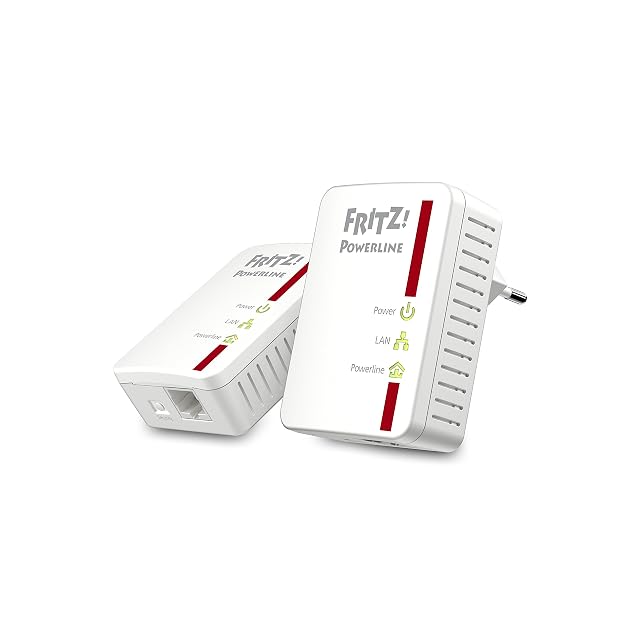
500 Mbit/s stated · Fast Ethernet socket, unrated · no standard named · no pass-through outlet · two units, two 1.80 m leads · AES 128-bit from the factory
A two-unit set encrypted before it leaves the factory, whose mains figure is five hundred and whose socket is named Fast Ethernet without a number.
Best for: A room where a printer, a games console or a media player needs a wired connection and where a hundred-megabit socket is not the constraint.
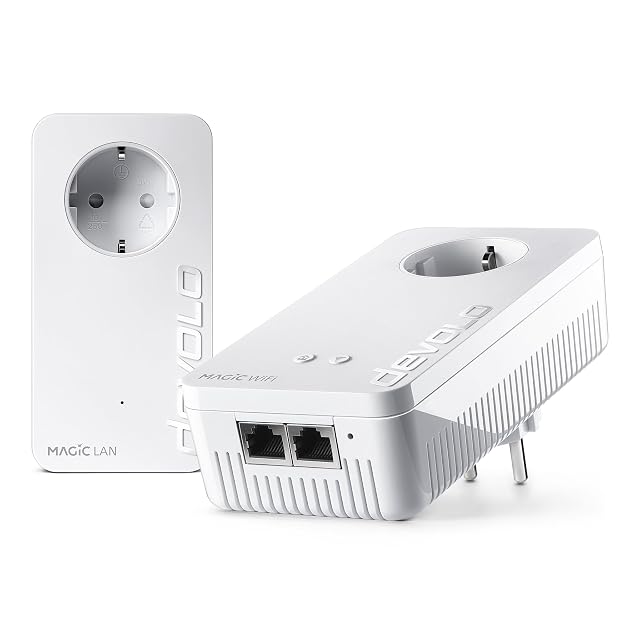
G.hn, stated not backwards compatible · 2400 Mbit/s over the mains · mesh wireless to 1200 Mbit/s · two gigabit sockets · three units, one lead · dLAN both named and excluded
A three-unit G.hn kit whose bullet says the older range is not supported and whose title prints the name of that older range.
Best for: A house where two floors both need coverage and one room needs a cable, and where nothing older from the same maker has to be kept working.
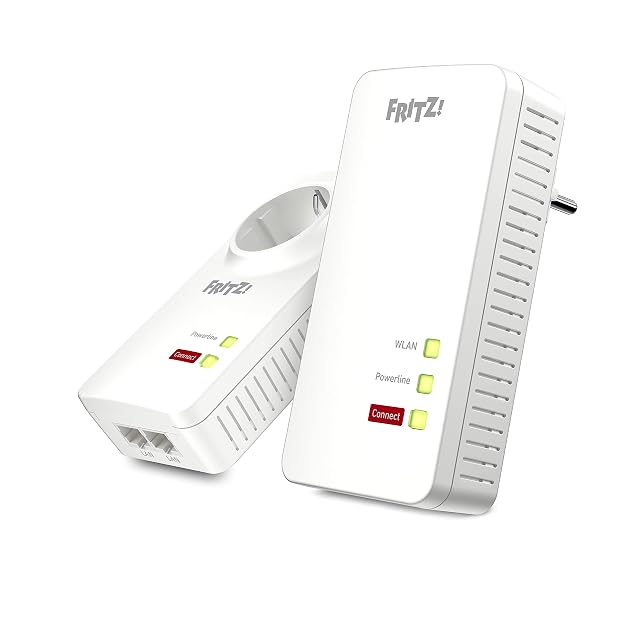
up to 1200 Mbit/s over the mains · Wi-Fi 5 access point at 866 plus 400 Mbit/s · three gigabit sockets across two units · WPS and WPA2 · no standard named
A two-unit set pairing a wireless adapter with a wired one, whose title, first bullet and second bullet each attach a rate to a different thing.
Best for: A house where the far room needs wireless and the room next to it needs two cables, and where a FRITZ!Box is already the router.