A repeater trades throughput for reach, and the listing rarely says so · review
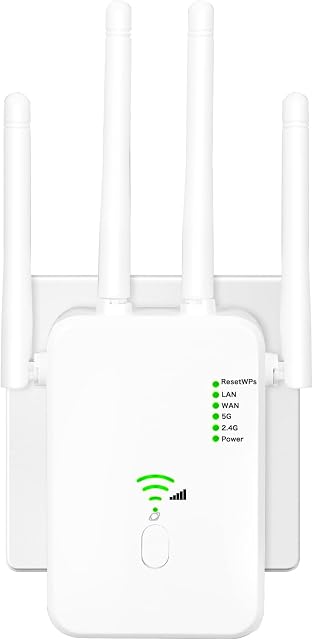
TVVNHA TVV9, dual-band repeater with three modes and four rotating antennas review
A dual-band repeater rated 867 Mbit/s on its 5 GHz radio, offering three modes and four rotating antennas, whose Ethernet socket is singular in the title and plural in a bullet.
The bottom line Better documented than most no-name repeaters — two band rates, an antenna specification, a device ceiling — with a socket count its own page cannot keep straight. Of the three unbranded units here it is the only one to publish 867 Mbit/s on 5 GHz rather than 900.
On the listing
Dual-band technology broadcasting two networks independently, 5 GHz at 867 Mbit/s for high-speed short-range traffic and 2.4 GHz at 300 Mbit/s for medium and long distances; four rotating 3 dBi high-gain antennas covering 360 degrees and aimed at bedrooms, kitchens, bathrooms, garages and cellars; three modes — repeater, access point and router — with the access point mode turning a wired connection into a wireless one; a dual-core processor stated to hold up to 35 devices, from phones and tablets to laptops, smart televisions, security cameras and printers; and heat dissipation through the case with vents on both sides of a heat-resistant ABS body.
Two rates, one badge
867 plus 300 is 1167. The badge says 1200. The bullets also write the unit as Mps rather than Mbit/s throughout, which is a typographic slip rather than a claim, and it is reported here as printed.
The socket, once each way
The title says Ethernet-Port. The third bullet says Ethernet ports. One is singular, one is plural, and neither is given a speed. A repeater with an access point mode needs a socket, so there is at least one; how many, and how fast, this page does not say.
What separates it from its neighbours
Two units in this family carry near-identical titles and publish 900 Mbit/s on 5 GHz. This one publishes 867, holds 35 devices rather than 15, and names its own brand inside the bullets. Those are the only differences the listings contain, and they are the ones recorded here.
Before ordering
If a cable can reach the spot, buy it for the access point mode rather than the repeater mode. The published rates describe the radios either way; only the wired arrangement avoids spending the air time twice.
Availability
Priced at roughly 18 € on the German Amazon store the day this page was checked.
In the French, Italian and Spanish Amazon catalogues with no live offer against it: the reference exists, nobody is filling it.
The American and British Amazon stores returned nothing at all, so the buy button there opens a search in that country rather than a page that would not load.
Every figure in this section is what Keepa held on the day this page was last updated. Stock and prices move without warning.
Prices quoted in this text were read on 10 September 2026. The live price is at the top of the page.
Where it holds up, and where it stops
Strengths
Publishes a rate for each band and says what each band is for, at short range and at longer range
Four rotating 3 dBi antennas are stated with the reason — reaching bedrooms, kitchens, bathrooms, garages and cellars
Names a device ceiling of up to 35 connections and a dual-core processor behind it
Compromises
The Ethernet socket is singular in the title and plural in a bullet, so the count cannot be taken from the page
The badge reads 1200 and the two published rates come to 1167
No generation, no designation and no stream count, so what a client needs in order to see 867 Mbit/s is unstated
Specifications
Wi-Fi generation
Not published on the listing — the five bullets cover the band rates, the antennas, the three modes, the device ceiling and the heat management, and none names a generation
IEEE designation
Not published on the listing — no 802.11 letter appears in the title or in any bullet, on a unit sold as compatible with all wireless devices
Stated class figure
1200 Mbit/s — stated in the title, split as 867 Mbit/s at 5 GHz and 300 Mbit/s at 2.4 GHz. Those come to 1167, so the badge rounds up by 33, and the bullets write the unit as Mps rather than Mbit/s
Band plan
Two radios broadcasting independently at the same time — stated: 5 GHz at 867 Mbit/s for short-range high-speed traffic, and 2.4 GHz at 300 Mbit/s described as suiting medium and long distances
Stream count
Not published on the listing — dual-band technology and a dual-core processor are named, and no stream figure appears for either radio
Plug-in or desktop form
Not published on the listing — heat dissipation holes on both sides of a heat-resistant ABS case are described, and neither a socket body nor a desktop body is named
Ethernet port count
Not published on the listing as a number — the title names an Ethernet port in the singular and the third bullet names Ethernet ports in the plural, and nothing on the page settles which
Port speed
Not published on the listing — no speed is given for the Ethernet socket under either of its two spellings
Access point mode
Yes — stated, one of three modes alongside repeater and router; the bullet describes it as turning a wired internet connection into a wireless access point
Amazon reference
B0H48W416P (same reference on 4 Amazon marketplaces)
EAN
0720932052884
The questions that come up before an order
What does the access point mode change?
It feeds the unit by cable instead of by radio, so nothing is received and retransmitted on the same air time. Where a cable can reach the spot, that mode removes the halving a repeater costs entirely, and it is the reason to notice the Ethernet socket on a repeater.
Do rotating antennas help?
They let the pattern be aimed, which is worth something when the target is one room in one direction rather than a whole floor. The gain figure of 3 dBi is modest; the aiming is the practical part, and this listing states both.
1200 Mbit/s badge, and 900 plus 300 published · four antennas · repeater, router and AP modes · 15 devices · no Ethernet socket anywhere
A dual-band repeater whose two published rates add up to its badge exactly, and which offers a router mode without naming an Ethernet socket anywhere on the page.
Best for: A wireless-only extension where nothing needs a cable and the badge arithmetic matters more than the brand.
A Wi-Fi 6 repeater whose headline figure is exactly the sum of its two published band rates, and whose product name carries a number the page never explains.
Best for: A household already running the maker’s own router that wants a mesh node with a Gigabit socket and no ambiguity about the arithmetic.