A repeater trades throughput for reach, and the listing rarely says so · review
TP-Link TL-WA850RE, 2.4 GHz repeater with one 10/100 LAN socket review
A long-standing single-band repeater whose Amazon.com listing borrows bullets from a dual-band model; TP-Link's own page says 2.4 GHz only and a 10/100 socket.
Amazon.com listed it on October 26, 2026, but no current offer passed our price check, so no price is quoted. The Amazon.com page exists, but nobody was selling the unit; a listing in that state is often a third-party import.
On the Amazon.com listing
The title reads “TP-Link 300Mbps Universal Wall-Plug Wi-Fi Range Extender - TL-WA850RE”. Below it, the bullets drift to another product: an “AC1900 Dual Band” rate of 600 plus 1300 Mbit/s, a Gigabit port and three external antennas, none of which belong to this unit. The description underneath returns to the 300 Mbit/s extender and its WPS setup. The specification below is therefore taken from TP-Link’s own US product page rather than from the bullets.
One number, one band
300 Mbit/s is the only rate this unit has, and TP-Link’s page ties it to 802.11n on 2.4 GHz — the same band carries 802.11g at 54 Mbit/s and 802.11b at 11 Mbit/s for older devices. There is no 5 GHz radio. Nothing is being added together here, which makes it the plainest figure in this family, and it is still a standard rate rather than an observed one.
A 10/100 socket
One LAN socket, and TP-Link rates it at 10/100 Mbit/s. That is enough for a streaming box or an older television; it is a ceiling for anything that copies files over the cable.
Two modes, one of them unlisted
TP-Link lists Range Extender and Access Point as working modes. The second matters more than it looks: run from a cable, the unit raises its own wireless network instead of repeating a weak one, and the halving a single-band repeater costs disappears.
Before ordering
Plug it in where the router signal is still good, not where the signal is worst. Everything past this unit is limited by what reaches it first, and the LEDs on the front exist to find that spot.
Where it holds up, and where it stops
Strengths
Names the standards it works with individually — 802.11b, g and n — rather than claiming compatibility in the abstract
An access point mode, listed by TP-Link, turns a wired socket into a wireless network without the halving a repeater costs
Draws about 3 W at most according to TP-Link, little enough to leave plugged in
Compromises
2.4 GHz only, so every device it serves shares the busier and slower band
The LAN socket is Fast Ethernet, 100 Mbit/s, which caps a wired television at a tenth of a gigabit
The Amazon.com listing mixes in bullets from a different, dual-band AC1900 model with three antennas, so the product page does not describe this unit reliably
Specifications
Wi-Fi generation
Wi-Fi 4 (802.11n) — the generation is not named on the listing; TP-Link's specification page gives 802.11n at up to 300 Mbit/s, with 802.11g and b supported
IEEE designation
802.11b, g and n — stated, as the routers the repeater is described as compatible with
Stated class figure
300 Mbit/s — stated in the Amazon.com title and on TP-Link's page. Only one figure belongs to this unit, so nothing is being summed, and it is a standard rate rather than a measured one
Band plan
2.4 GHz only — not stated on the Amazon.com listing; TP-Link's US specification page gives a single 2.4–2.4835 GHz radio and two internal antennas
Stream count
Not published — TP-Link lists two internal antennas and no stream figure
Plug-in or desktop form
Wall plug — TP-Link's specification page lists a miniature wall-plug body with EU, UK and US plug types, 100–240 V input and about 3 W maximum consumption
Ethernet port count
One — stated in the title as one port, and described as a LAN socket for wiring televisions, games consoles and similar devices into the wireless network
Port speed
10/100 Mbit/s — not on the Amazon.com listing; stated on TP-Link's US specification page. Fast Ethernet, not gigabit
Access point mode
Yes — TP-Link's specification page lists Range Extender and Access Point as working modes; the Amazon.com listing names neither
Amazon reference
B00A0VCJPI
EAN
1210002614542
On Amazon.com
Amazon.com listed it on October 26, 2026, but no current offer passed our price check, so no price is quoted.
Where this unit differs
Put against the median of its own group on this site — not against every network product sold.
Stated class figure300 Mbit/s — stated in the Amazon.com title and on TP-Link's page. Only one figure belongs to this unit, so nothing is being summed, and it is a standard rate rather than a measured one-75 % against the median of this group
Band plan2.4 GHz only — not stated on the Amazon.com listing; TP-Link's US specification page gives a single 2.4–2.4835 GHz radio and two internal antennas-52 % against the median of this group
Wi-Fi generationWi-Fi 4 (802.11n) — the generation is not named on the listing; TP-Link's specification page gives 802.11n at up to 300 Mbit/s, with 802.11g and b supported-33 % against the median of this group
The questions that come up before an order
Why does a repeater halve what passes through it?
Because a single radio has to receive a frame and send it on again, and both use the same air time. Everything that reaches the far side has crossed the same radio twice. Units that avoid this keep a second band for the link back to the router. This one has only the 2.4 GHz radio, so the halving applies — unless it is cabled and run as an access point.
What are the signal LEDs for?
They show how strong the signal from the router is at the outlet the unit is plugged into, and TP-Link adds a night mode to the LED control, so the unit can be moved until the reading is good. Since a repeater can only pass on what reaches it, that reading is the single most useful thing on the case.
Our score
7.2/ 10
A plain single-band 300 Mbit/s extender with a 10/100 socket, and an access point mode its Amazon.com listing never mentions. For a television in a back room behind an older router it does the job; anything that needs 5 GHz or more than 100 Mbit/s through the socket needs a different unit.
The buyer this one serves, among network and storage gear
A single stubborn corner served by an older router, where one wired socket for a television is wanted and speed is not the point.
What this one costs among network and storage gear
A reference exists on these Amazon stores: France, Germany, Italy, Spain, United Kingdom, United States. Listed is not the same as in stock — availability changes daily.
Details checked on October 26, 2026.
Sources
Specifications: the manufacturer sheet for network and storage gear and the matching Amazon product page. Prices and availability: Keepa. Every figure on this page names its source.
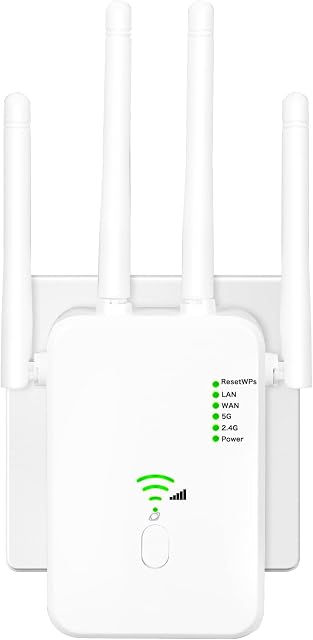
1200 Mbit/s badge, and 900 plus 300 published · four antennas · repeater, router and AP modes · 15 devices · no Ethernet socket anywhere
A dual-band repeater whose two published rates add up to its badge exactly, and which offers a router mode without naming an Ethernet socket anywhere on the page.
Best for: A wireless-only extension where nothing needs a cable and the badge arithmetic matters more than the brand.
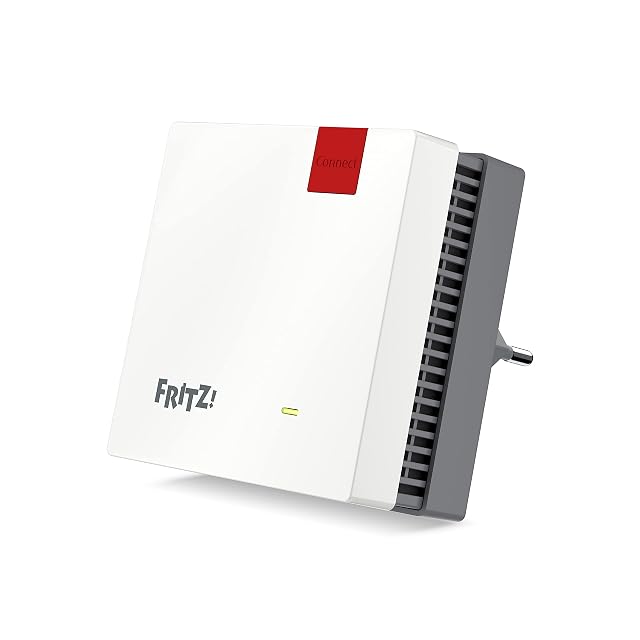
A Wi-Fi 6 repeater whose headline figure is exactly the sum of its two published band rates, and whose product name carries a number the page never explains.
Best for: A household already running the maker’s own router that wants a mesh node with a Gigabit socket and no ambiguity about the arithmetic.