The bottom line It publishes exactly the same pair of band rates as the Bfhdbdt unit beside it — 900 and 300 — and the same device ceiling; where the two genuinely differ is that this listing describes a wall-mounted body and names Ethernet ports, and the other names neither.
On the listing
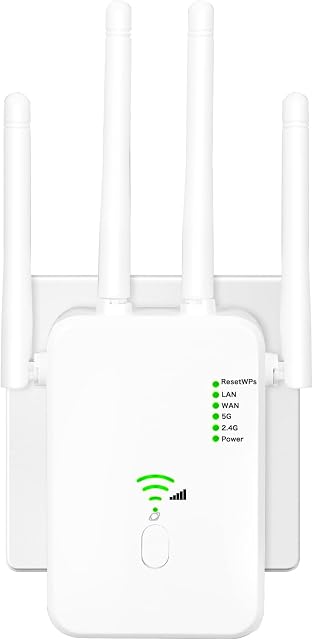
Four rotating 3 dBi high-gain antennas covering 360 degrees and aimed at bedrooms, kitchens, bathrooms, garages and cellars; dual-band technology broadcasting two networks independently, 5 GHz at 900 Mbit/s for short-range high-speed traffic and 2.4 GHz at 300 Mbit/s for medium and long distances; a security bullet naming WPA and WPA2 and describing the unit as suited to homes, businesses and travel; a compact wall-mounted design with Ethernet ports offering repeater and AP operation, and repeater, router and AP modes with the unit also usable as a client; and setup by pressing WPS on the router and on the unit within a minute, with a claim of compatibility with 99.99 per cent of routers and room for 15 devices.
The pair of numbers it shares
900 at 5 GHz and 300 at 2.4 GHz, adding to the 1200 on the title. The listing next to this one, from a different unnamed brand, publishes the identical pair and the identical device ceiling. That is not a resemblance to be talked around: two products publish the same figures, and both pages say so.
The one thing it describes that they do not
A wall-mounted body. Neither of the other two unbranded units here says what shape it is. This one does, and adds that it can be moved for the best coverage. It stops short of saying whether the mounting is a plug or a bracket, which is the part that decides whether a socket is consumed.
Ports, plural, uncounted
Ethernet ports appear in the fourth bullet in the plural, with no number and no speed. Two of the four modes on offer — access point and client — are defined by what plugs into them.
Before ordering
Confirm the socket count and the mounting. On a repeater the difference between one socket and two is the difference between feeding it by cable and feeding a television at the far end, and this page allows either reading.
Availability
Priced at roughly 30 € on the German Amazon store the day this page was checked.
In the French, Italian and Spanish Amazon catalogues with no live offer against it: the reference exists, nobody is filling it.
The American and British Amazon stores returned nothing at all, so the buy button there opens a search in that country rather than a page that would not load.
Every figure in this section is what Keepa held on the day this page was last updated. Stock and prices move without warning.
Prices quoted in this text were read on 10 September 2026. The live price is at the top of the page.
Where it holds up, and where it stops
Strengths
The only one of the three unbranded repeaters here to describe its own body, as a compact wall-mounted design
Names a client mode as well as repeater, router and access point, which is a fourth arrangement the neighbouring listings do not offer
The two published band rates add up to the badge exactly, with no rounding
Compromises
Ethernet ports are named in the plural and never counted or rated
No generation, no designation and no stream count, so what a client needs to see 900 Mbit/s is unstated
The security bullet claims the unit prevents others stealing the network, which is a claim about a password rather than about this product
Specifications
Wi-Fi generation
Not published on the listing — the five bullets cover the antennas, the band rates, the security, the modes and the WPS setup, and none names a generation
IEEE designation
Not published on the listing — WPA and WPA2 are named for security and no 802.11 letter appears anywhere on the page
Stated class figure
1200 Mbit/s — stated in the title, split as 900 Mbit/s at 5 GHz and 300 Mbit/s at 2.4 GHz, which come to 1200 exactly. It is the same pair of figures the Bfhdbdt listing publishes
Band plan
Two radios broadcasting independently at the same time — stated: 5 GHz at 900 Mbit/s for short-range high-speed traffic and 2.4 GHz at 300 Mbit/s for medium and long distances
Stream count
Not published on the listing — dual-band technology is named and no stream figure appears for either radio
Plug-in or desktop form
Wall-mounted — stated, described as a compact wall-mounted design allowing easy deployment and flexible movement for the best signal coverage. Whether it hangs on a socket or on a bracket is not said
Ethernet port count
Not published on the listing as a number — the fourth bullet names Ethernet ports in the plural and no count is given anywhere
Port speed
Not published on the listing — the Ethernet ports are named without a speed
Access point mode
Yes — stated as one of three modes, repeater, router and AP, with the AP mode described as turning a wired internet connection into a wireless access point; the same bullet adds that the unit can act as a client
Amazon reference
B0H3SNNNPB (same reference on 4 Amazon marketplaces)
EAN
0739719325950
The questions that come up before an order
What is a client mode on a repeater?
It turns the unit into a wireless adapter for something that only has an Ethernet socket — an older television, a printer, a games console. The device plugs into the unit by cable and the unit does the talking to the router. This listing names the mode; it does not describe how it is selected.
Does a wall-mounted design mean it plugs into a socket?
Not necessarily, and the listing does not say. Wall-mounted can describe a body that hangs on a bracket with a separate power lead, or one whose plug is the mounting. The distinction decides whether it occupies a socket, and it is left open here.
1200 Mbit/s badge, and 900 plus 300 published · four antennas · repeater, router and AP modes · 15 devices · no Ethernet socket anywhere
A dual-band repeater whose two published rates add up to its badge exactly, and which offers a router mode without naming an Ethernet socket anywhere on the page.
Best for: A wireless-only extension where nothing needs a cable and the badge arithmetic matters more than the brand.
A Wi-Fi 6 repeater whose headline figure is exactly the sum of its two published band rates, and whose product name carries a number the page never explains.
Best for: A household already running the maker’s own router that wants a mesh node with a Gigabit socket and no ambiguity about the arithmetic.